
Gdansk Airport Guide: The Baltic Coast’s Low Cost Hub
Gdansk Airport serves the Tricity on the Baltic coast. Codes, runway, terminals, Wizz Air and Ryanair routes, rail links and spotting tips explained.
 By The Aviation Hub
5 min read
Updated October 20, 2026
Gdansk Lech Walesa Airport serves the Tricity of Gdansk, Gdynia and Sopot on the Polish Baltic coast. Gdansk Airport handled almost 7.4 million passengers in 2025, which makes it the third busiest airport in Poland. Growth has been driven by low cost carriers and by strong links with Scandinavia and the United Kingdom. A single long runway, a modern terminal and a direct rail line give it the feel of a much larger field than its numbers suggest.
Gdansk Airport at a Glance
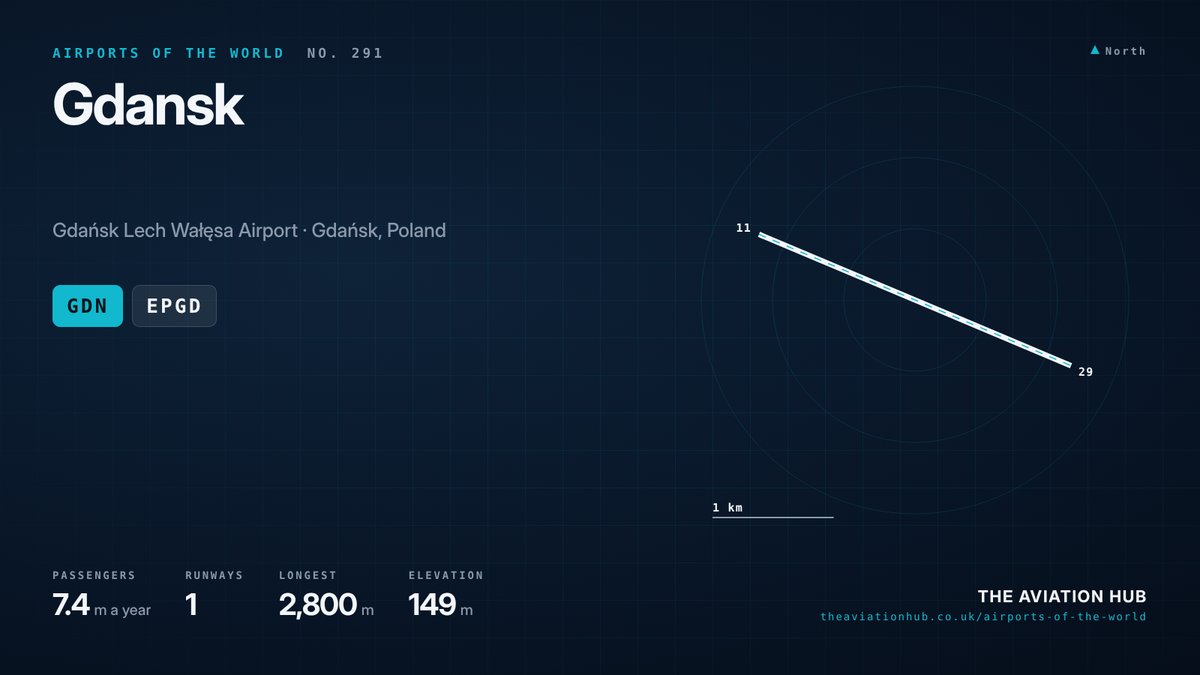
The IATA code is GDN and the ICAO code is EPGD. The airport sits on high ground near the village of Rebiechowo, about 7.5 miles (12 km) west of the old town, at an elevation of 149 metres (489 ft). It has one runway and one working passenger terminal, Terminal 2. The older Terminal 1 no longer handles passengers and is earmarked for demolition.
Traffic in 2025 was roughly 7.4 million passengers, up about 10 per cent on 2024, with more than 61,000 aircraft movements. Wizz Air and Ryanair carry about three quarters of all travellers, with LOT Polish Airlines a distant third. The airport company is owned by regional and city authorities together with the state enterprise Polish Airports. Rail times and car park rates are on the airport’s official website.
How Gdansk’s Airport Came to Be
Passenger flying in the city began in 1919 at Langfuhr, in what was then the Free City of Danzig and is now the district of Wrzeszcz. In 1922 Aerolloyd, a forerunner of LOT, opened the first Polish air route here, linking Gdansk with Warsaw and Lviv. The old field was hemmed in by housing, and problems with its runway lighting in the late 1960s led to a ban on night flights.
The answer was a new site on the plateau west of the city. The Wrzeszcz airport closed on 1 May 1974, and flights moved to Rebiechowo the same year. Traces of the old runway survive in the Zaspa housing estate. Terminal 1 opened in 1997. In 2004 Gdansk Airport was named after Lech Walesa, the shipyard electrician who led Solidarity and served as president of Poland from 1990 to 1995.
The first phase of Terminal 2 opened in April 2012, just ahead of the Euro 2012 football championship. Traffic passed one million in 2006, two million in 2010 and three million in 2014, and has kept climbing.
Runways at Gdansk Airport
Gdansk Airport has a single runway, 11/29, which is 2,800 metres (9,186 ft) long and 45 metres wide with an asphalt surface. It is equipped with a Category IIIb instrument landing system, which allows landings in very low visibility. That matters on a coast prone to fog in autumn and winter.
Westerly winds dominate, so runway 29 is in use most of the time, with arrivals approaching over the southern suburbs of the city. Runway 11 takes over in easterly conditions. The length suits every narrow body in regular use and allows occasional wide body charters, though heavy long haul operations would need weight restrictions.
Terminals and Airlines
Terminal 2 handles all passenger flights at Gdansk Airport. A western pier, built between 2019 and 2022, added about 16,000 square metres and extended the building by around 180 metres. It brought a larger arrivals hall, more passport desks and jet bridges for both Schengen and non Schengen flights. The airport has nine jet bridges in total, designed to fit turboprops such as the De Havilland Canada Dash 8-400 as well as jets.
Wizz Air carried almost three million passengers in 2025 and Ryanair close to 2.5 million, and both base aircraft here. LOT carried around 300,000, mostly on its Warsaw shuttle. Lufthansa, KLM, SAS, Norwegian, Finnair and Eurowings provide hub links, which places all three global alliances in the terminal. DHL, FedEx and UPS run cargo flights.
Routes and Destinations
Scandinavia is the heart of the network. Copenhagen was the busiest route in 2024 with about 392,000 passengers, followed by Stockholm Arlanda with about 345,000 and Warsaw Chopin with about 286,000. Oslo, Bergen, Gothenburg and several smaller Norwegian and Swedish cities follow, reflecting both labour migration and tourism.
The United Kingdom is the next big market, with Wizz Air, Ryanair and Jet2 flying to London, Manchester, Bristol, Edinburgh, Newcastle, Aberdeen and other cities. Hub flights to Frankfurt, Amsterdam, Copenhagen, Helsinki and Warsaw connect onward worldwide. Summer adds charters and scheduled sun routes to Spain, Greece, Turkey and Egypt.
Getting to and from Gdansk Airport
Rail is the best option. The Pomeranian Metropolitan Railway, known as PKM, runs from a station beside Terminal 2 to Gdansk Wrzeszcz and Gdynia, connecting with the frequent SKM suburban trains along the coast. The trip to Wrzeszcz takes around 20 minutes, and the old town is a short onward hop. Tickets are cheap, at a few zloty.
City buses run to the centre, Wrzeszcz and Sopot, with night services on some routes. Taxis and ride hailing apps take around 25 minutes to the old town, typically for less than PLN 80 (about £16). Gdansk Airport has multi storey and surface parking, and the ring road links it to the A1 motorway and the coast road to Gdynia.
Spotting and Photography
The open farmland around the field makes Gdansk Airport a relaxed place to watch aircraft. Minor roads near both runway ends give views of approaches, and the eastern end works well for arrivals on runway 29. The PKM platforms also look across parts of the airport. Afternoon light generally favours positions on the southern side.
Traffic is dominated by Wizz Air and Ryanair narrow bodies, but SAS, Finnair and Lufthansa regional jets and the occasional freighter add variety. Stay on public land, keep clear of the perimeter fence and follow any instructions from airport security.
What Comes Next
The western pier has given the terminal breathing space, and the airport company has a 30 year development plan to guide further growth. Demolishing Terminal 1 will free land for aprons and future buildings. Wizz Air and Ryanair are both still adding aircraft in Poland, so passenger numbers should keep rising.
The new central airport planned near Warsaw could change how LOT feeds the coast in the 2030s. For now Gdansk Airport looks set to pass eight million passengers before long, with Scandinavia and the UK still at its core. See where it sits among Baltic airports on the Airports of the World map.
Continue to follow The Aviation Hub for more analysis and insight.
Advertise with us Your brand, in front of an aviation audience Home page and in-article placements, sold directly, one advertiser per slot. From £250 a year. See the rates

