
Beirut Airport Guide: Lebanon’s Resilient Mediterranean Hub
Beirut Airport is Lebanon's only commercial gateway and home of Middle East Airlines. Three runways, two wings, routes, access and spotting explained.
 By The Aviation Hub
7 min read
Updated October 20, 2026
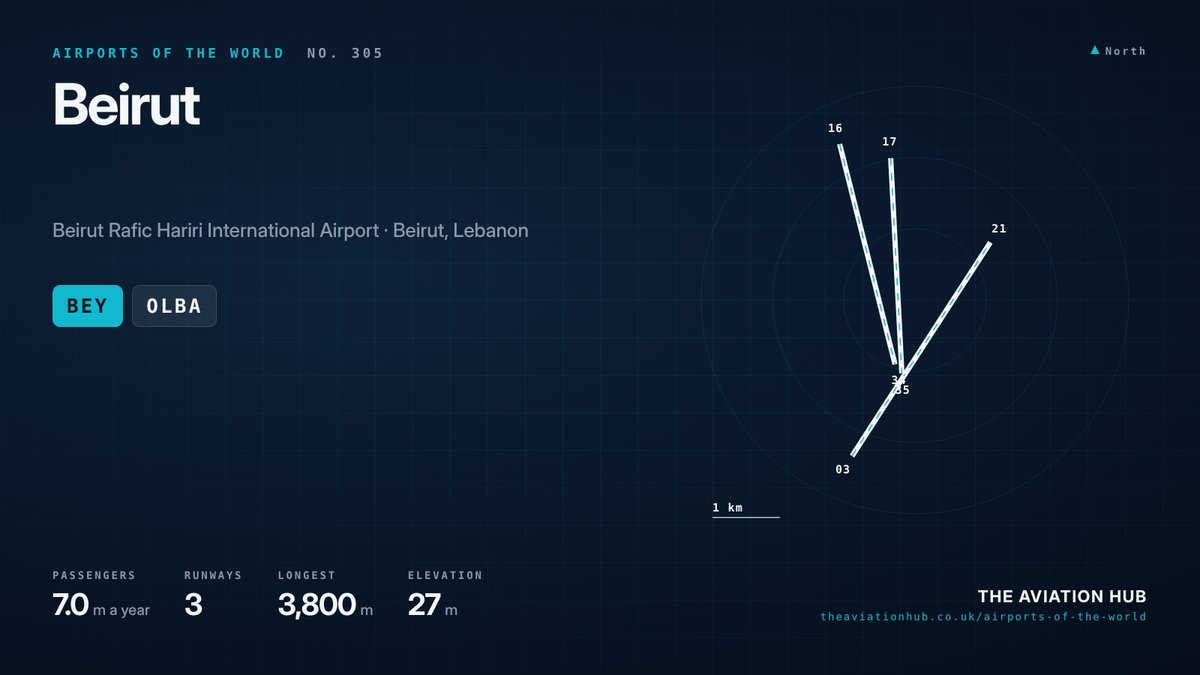
Beirut Rafic Hariri International is Lebanon’s sole commercial airport and one of the most resilient in the world. Known to everyone as Beirut Airport, it sits on the coast at the southern edge of the capital, hemmed in by the city on one side and the sea on the other. In a good year it handles around seven million passengers, most of them on the national carrier Middle East Airlines or the Gulf giants that connect Lebanon’s vast diaspora. It has been bombed, besieged and rebuilt more than once, and it keeps flying.
Beirut Airport at a Glance
The IATA code is BEY and the ICAO code is OLBA. The terminal lies about 5 miles (9 km) south of downtown Beirut, beside the suburbs of Khalde and Ouzai. Elevation is 87 feet (27 m). There are three runways, a single main terminal split into East and West wings, and a separate general aviation terminal opened in 2005.
The Directorate General of Civil Aviation, part of the Ministry of Public Works and Transport, owns and runs Beirut Airport directly, including its air traffic control. Passenger numbers peaked at well over eight million before Lebanon’s 2019 financial collapse and fell sharply during the pandemic and the 2024 conflict, then recovered towards seven million. Middle East Airlines, usually written MEA, is the dominant carrier and keeps its headquarters, training centre and maintenance arm MASCO on site. Live flight information is available on the airport’s official website.
How Beirut’s Airport Came to Be
Beirut International Airport opened on 23 April 1954, replacing the cramped Bir Hassan airfield a short distance to the north. Lebanon was then the banking and leisure capital of the Arab world, and the new airport quickly became a crossroads between Europe, the Gulf and Africa. MEA, founded in 1945, grew with it, adding Vickers Viscounts, de Havilland Comets and later Boeing 707s.
The airport’s history mirrors the country’s. In December 1968 Israeli commandos raided the field and destroyed 14 civilian aircraft on the ground. The civil war from 1975 closed it repeatedly, and the 1983 bombing of the United States Marine barracks beside the runway killed 241 servicemen. Through all of it MEA kept a skeleton schedule running whenever the runways were usable.
Reconstruction after 1990 brought a new East Wing in 1998 and a West Wing in 2002, along with a new landing runway built out into the sea and a new 3,800 m runway 03/21. The airport was renamed in 2005 after former prime minister Rafic Hariri, who drove the rebuilding and was assassinated that February. Israeli strikes cratered all three runways in July 2006 and closed the field for about five weeks. The 2020 port explosion damaged the terminal, and the 2024 conflict, and again the fighting of early 2026, saw most foreign airlines suspend flights while MEA kept operating.
Runways at Beirut Airport
Beirut Airport is unusual for an airport of its size in having three runways. The longest is 03/21 at 3,800 m (12,467 ft) with a concrete surface and a width of 45 m. It was built in the 1990s beside the old 03/21, which became a taxiway, and is the principal departure runway, pointing aircraft out over the Mediterranean on runway 21 and away from the densely packed southern suburbs.
Runway 16/34 is 3,395 m (11,138 ft) of concrete, projects into the sea at an angle and serves as the main landing runway. It was built to move landings away from the city and was renumbered from 17/35 in 2004. Arrivals on runway 16 come in from the north over the sea, parallel to the Beirut shoreline, which gives passengers a fine view of the city. The third runway, 17/35, is an asphalt strip of 3,250 m (10,663 ft) and 60 m width. It remains open but sees little use beyond overflow and maintenance periods.
The split between a departure runway and a landing runway is driven by noise and geography. The hills of Mount Lebanon rise steeply to the east, so almost every movement happens over water.
Terminals and Airlines
The main terminal is one connected building. The East Wing, with gates 1 to 12, opened in 1998, and the West Wing with gates 13 to 23 followed in 2002. Both wings funnel into a shared check in hall and a single arrivals level, forming a U shape. Air bridges serve 19 of the 23 gates, and gates 2 and 3 have twin air bridges for the largest wide bodies.
MEA operates the largest share of flights by a wide margin, flying Airbus A320, A321neo and A330-200 aircraft from its base and offering the Cedar Lounge, the most comfortable airside space in the building. In normal times Emirates, Qatar Airways, Etihad, flydubai and Air Arabia fight for the Gulf transfer traffic, though foreign schedules have been suspended and restored several times since 2024. Turkish Airlines and Pegasus serve Istanbul, and Air France, Lufthansa, Aegean and Royal Jordanian link Europe and the Levant. Iraqi Airways, EgyptAir and Ethiopian cover the region and Africa. MEA Ground Handling takes care of about 80 per cent of movements, with Lebanese Air Transport handling the remainder.
Routes and Destinations
Dubai is one of the busiest routes from Beirut Airport, fed by Emirates and flydubai alongside MEA. Istanbul, Doha, Cairo, Paris Charles de Gaulle and Jeddah are other major routes. The Gulf states, Europe and West Africa are the three pillars of the schedule, because that is where the Lebanese diaspora lives and works. MEA’s network stretches from London Heathrow and Paris to Abidjan, Accra and Lagos, with Abidjan among the longest at about 3,200 miles (5,150 km).
Summer is the peak. Expatriates return in July and August, and the airport handles close to double its winter traffic on the busiest days. Winter brings a dip followed by a pre Christmas surge. Cargo matters more than at most airports this size, since Lebanon imports almost everything by air or sea. Dedicated freighters and MEA’s own belly capacity carry pharmaceuticals, perishables and spare parts.
Getting to and from Beirut Airport
There is no rail link and no metro. Beirut Airport connects to the city by the airport road and the coastal highway, and a taxi is the realistic option for most arrivals. Official airport taxis are the most expensive choice, while shared service taxis and ride hailing apps such as Bolt and Uber cost less if you walk to the roundabout outside the terminal. Journey times range from 20 minutes at night to an hour in rush hour traffic.
Public buses on routes LCC 1 and 5 and OCFTC 7 and 10 stop at the airport roundabout, about 1 km from the terminal, and run to Hamra and the Charles Helou bus station for a small fare. They are cheap but unreliable. A three level car park holds around 2,350 cars, and most hotels offer pre booked transfers.
Spotting and Photography
Beirut rewards the patient spotter but demands discretion. The best public viewpoint is the Ramlet el Baida beach and corniche to the north, where arrivals on runway 16 fly parallel to the shore in the afternoon light. Aircraft departing runway 21 climb out over the water and can be photographed from the Khalde coast road south of the field.
The fleet mix is the attraction: MEA’s A321neos and A330s, a steady run of Gulf wide bodies, Turkish and European narrow bodies, and freighters that rarely appear elsewhere in the region. Security is tight and the army guards the perimeter. Never photograph from the airport road, never aim a lens at military positions, and keep your camera out of sight at checkpoints. Lebanese spotters are welcoming and know where it is safe to stand; join them rather than going it alone.
What Comes Next
The government announced a $122 million second terminal in March 2023, to be run under a 25 year concession by Ireland’s daa International, but scrapped the deal at the end of that month amid criticism that there had been no tender. A new plan drawn up with Dar Al Handasah envisages a terminal of 11 gates for about five million passengers, and the government also wants to reopen Rene Mouawad Airport in the north to relieve Beirut. Funding depends on political stability that Lebanon has rarely enjoyed.
The constraints are clear. There is no space for a fourth runway, the state has little money, and the airport’s fortunes rise and fall with the region’s conflicts. Yet Beirut Airport has outlasted every crisis thrown at it, and MEA has kept its fleet renewed throughout. The direction is cautious growth, with Terminal 2 the project to watch. See where it sits among the region’s gateways on our Airports of the World map.
Continue to follow The Aviation Hub for more analysis and insight.
Advertise with us Your brand, in front of an aviation audience Home page and in-article placements, sold directly, one advertiser per slot. From £250 a year. See the rates

