
Tehran Imam Khomeini Airport Guide: Iran’s Desert Gateway
Tehran Imam Khomeini Airport handles nearly all of Tehran's international flights. Two long runways, the Salaam terminal, routes, metro and spotting explained.
 By The Aviation Hub
7 min read
Updated October 20, 2026
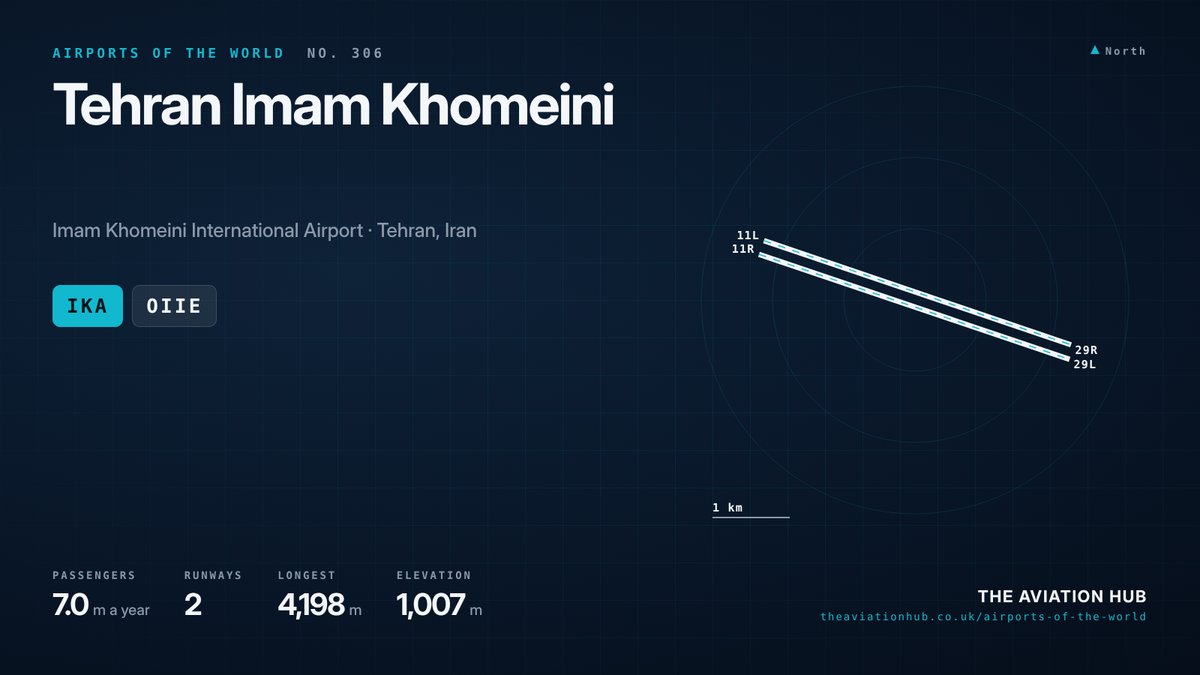
Imam Khomeini International stands on the high desert plateau south of Tehran, a long way from the city it serves. Almost every international flight to the Iranian capital uses Tehran Imam Khomeini Airport, while domestic traffic stays at the old Mehrabad field close to the centre. Around 7.7 million passengers used it in 2024, nearly all of them on Iranian carriers or the Gulf and Turkish airlines that bridge Iran’s isolation. Two runways of more than 4,000 metres, a sprawling arc shaped terminal and a newer international hall make it a far larger facility than its traffic suggests.
Tehran Imam Khomeini Airport at a Glance
The IATA code is IKA and the ICAO code is OIIE. The airport lies about 22 miles (35 km) southwest of central Tehran, on the road to Qom, at an elevation of 3,305 feet (1,007 m). There are two parallel runways and two passenger terminals in use: Terminal 1 and the Salaam terminal opened in 2019. A third, called Iranshahr, remains on the drawing board.
The Imam Khomeini Airport City Company, a state body under the Ministry of Roads and Urban Development, owns and operates Tehran Imam Khomeini Airport and the free trade zone around it. Iran Air, Mahan Air, Iran Aseman Airlines and Meraj Airlines treat it as their hub, and a crowd of smaller Iranian carriers such as Qeshm Air, Iran Airtour and Zagros base aircraft here. Passenger numbers reached roughly 7.67 million in 2024. Terminal maps and flight status are published on the airport’s official website, though its English pages are patchy.
How Tehran’s Airport Came to Be
The project predates the Islamic Republic. By the mid 1970s Mehrabad was choked, and the Shah’s government commissioned a vast new airport on the Qom road, planned as Aryamehr International. Construction began in 1977. The 1979 Revolution and the war with Iraq stopped work for years, and the half built site sat in the desert through the 1980s. The name changed to honour Ruhollah Khomeini, the founder of the Islamic Republic, by 2000.
President Khatami inaugurated the airport in February 2004, but its first day of operations, on 8 May 2004, lasted a matter of hours. The Revolutionary Guard closed the airport after its first landing, citing objections to the Turkish led consortium that had been contracted to run it. The contract was annulled and the airport reopened under domestic management on 30 April 2005. All international scheduled flights transferred from Mehrabad over the following years.
An instrument landing system arrived in 2009. Hotels opened on the site in 2015, and the Salaam terminal was inaugurated in June 2019 to lift capacity. The airport has also seen tragedy. Caspian Airlines Flight 7908 crashed after take off in 2009, killing 168, and Ukraine International Airlines Flight 752 was shot down by the Revolutionary Guard minutes after departure in January 2020, killing all 176 on board.
Runways at Tehran Imam Khomeini Airport
Tehran Imam Khomeini Airport has two parallel asphalt runways built for the hot and high conditions of the plateau. Runway 11L/29R is the longer at 4,198 m (13,772 ft) and 45 m wide, with its first 450 metres laid in concrete to withstand the heavier departures. Runway 11R/29L measures 4,092 m (13,425 ft) and is also 45 m wide. The length matters: at over 1,000 metres elevation and with summer temperatures above 40 degrees Celsius, fully loaded wide bodies need every metre.
The airport has far more runway capacity than its current movements need. Westerly winds often favour the 29 direction. Approaches from the east cross open desert, which gives pilots clear visual references but also exposes operations to dust storms that occasionally cut visibility. Airspace restrictions over Iran have at various times forced foreign carriers to reroute or suspend flights.
Terminals and Airlines
Terminal 1 is the original building, a long arc shaped structure whose ends seem to merge into the desert horizon. Paul Andreu redesigned it in the 1990s, and it feels its age despite periodic refurbishment. Iran Air, Mahan Air and most of the domestic Iranian carriers operate here, alongside the Gulf airlines. Iran Air flies an ageing fleet of Airbus A300s, A310s, A320s and a few A330-200s delivered after the 2015 nuclear agreement. Mahan Air runs A340s and Boeing 777-200ERs on longer routes.
The Salaam terminal opened in 2019 to lift international capacity, and it is the newer and brighter of the two halls. Foreign carriers have come and gone with the sanctions cycle. Turkish Airlines, Pegasus, Qatar Airways, Emirates, flydubai and Oman Air have been the mainstays, with Aeroflot, Austrian and Lufthansa appearing and disappearing according to politics. Lounges are limited to a CIP facility used mostly by Iran Air’s premium passengers.
Routes and Destinations
Istanbul is one of the most important routes from Tehran Imam Khomeini Airport, served by Turkish Airlines, Pegasus, Iran Air and several Iranian carriers with many daily departures. Dubai follows, with Emirates, flydubai and Mahan Air carrying trade and family traffic. Najaf and Baghdad are heavily flown pilgrim routes, Doha and Muscat provide onward connections, and Moscow has become a vital link since 2022.
Mahan Air’s long haul network has reached Guangzhou, Shanghai and Kuala Lumpur, and the carrier has even flown to Caracas. Iran Air served European cities including Frankfurt, Milan and Paris until EU sanctions in October 2024 ended those flights. The schedule swells during Nowruz in March and the Hajj season, and shrinks sharply during periods of regional tension. Cargo is significant, with Mahan’s freighters and belly space on Gulf carriers moving pharmaceuticals and machinery that cannot easily come by sea.
Getting to and from Tehran Imam Khomeini Airport
The metro changed everything. A station on Tehran Metro Line 1 opened at the airport in August 2017, and trains run to Shahr e Rey and on into the city centre. The journey to central Tehran takes about an hour with a change, and the fare is a few thousand tomans, which makes it by far the cheapest option. Services are not frequent late at night, so check timings for early departures.
By road the airport sits beside the Tehran to Qom and Tehran to Saveh freeways. A taxi from the terminal to central Tehran takes 45 minutes to over an hour depending on the capital’s notorious traffic, and fares change often with inflation. Ride hailing apps Snapp and Tapsi work for arrivals with a local SIM. Mehrabad, where domestic connections depart, is around 40 minutes away by road. Parking is plentiful and cheap, and the airport’s hotels sit within walking distance of Terminal 1.
Spotting and Photography
Spotting at Tehran Imam Khomeini Airport requires caution and common sense. Photography of airports and military sites is a sensitive matter in Iran, and the airport lies within a restricted zone patrolled by security forces. The practical approach is to photograph from inside the terminal, where the gate areas of both buildings give good views of the apron and the runway beyond. The departure lounge in the Salaam terminal has the better glass.
The reward is a fleet mix found nowhere else. Airbus A300s and A310s, Boeing 747-400s, McDonnell Douglas MD-80 series jets and Fokker 100s still fly in Iranian colours, alongside Gulf and Turkish wide bodies. Do not photograph from the perimeter roads, never point a camera at uniformed personnel or military aircraft, and keep images on your phone discreet at checkpoints. Iranian enthusiasts are passionate and generous with advice, and their guidance is the safest route to good pictures.
What Comes Next
The master plan for the airport city is ambitious on paper: the Iranshahr terminal, more cargo facilities, a larger free trade zone and a passenger capacity far beyond today’s traffic. Hotels, logistics parks and a rail freight link have all been promised. Delivery depends on money and on relations with the outside world, and both have been in short supply since 2018.
The airport was hit by Israeli airstrikes in October 2024, and all flights were suspended in March 2026 as war engulfed Iran. At the time of writing, operations remain subject to the security situation, and foreign airlines return only when their insurers allow. Tehran Imam Khomeini Airport has the runways and the land to be a major hub. Whether it ever becomes one is a question of politics, not aviation. See where it sits on our Airports of the World map.
Continue to follow The Aviation Hub for more analysis and insight.
Advertise with us Your brand, in front of an aviation audience Home page and in-article placements, sold directly, one advertiser per slot. From £250 a year. See the rates

