
Cali Airport Guide: Palmaseca and the Cauca Valley
Cali Airport, still known locally as Palmaseca, links southwest Colombia with Bogota, Madrid and Miami. Read about its runway, routes and transport.
 By The Aviation Hub
6 min read
Updated October 20, 2026
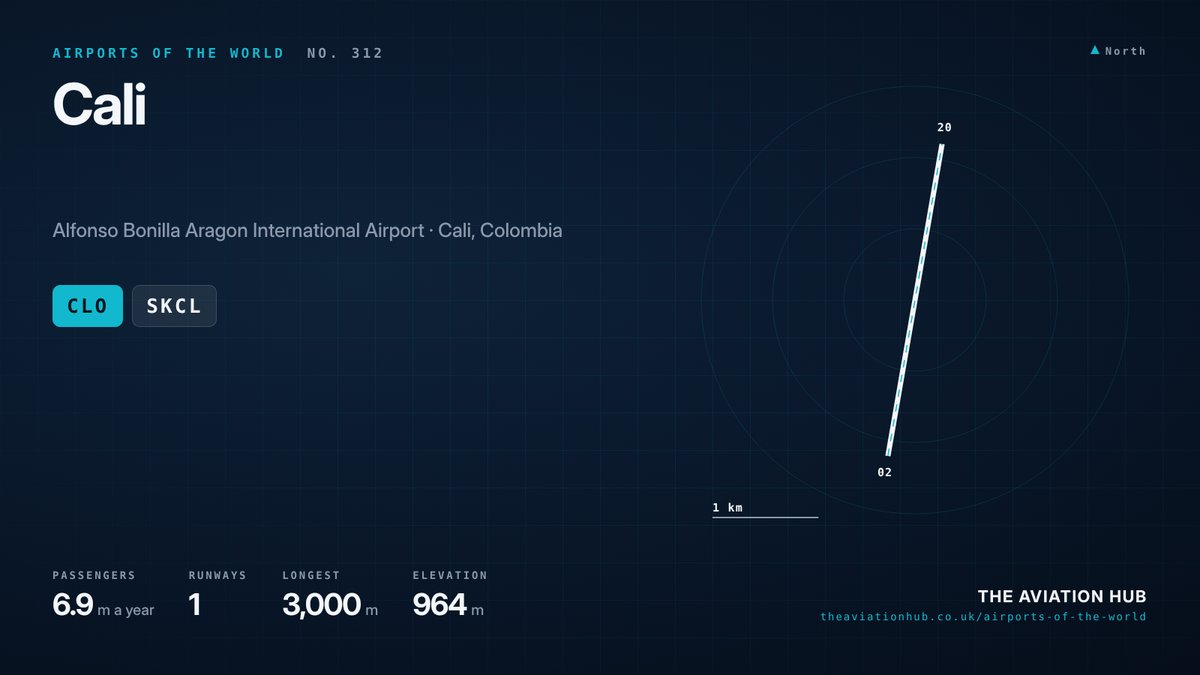
Cali Airport, officially Alfonso Bonilla Aragon International Airport, serves Colombia’s third largest city and the wider Valle del Cauca. It sits among sugar cane fields in the Cauca River valley, between Cali and the town of Palmira. Locals still call it Palmaseca, after the estate it was built on. With direct flights to Spain, the United States, Panama and Mexico, it is one of the busiest gateways in Colombia outside Bogota.
Cali Airport at a Glance
The IATA code is CLO and the ICAO code is SKCL. The terminal lies roughly 12 miles (19 km) northeast of central Cali, inside the municipality of Palmira. Elevation is 3,162 feet (964 m). There is one runway and one main terminal with separate domestic and international areas. Colombia’s civil aviation authority, Aerocivil, owns and operates the airport.
Cali Airport handled 5,686,212 passengers in 2019, the last year with full official figures on record, along with more than 81,000 aircraft movements and about 44,000 tonnes of cargo. Traffic has since grown to roughly seven million a year. Avianca runs a domestic hub here, and cargo carrier Aerosucre treats it as a focus city. The airport operates around the clock with no noise restrictions. Schedules and services are listed on the airport’s official website.
From El Guabito to Palmaseca
Aviation reached Cali in 1921, when Italian pilot Ferruccio Guicciardi made the first landing in the city. Regular operations began on 21 September 1933 at El Guabito, a site chosen to support military flying after the 1932 war with Peru. A larger airport known as Calipuerto opened on 17 April 1947 and served the city through the postwar boom.
The current airport opened on 24 July 1971 as Palmaseca International Airport, under President Misael Pastrana Borrero. Its timing was tied to the Pan American Games, which Cali hosted that year. In June 1989 local authorities renamed it after Alfonso Bonilla Aragon, a civic leader and journalist. The change was unpopular, and business groups lobbied to restore the old name.
The 1990s brought two tragedies linked to Cali Airport. Copa Airlines Flight 201 from Panama City crashed in the Darien Gap in June 1992. On 20 December 1995 American Airlines Flight 965, a Boeing 757 from Miami, struck a mountain near Buga during its descent after a navigation error. It remains the deadliest air disaster in Colombian history.
Runways at Cali Airport
Cali Airport has a single asphalt runway, 02/20, measuring 3,000 m (9,842 ft) and 45 m wide. At 964 m above sea level, the warm valley air reduces aircraft performance, but the runway is long enough for wide body flights to Madrid. Most traffic is Airbus A320 family equipment, with ATR 72 turboprops on regional routes and freighters on the cargo ramp.
The runway runs roughly north to south along the valley floor, with the Western Cordillera to the west and the Central Cordillera to the east. That terrain shapes every approach, and the AA965 accident showed how unforgiving it can be. Part of the runway was repaved in 1989 after 700 m of surface deteriorated. Because it operates 24 hours a day, the airport often serves as the alternate for Bogota El Dorado when weather closes the capital.
Terminals and Airlines
Passengers use one terminal building, with a domestic satellite and an international satellite reached after security. A cargo terminal, general aviation area and fire station were added in the mid 1980s. Avianca has an executive lounge in the domestic satellite. Facilities are functional rather than glamorous, and peak hours can feel crowded.
Avianca is the largest airline, flying Airbus A320s and A320neos on domestic trunk routes and Boeing 787s to Madrid. LATAM Colombia, Wingo and JetSMART compete hard on domestic fares, while state carrier SATENA and Clic serve smaller regional points. International airlines include American Airlines to Miami, Copa to Panama City, Aeromexico to Mexico City and World2Fly to Madrid. Aerosucre runs Boeing 737 freighters from the cargo apron.
Routes and Destinations
Bogota is the dominant route, served many times a day by Avianca, LATAM, Wingo and JetSMART, with a flight time of under an hour. Medellin, Cartagena, Barranquilla, Santa Marta and Pasto follow, and San Andres is a strong seasonal leisure market. JetSMART adds low cost links to Cartagena and beyond, and has also opened international routes to Punta Cana and Santiago de Chile.
The longest route from Cali Airport is Madrid, about 5,160 miles (8,300 km) away, flown by Avianca and World2Fly for the large Colombian community in Spain. Miami, Fort Lauderdale and seasonal New York JFK serve the diaspora in the United States. JetBlue began daily Fort Lauderdale flights on 15 October 2026, and Venezolana scheduled Porlamar from 19 September 2026. Regional exports and imported goods support a steady cargo business.
Getting to and from Cali Airport
There is no rail link, and Cali’s MIO bus rapid transit system does not reach the terminal. The cheapest sensible option is the airport bus service from Cali’s main Terminal de Transportes, where buses and vans leave frequently for a few thousand pesos and take around 40 minutes. They also stop along the main road to Palmira for passengers heading east.
Taxis from Cali Airport to the city use regulated fares and take 30 to 45 minutes, depending on traffic on the Cali to Palmira highway. Ride hailing apps operate in Cali but pickups at the terminal can be awkward. Newer roads link the airport with the industrial town of Yumbo. Parking sits directly in front of the terminal and is inexpensive by European standards.
Spotting and Photography
The setting is the draw. Aircraft descend over a patchwork of sugar cane with the Andes rising on both sides of the valley, and the light at dawn and late afternoon can be spectacular. Rural roads through the cane fields near each end of the runway give clear views of approaches, though some are private plantation tracks and access varies.
Morning light favours the eastern side of the field and evenings favour the west. Passenger wide body visits are largely limited to the Madrid flights, but the mix of Avianca, Wingo, JetSMART, Copa and freighters keeps things interesting. Colombian airports have visible police and military security. Stay on public roads, avoid photographing checkpoints, and explain your hobby politely if questioned.
What Comes Next
New routes are the clearest sign of momentum. JetBlue’s arrival, renewed links to Venezuela and continued low cost growth point to a busier international operation. The terminal, however, still reflects decades of incremental extension rather than a single modern design. Aerocali’s operating concession ran out in 2025, and the national infrastructure agency is working on a new private concession to expand it. Capacity will need to follow demand.
Cali Airport has a long runway, round the clock operations and a large catchment in southwest Colombia. Its challenge is persuading airlines to bypass Bogota and fly direct. The verdict: steady growth, more international links and a terminal upgrade that is overdue. Compare it with Bogota and Medellin on our Airports of the World map.
Continue to follow The Aviation Hub for more analysis and insight.
Advertise with us Your brand, in front of an aviation audience Home page and in-article placements, sold directly, one advertiser per slot. From £250 a year. See the rates

