Bergen Airport, Flesland, is the main gateway to western Norway and the country’s second busiest airport after Oslo. It sits on the coast southwest of the city, serving Bergen, the fjords of Vestland and a large offshore oil and gas industry. A record 6.7 million passengers used it in 2025. Alongside the airline traffic, it runs a major offshore helicopter operation, flying workers to North Sea platforms.
Bergen Airport at a Glance
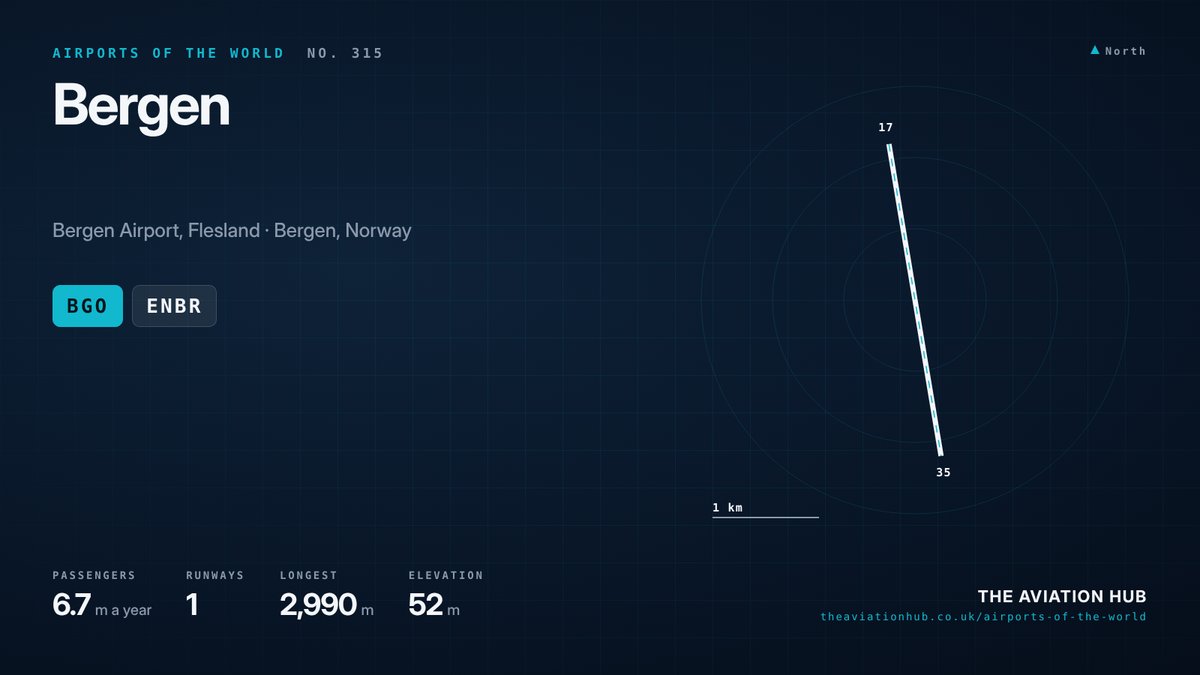
The IATA code is BGO and the ICAO code is ENBR. The terminal lies about 12 miles (20 km) southwest of Bergen city centre, roughly 30 minutes by road. Elevation is 170 feet (52 m). There is one runway, a terminal complex for airline passengers and a separate helicopter terminal for offshore flights. Avinor, the state owned airport operator, runs the civil side, while the military owns the runway, the main taxiway and land to the north.
Bergen Airport handled 6,704,306 passengers in 2025, up 2.2 per cent on 2024 and above the 2019 figure of 6.5 million. SAS, Norwegian and Widerøe are the largest airlines, and Widerøe runs an operating base for its regional network. Around 23 airlines fly scheduled services. CHC Helikopter Service and Bristow Norway fly offshore crews. Timetables, parking and transport details are available on the airport’s official website.
A Short History of Flesland
Bergen took to the air on water. Before Flesland, seaplanes used water aerodromes at Flatoy, Sandviken and Herdla, and Norway’s first scheduled airline service left Sandviken in 1920. In the 1930s the hilly ground at Flesland limited any runway to around 850 m, so Herdla was preferred, and the Germans built runways there during the Second World War.
The Cold War changed the calculation. Construction at Flesland started on 14 August 1952, funded by a national military communications project with NATO grants, at a total cost of NOK 70 million. A Royal Norwegian Air Force Otter made the first landing on 18 June 1954. The military began using the field that September, and civil flights started on 2 October 1955.
For decades Bergen Airport was SAS’s intercontinental gateway in Norway, because Oslo Fornebu’s runway was too short for the Douglas DC-8. Offshore helicopter flights began in May 1976, serving the Statfjord field with Sikorsky S-61s. A new terminal opened in 1988, and the current terminal arrived in August 2017 with capacity for about 10 million passengers a year.
Runways at Bergen Airport
Bergen Airport has a single runway, 17/35, measuring 2,990 m (9,810 ft) by 45 m with an asphalt surface. It runs roughly north to south across the Flesland peninsula. Both directions have Category I instrument landing systems, and the runway can handle up to 20 landings and 20 departures an hour. That is ample for Boeing 737s, Airbus A320s and occasional wide body charters.
Weather is the defining factor. Bergen is famously wet, and the southerly fronts that bring the rain usually put runway 17 in use, with arrivals from the north. Low cloud and strong crosswinds are common in winter. The instrument landing systems could be upgraded to Category II or III with minor work, which would allow landings in lower visibility and cut weather diversions.
Terminals and Airlines
The 2017 terminal at Bergen Airport handles domestic flights, with gates B15 to B20, and connects to the 1988 building, which keeps nine jet bridges for international flights. Gate 24 can take wide bodies as large as the Airbus A340 and Boeing 747, and several gates can switch between domestic and international use. International passengers walk through the duty free shop to reach their gates, a layout criticised by temperance groups.
SAS flies Airbus A320neos and regional jets to Oslo, Stockholm, Copenhagen and other Nordic points. Norwegian runs a large domestic and European network with 737-800s and 737 MAX 8s. Widerøe flies Dash 8 turboprops and Embraer E190-E2 jets along the coast and to smaller towns. KLM, Lufthansa and Icelandair link Bergen with their hubs. The helicopter terminal has nine stands, and Sikorsky S-92s are among the main offshore types.
Routes and Destinations
Oslo Gardermoen is by far the busiest route, carrying around 1.5 million passengers a year in the early 2010s. In 2011 Oslo to Bergen was Norway’s second busiest air route after Oslo to Trondheim. Stavanger and Trondheim follow, with Alesund and dozens of coastal destinations served by Widerøe. These routes compete with long and slow land journeys across fjords and mountains.
Internationally, London, Copenhagen, Amsterdam and Frankfurt have long been the leading routes from Bergen Airport. Stockholm, Paris and Reykjavik add year round links, and in summer the map expands to Mediterranean sun destinations. Winter routes to the Canary Islands, about 2,450 miles (3,900 km) away, are among the longest flights, beaten by seasonal Sunclass charters to Sal in Cape Verde, about 3,320 miles (5,340 km) away. United briefly flew seasonally to Newark in 2022. Offshore helicopters carried around 190,000 passengers in 2021.
Getting to and from Bergen Airport
The Bergen Light Rail, or Bybanen, has its southern terminus at the airport and opened there in April 2017. Trams run frequently to the city centre in around 45 minutes on a standard Skyss ticket, the cheapest sensible option. The Flybussen airport coach is quicker, reaching the centre in about 20 to 30 minutes and running every 10 minutes for a higher fare.
By car, the airport is reached on National Road 580, roughly 30 minutes from the city. Avinor offers about 3,500 parking spaces, 1,500 of them in a garage, and a private operator adds another 700. Taxis are expensive, typically NOK 500 to 700 (about £37 to £52). A shuttle bus links Bergen Airport with Flesland Quay, where fast ferries sail to Austevoll, Sunnhordland, Haugesund and Stavanger.
Spotting and Photography
Flesland rewards patience. Public roads and footpaths near both ends of the runway give views of approaches, with rocky shoreline, pine trees and the sea framing the shots. Heavy rain is common, so the best sessions follow a passing front, when the air is clear and the light is sharp. Long summer evenings give soft light late into the night.
The offshore helicopters are the speciality. S-92s and other heavy rotorcraft depart throughout the day, often in conditions that would ground light aircraft. Airline traffic is mostly Nordic, but KLM Embraers, Lufthansa A320s and summer charters add variety. The military owns much of the airfield, so keep away from restricted areas, avoid photographing military installations and follow any instruction from security staff.
What Comes Next
Avinor expects a second runway of about 2,260 m to be needed by the mid 2030s, possibly on the military land north of the terminal. The long term master plan envisages 32 gates and 14 apron stands by around 2060. Norwegian railway planners have also studied a 20 minute airport rail link from Bergen station through a tunnel under Lovstakken.
The offshore helicopter business will follow North Sea investment, while the energy transition slowly changes its shape. Airline traffic is already at record levels and the 2017 terminal has room to grow. The verdict: Bergen Airport is set for steady growth, with weather resilience and a second runway the big questions for the next decade. See how it compares with Oslo and Stavanger on our Airports of the World map.
Continue to follow The Aviation Hub for more analysis and insight.
Advertise with us Your brand, in front of an aviation audience Home page and in-article placements, sold directly, one advertiser per slot. From £250 a year. See the rates