
Paris Beauvais Airport Guide: Ryanair’s Paris Outpost
Paris Beauvais Airport sits 43 miles from Paris but carries millions on Ryanair and Wizz Air. Read about its runways, coach link, routes and history.
 By The Aviation Hub
6 min read
Updated October 20, 2026
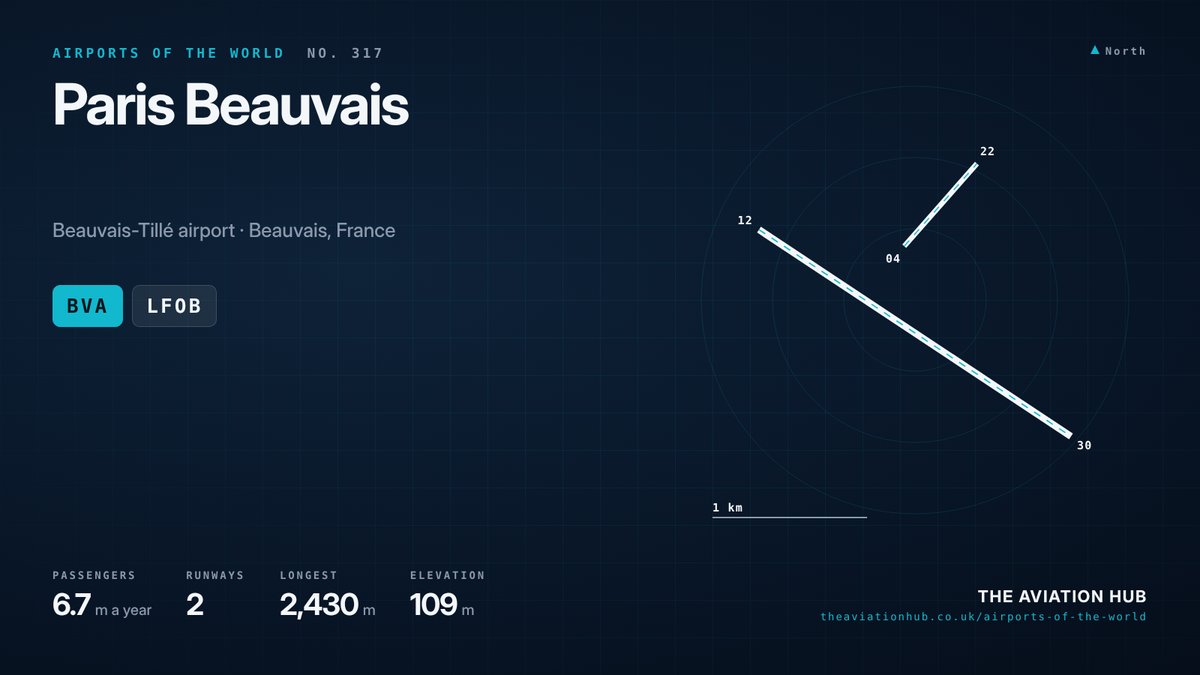
Paris Beauvais Airport is the low cost gateway to the French capital, even though it sits about 43 miles (69 km) north of Paris in a different region. Officially Beauvais Tillé Airport, it grew from an empty former military field into one of France’s busier airports almost entirely on the back of Ryanair. Roughly 6.7 million passengers now pass through each year. For many travellers from Eastern Europe, Morocco and Italy, it is the cheapest way to reach Paris.
Paris Beauvais Airport at a Glance
The IATA code is BVA and the ICAO code is LFOB. The airport lies in the commune of Tillé, about 2.5 miles (4 km) north of Beauvais town centre in the Hauts de France region. Elevation is 359 feet (109 m). There are two runways and two small terminals. The local chamber of commerce, the CCI de l’Oise, leads the public body that runs the airport.
Paris Beauvais Airport handled 4,614,424 passengers in 2022 as traffic rebounded from the pandemic, and growth since has taken it to around 6.7 million a year. Ryanair is the dominant airline and has based aircraft here since December 2020. Wizz Air is the second major carrier, with routes to Central and Eastern Europe and the Caucasus. Coach times and terminal information are on the airport’s official website.
A Short History of Beauvais Tillé
The airfield was built in the 1930s. German forces seized it in June 1940, and the Luftwaffe used it as a bomber base, with KG 76 raiding London from here in September 1940 during the Battle of Britain. Allied troops liberated the area in early September 1944, and the US Army Air Forces turned it into Advanced Landing Ground A-61.
The 322nd Bombardment Group flew Martin B-26 Marauders from Beauvais until March 1945. The Americans handed the field back to France in August 1945. In 1950 the French government offered the base to NATO, but funding for a planned jet runway never arrived, and the plans were abandoned in 1953. For decades afterwards the airport saw little more than private and charter flying, with a hangar serving as the terminal from 1979.
Everything changed in May 1997, when Ryanair arrived with three daily flights to Dublin. The Irish airline marketed the field as Paris Beauvais, and the name stuck. Terminal 2, a 6,000 square metre building, opened in 2010 to cope with growth. A new control tower on the south side replaced the 1962 tower on 22 January 2019.
Runways at Paris Beauvais Airport
The main runway at Paris Beauvais Airport, 12/30, is asphalt and measures 2,430 m (7,972 ft) by 45 m. It handles the Boeing 737-800s, 737 MAX 8-200s and Airbus A321neos that make up almost all scheduled traffic. Runway 12 has a Category III instrument landing system, allowing landings in visibility as low as 75 m, while runway 30 has Category I. That matters in a part of northern France prone to winter fog.
The secondary runway, 04/22, is asphalt, 708 m (2,323 ft) long and 18 m wide, and is used only by light aircraft. Night flying has been strictly restricted since 2007 to protect local residents, and the terminals close between 23:30 and 06:30. That curfew forces airlines into tight early morning and late evening waves. French air traffic control strikes hit Beauvais hard, as in June 2023, when about half of flights were cancelled.
Terminals and Airlines
Paris Beauvais Airport has two compact terminals with cafes, shops and duty free on both sides of security. Terminal 1 is the original building, and Terminal 2 handles much of the overflow. Boarding is by walking across the apron and climbing steps, the classic low cost model. A 78 room Ibis Budget hotel next to Terminal 2 serves passengers on dawn departures.
Ryanair flies a vast network with Boeing 737s, from Dublin and Barcelona to Rome, Milan, Madrid, Krakow and a long list of seasonal sun spots. Wizz Air uses Airbus A320s and A321neos to Belgrade, Chisinau, Sofia, Tirana and Yerevan. Smaller carriers include HiSky to Chisinau and Baia Mare, Dan Air seasonally to Bacau and Volotea seasonally to Bastia. There are no lounges of note and no long haul flights.
Routes and Destinations
The route map reflects migration and tourism. Morocco is a major market, with Ryanair flights to Marrakesh, Tangier, Nador and other cities serving the large Moroccan community around Paris. Italy, Spain and Portugal provide the leisure and city break traffic, while Romania, Moldova, Serbia, Bulgaria and Albania form the core of Wizz Air’s operation.
Yerevan, about 2,140 miles (3,440 km) away, is among the longest routes. Summer brings extra flights to Greece, Croatia and the Mediterranean islands, and winter adds the Canary Islands. Routes come and go quickly: Ryanair drops Trieste from October 2026 and suspends Sarajevo for the 2026 to 2027 winter. Cargo is negligible. Paris Beauvais Airport remains a passenger operation built on low fares.
Getting to and from Paris Beauvais Airport
The airport coach is the standard way to reach Paris. It runs to Porte Maillot, beside the Palais des Congrès in the 17th arrondissement, in about 75 minutes, timed around flight arrivals and departures. A one way ticket costs around €17 (£15). From Porte Maillot, Metro Line 1 and the RER C connect to the rest of the city.
Rail is cheaper but slower. A local bus and an airport shuttle run to Beauvais station, about 2.5 miles (4 km) away, where regional trains reach Paris Gare du Nord in roughly 75 to 90 minutes. Beauvais also has trains to Amiens. A taxi to central Paris is expensive, often well over €150, and minibus shuttles offer a middle ground. On site parking is cheap by Paris standards.
Spotting and Photography
Paris Beauvais Airport is quiet and rural, which suits enthusiasts. Country roads near both ends of runway 12/30 give clear views over open farmland, and the absence of tall buildings makes for clean shots. Prevailing westerly winds mean runway 30 is common, with arrivals from the southeast. Afternoon light favours the southern side of the field.
The variety is limited, but Wizz Air, HiSky and the occasional charter break up the Ryanair 737s. Early morning and evening banks provide the busiest windows. Park only in legal spots, do not block farm access tracks and stay well clear of the perimeter fence. French gendarmes patrol the area and expect visitors to keep their distance.
What Comes Next
There is no grand expansion plan. Growth at Beauvais has come from squeezing more flights into the existing terminals and apron, and the night restrictions limit how far that can go. Local residents remain sensitive to noise, and any attempt to lift the curfew would meet fierce resistance. Investment has focused on the terminal, the hotel and the 2019 control tower.
The real variables are Ryanair’s appetite and Paris airport charges. If Charles de Gaulle and Orly become more expensive, Beauvais will win more traffic. The verdict: Paris Beauvais Airport will stay a lean low cost gateway, busy and basic, and its success will depend on airlines rather than concrete. Compare it with the main Paris airports on our Airports of the World map.
Continue to follow The Aviation Hub for more analysis and insight.
Advertise with us Your brand, in front of an aviation audience Home page and in-article placements, sold directly, one advertiser per slot. From £250 a year. See the rates

