
Tashkent Airport Guide: Uzbekistan’s Main Hub Explained
Tashkent Airport is the Uzbekistan Airways hub and the main gateway to Uzbekistan. Runways, terminals, routes, access and the new airport planned for 2030.
 By The Aviation Hub
6 min read
Updated October 20, 2026
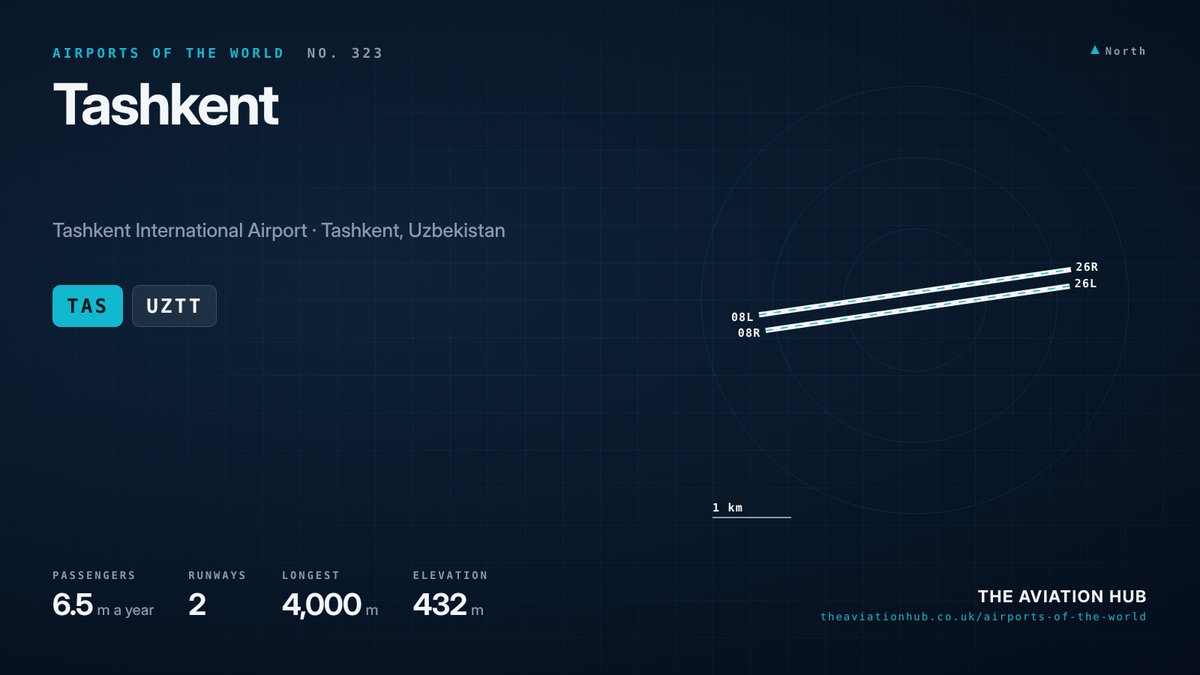
Tashkent Airport, named for Islam Karimov, is the main gateway to Uzbekistan and the home base of Uzbekistan Airways. It lies unusually close to the centre of the capital, only a few miles south of the city’s main squares, with housing pressed up against the perimeter. Two long parallel runways and a pair of terminals separated by the airfield itself handled close to 10 million passengers in 2025. Traffic has roughly doubled since the country opened up to visa free tourism, and a replacement airport is already under construction.
Tashkent Airport at a Glance
The airport carries the IATA code TAS and the ICAO code UZTT. It sits at an elevation of 432 m (1,417 ft) on the plain below the Tian Shan foothills. Two parallel runways, 08L/26R and 08R/26L, run east to west, both long enough for the largest aircraft in service.
Terminal 2 handles international flights and Terminal 3 handles domestic services. They stand on opposite sides of the runways, which makes connecting between them a journey by road rather than a walk. Passenger numbers reached around 9.99 million in 2025, up from about 8.7 million in 2024. Uzbekistan Airways is the dominant hub carrier, joined by newer locals Centrum Air, Qanot Sharq, Silk Avia, FlyOne Asia and the freight operator My Freighter. Uzbekistan Airports, a state company, runs the field. Current timetables are on the airport’s official website.
How Tashkent’s Airport Came to Be
Aviation in Tashkent dates to the early Soviet period. The first passenger flight, a Junkers F 13 on the Tashkent to Pishpek to Almaty route, took off on 12 May 1924. The airfield grew through the Second World War as the city became an industrial centre, and it gained international status in 1958. In 1972 the Tupolev Tu-144 supersonic airliner began flights between Moscow and Tashkent, years before it carried fare paying passengers.
Uzbekistan Airways was founded in 1992 after independence and inherited the Aeroflot fleet based here. The international terminal was rebuilt in 2001 and the domestic Terminal 3 opened in 2011. A presidential decree in January 2017 renamed the airport after Islam Karimov, the country’s first president. Tashkent Airport has since benefited from a wave of liberalisation that brought foreign carriers and new Uzbek start ups to the gates.
Runways at Tashkent Airport
Runway 08L/26R is the longer of the pair at 4,000 m (13,123 ft) and 60 m wide, with a concrete surface. Runway 08R/26L measures 3,905 m (12,812 ft) by 45 m and is asphalt. Both are rated for heavy wide bodies and meet the standards for the Boeing 787 and Airbus A380. The lengths reflect Soviet era planning for heavy military and cargo types as much as civil need.
The terminals sit on opposite sides of the runways, and the city wraps around the field, so departures and arrivals in both directions pass over built up districts. Tashkent Airport sees hot summer afternoons above 40 degrees Celsius, when the long runways earn their keep for fully loaded Boeing 787-8 and 767-300ER departures to Europe and East Asia. Winter brings fog and the occasional snow closure, though de icing capacity has improved markedly.
Terminals and Airlines
Terminal 2 is the international building, expanded from 45,000 to around 65,000 square metres in 2021 and joined in 2024 by a 24 room passenger hotel. Uzbekistan Airways fills much of the board with Airbus A320neo and A321neo narrow bodies and Boeing 787-8 wide bodies. Turkish Airlines is the largest foreign operator with up to 14 weekly flights from Istanbul. Etihad, flydubai, Qatar Airways, Air Arabia, Korean Air, Asiana, China Southern, Air China, Aeroflot, S7 and Ural Airlines all serve the terminal, as do Air Astana, AirAsia X and LOT.
Low cost Uzbek carriers have multiplied. Centrum Air and Qanot Sharq fly leisure and labour migration routes to Russia, Turkey and the Gulf, while Silk Avia operates ATR 72-600 turboprops on thinner domestic sectors. Terminal 3 across the field handles the domestic network to Samarkand, Bukhara, Urgench, Fergana, Namangan, Nukus and Termez. It is a modest building rated for about 400 passengers an hour. Business class passengers have access to a lounge in Terminal 2, but there is no alliance lounge.
Routes and Destinations
Russia remains the largest single market from Tashkent Airport, with Moscow served many times daily by Uzbekistan Airways, Aeroflot and the Uzbek low cost carriers, plus a long list of regional Russian cities carrying migrant workers. Istanbul is the busiest western gateway and the natural connection for European traffic. Dubai, Sharjah, Doha and Jeddah carry Gulf business and pilgrimage flows. Seoul Incheon is strong on the back of a large Korean Uzbek community.
The longest sector is Uzbekistan Airways’ nonstop to New York JFK, launched in 2017 and about 6,320 miles (10,180 km), flown with the 787. London, Paris, Munich, Rome, Madrid and Milan complete the European long haul set, and Qanot Sharq adds London Gatwick. Domestically, Samarkand and Bukhara carry the tourist traffic and peak sharply in spring and autumn. Cargo is growing fast through My Freighter and YTO Cargo Airlines, with Tashkent positioned as a China to Europe transit point.
Getting to and from Tashkent Airport
The airport is close enough to the city that most journeys take 15 to 25 minutes. Taxis and ride hailing apps, chiefly Yandex Go and MyTaxi, are the standard option and a trip to the centre costs around 30,000 to 50,000 som (roughly £2 to £3). Agree the fare or use the app rather than accepting offers from touts in the arrivals hall.
There is no direct metro station. The nearest Tashkent Metro stops are a short taxi ride away, and several city bus routes pass the airport approach road for a fare of a few thousand som, though luggage space is tight. Drivers can use the first floor drop off lane for up to ten minutes free of charge, with cameras issuing fines beyond that. Paid short and long stay parking sits in front of Terminal 2. Transfers between the domestic and international terminals mean leaving the airport and travelling by road.
Spotting and Photography
Uzbekistan was long a difficult country for enthusiasts and some caution remains. Photography inside the terminal is tolerated but security staff may still object to cameras pointed at the apron. The best views come from the windows of the international departure gates, which look across the apron.
Outside the fence, the eastern approach to runway 26 crosses residential streets where arrivals pass low. Keep away from any military aircraft, avoid photographing police or soldiers and carry identification. Tashkent Airport has become more relaxed in recent years, but enthusiasts should still be polite and move on if asked.
What Comes Next
Work started in late 2024 to enlarge the arrivals hall and merge arrivals and departures into a single Terminal 2 complex handling around 2,400 passengers an hour. That is a stopgap. The real future lies at a new greenfield site near Yangiyul in Tashkent Region, roughly 20 miles (30 km) from the city, where a replacement Tashkent International Airport is under construction. It is scheduled to open in late 2030, at which point the current field is due to close and the land will be redeveloped.
Until then, Tashkent Airport will keep squeezing more traffic through a cramped site hemmed in by the city. Growth looks assured given the tourism boom and the rise of Uzbek low cost carriers. Explore other Central Asian gateways on the Airports of the World map.
Continue to follow The Aviation Hub for more analysis and insight.
Advertise with us Your brand, in front of an aviation audience Home page and in-article placements, sold directly, one advertiser per slot. From £250 a year. See the rates

