Rio Santos Dumont Airport is the city centre airfield of Rio de Janeiro, built on reclaimed land on the edge of Guanabara Bay. It lies about a mile (2 km) from the downtown business district, close enough for some passengers to walk to meetings. Two short runways, an approach past Sugarloaf Mountain and the long running air shuttle to Sao Paulo give it real character. A federal cap now holds traffic at around 6.5 million passengers a year, pushing longer routes back to Galeao.
Rio Santos Dumont Airport at a Glance
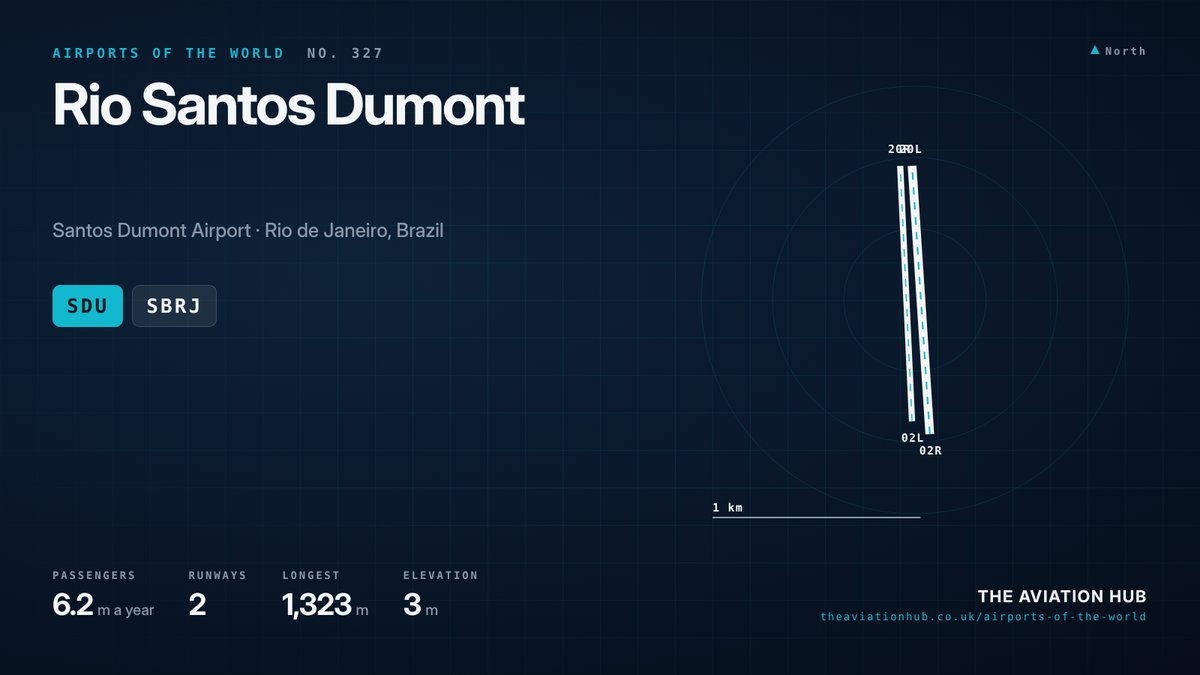
The airport uses the IATA code SDU and the ICAO code SBRJ. It sits just 3 m (11 ft) above sea level on a promontory between Centro and the Flamengo waterfront. Two parallel asphalt runways serve the field. The terminal combines a listed 1945 building with a glass departures extension opened in 2007. State owned Infraero runs the airport.
Rio Santos Dumont Airport handled about 6.2 million passengers in 2025, close to the official limit. That is barely half the 11.4 million recorded in 2023, before the federal government stepped in to rebalance traffic towards Galeao. Azul, Gol and LATAM Brasil all treat it as a focus city, flying domestic trunk routes. Departures and passenger notices appear on the airport’s official website.
How Rio’s City Airport Came to Be
Aviation on this spot began with seaplanes. A terminal at Calabouco Point handled flying boats, and in 1934 a first runway was laid on land reclaimed from the bay. The airport opened on 30 November 1936 as Calabouco Airport. The first commercial service was a VASP Junkers Ju 52 from Sao Paulo Congonhas.
The field was soon renamed for Alberto Santos Dumont, the Brazilian aviation pioneer who flew his 14-bis in Paris in 1906. A 1953 law made a formal exception to keep the name in place. The 1945 terminal building became a national landmark in 1998. The Ponte Aerea shuttle to Congonhas, launched in 1959, ran hourly departures and became a Brazilian institution until 1999.
A fire on 13 February 1998 closed the airport until mid August that year. A new departures extension opened on 26 May 2007, ahead of the Pan American Games, and lifted capacity to 8.5 million passengers a year. A BRL 152 million upgrade of the arrivals side followed and was finished in 2013. Traffic then kept climbing until the cap arrived in 2024.
Runways at Rio Santos Dumont Airport
Two parallel asphalt runways serve Rio Santos Dumont Airport. Runway 02R/20L is 1,323 m (4,341 ft) long and 42 m wide. Runway 02L/20R is 1,260 m (4,134 ft) by 30 m. They are among the shortest runways where Boeing and Airbus jets operate in regular service, and the bay sits just beyond both ends. Crews flying the Boeing 737-800, Airbus A320 and Embraer E195-E2 need precise touchdowns and firm braking.
The approach is the big talking point. Arrivals on runway 02 come in from the south and must work around Sugarloaf Mountain before lining up. Landings on runway 20 arrive from the north, low over Guanabara Bay with the Rio to Niteroi bridge in view. Since 2009 the field has closed overnight between 23:00 and 06:00, and hourly movements were cut from 23 to 19 at the same time.
Terminals and Airlines
Inside Rio Santos Dumont Airport, the terminal is split by direction of travel. The 1945 building handles arrivals, while the 2007 extension handles departures. Its departures lounge was the first in Brazil to be fully enclosed in transparent material, giving sweeping views of the bay. Everything is compact, and the walk from kerb to gate is short.
LATAM Brasil, Gol and Azul share almost all scheduled traffic. LATAM flies the Airbus A319 and A320, Gol uses the Boeing 737-800 and 737 MAX 8, and Azul operates the Embraer E195-E2 alongside older E195s. All three run frequent services to Sao Paulo Congonhas, the heart of the operation. Business jets and air taxi firms also use the field, adding variety to the apron.
Routes and Destinations
Sao Paulo Congonhas is the defining route from Rio Santos Dumont Airport. The Ponte Aerea, or air bridge, links the two city centre airports with departures through the day, and the 225 mile (360 km) hop takes under an hour. Brasilia is the next major trunk route, served by Gol and LATAM for government and business travellers. Belo Horizonte Confins, Campinas and Sao Paulo Guarulhos round out the core network.
The 2024 cap reshaped the schedule. In 2023 the federal government first moved to restrict the field to short routes, then replaced that plan with an annual limit of 6.5 million passengers. The aim is to rebuild Galeao as Rio’s main hub. LATAM adds seasonal leisure flights to Porto Seguro and Salvador, the latter roughly 750 miles (1,200 km) away. Cargo is minor, though tonnage rose about a third in 2025.
Getting to and from Rio Santos Dumont Airport
Location is the airport’s great advantage. The VLT Carioca light rail has a stop at the terminal, linking it with downtown, the metro, Central do Brasil railway station and the main bus station. It is the cheapest sensible option and reaches the heart of Centro in minutes. The metro does not reach the terminal itself, but the light rail connects with it.
Taxis and app based rides wait outside arrivals and reach Copacabana in around 20 to 30 minutes outside rush hour, running along the Flamengo waterfront. Ipanema and Leblon take longer. City buses run along the avenues nearby. Parking is limited and expensive, so few locals drive. Galeao lies about 12 miles (20 km) away for connections to international flights.
Spotting and Photography
Rio Santos Dumont Airport offers some of the most photogenic spotting anywhere. Flamengo Park, the landscaped waterfront south of the field, gives clear views of aircraft on short final with Sugarloaf behind. The Marina da Gloria sits even closer to the southern end. To the north, the waterfront near Praca XV and the Niteroi ferry terminal looks across to departures heading out over the bay.
Afternoon light suits the Flamengo side, with the sun behind photographers facing the bay. A ride up Sugarloaf by cable car gives an aerial view of aircraft turning below. Rio demands street sense, so keep expensive equipment discreet and avoid quiet areas after dark. Stay on public land, respect the fences and follow any instruction from airport security or police.
What Comes Next
The future of Rio Santos Dumont Airport is a policy question rather than an engineering one. The 6.5 million cap is designed to push traffic back to Galeao, which lost connections as Santos Dumont boomed. Runway safety area upgrades were approved during the quieter period after the cap. A concession bundled with Galeao has been floated and could reshape how both airports are run.
Physical expansion would need more reclaimed land, which looks unlikely. Expect the field to remain a compact shuttle airport for Sao Paulo, Brasilia and Belo Horizonte, with Galeao carrying longer routes. Verdict: smaller than its 2023 peak, but still the easiest way to fly in and out of Rio. See how it compares with other city airports on the Airports of the World map.
Continue to follow The Aviation Hub for more analysis and insight.
Advertise with us Your brand, in front of an aviation audience Home page and in-article placements, sold directly, one advertiser per slot. From £250 a year. See the rates