
Gold Coast Airport Guide: Two States, One Main Runway
Gold Coast Airport straddles the Queensland and NSW border. Runway, Jetstar and Virgin routes, bus links, spotting tips and expansion plans.
 By The Aviation Hub
5 min read
Updated October 20, 2026
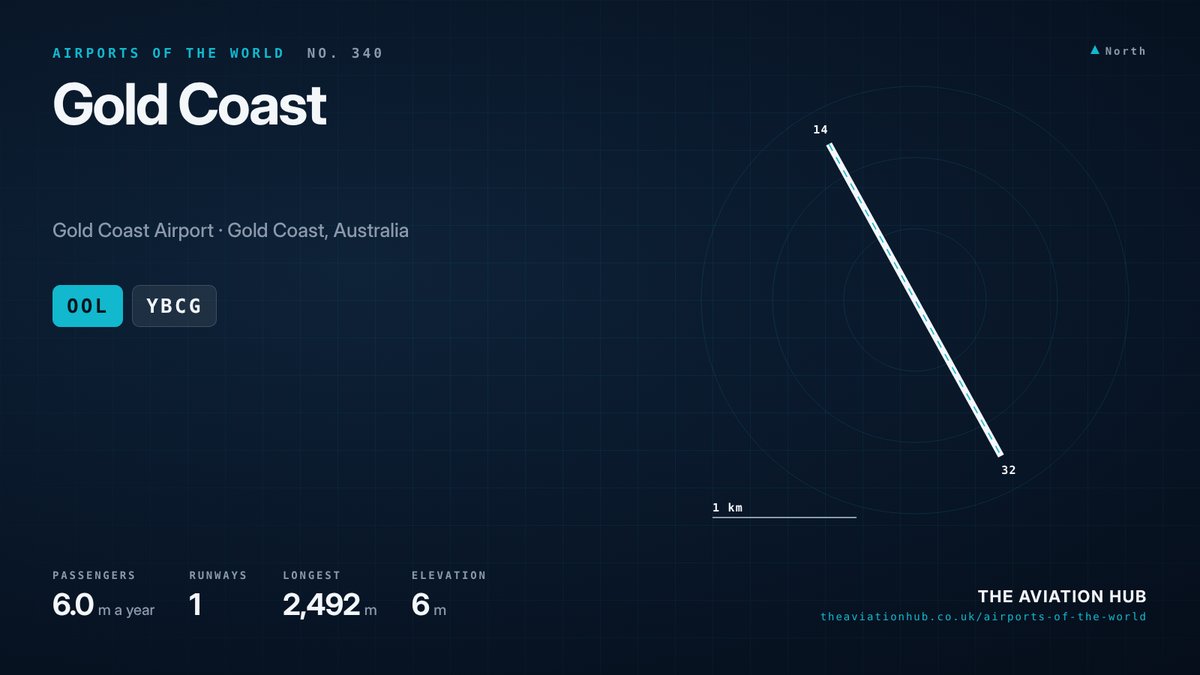
Gold Coast Airport, long known as Coolangatta, is the main gateway to one of Australia’s best known holiday coasts. It sits at Bilinga about 56 miles (90 km) south of Brisbane, with its runway crossing the border between Queensland and New South Wales. Jetstar treats it as a hub, and leisure traffic from Sydney, Melbourne and New Zealand drives most of the numbers. The airport handled about 6.2 million passengers in 2024.
Gold Coast Airport at a Glance
The airport uses the IATA code OOL and the ICAO code YBCG, both carried over from the Coolangatta days. It sits 6 m (21 ft) above sea level, wedged between the Pacific beaches and the Tweed hinterland. A single main runway and an expanded main terminal handle airline traffic. Queensland Airports Limited, which also runs Townsville, Mount Isa and Longreach, has operated it under a long term lease since 1998.
Gold Coast Airport handled 6,206,216 passengers in 2024, including about 628,000 international travellers, slightly below the 2018 peak of 6.49 million. Jetstar is the largest airline, with Virgin Australia, Qantas and Air New Zealand also prominent. The airport runs on Queensland time all year, so its clocks stay put while neighbouring New South Wales observes daylight saving. Flight details are on the airport’s official website.
How the Gold Coast’s Airport Came to Be
The field began in 1936 as three grass strips, intended only as an emergency landing ground for airmail aircraft between Brisbane and Sydney. Passenger flights began in 1939. In March 1949 a Lockheed Lodestar crashed after take off from the strip, killing all 21 aboard, at the time Queensland’s worst civil aviation accident.
The Eric Robinson Building opened in 1981 as the main terminal. The airport kept the name Coolangatta, an Aboriginal term usually translated as place of good view, until 1989, when it became Gold Coast Airport. Queensland Airports Limited took a long term lease on 29 May 1998. Jetstar declared it a hub in 2010, the same year a $100 million redevelopment roughly doubled the terminal to almost 27,000 square metres.
The main runway was extended and a full length parallel taxiway opened in May 2007. The Tugun Bypass, opened in 2008, runs through a 334 m tunnel beneath the runway. The airport served as the official gateway for the 2018 Commonwealth Games, and a southern terminal expansion of 30,000 square metres followed, built by Lendlease from July 2019.
Runways at Gold Coast Airport
The main runway at Gold Coast Airport is 14/32, 2,492 m (8,176 ft) long and 45 m wide with an asphalt surface. It handles Airbus A320s and A321neos, Boeing 737s, and it can take wide body jets on international and charter flights. A short secondary strip, 17/35, is just 582 m (1,909 ft) long and suited only to light aircraft.
The runway straddles the state border, with its southern end in New South Wales. Approaches from the north cross the beaches of Tugun and Bilinga, while arrivals from the south pass over Tweed Heads. An instrument landing system approved in 2016 was delayed by ground contamination and resident noise concerns before it went live in February 2019 for use in poor weather. Sea breezes and summer storms are the main weather factors.
Terminals and Airlines
All airline flights at Gold Coast Airport use the main terminal, enlarged in 2010 and again through Project LIFT, a programme of around $300 million that began in 2016. The upgrades added wide body aircraft stands and a three level southern extension. Virgin Australia and Qantas both run lounges.
Jetstar is the dominant airline, flying Airbus A320 and A321neo jets to Adelaide, Melbourne, Sydney, Cairns, Hobart, Canberra and New Zealand. Virgin Australia flies Boeing 737s to Sydney, Melbourne, Adelaide, Canberra and Bali. Qantas serves Sydney, Melbourne and Auckland. Air New Zealand flies to Auckland, Fiji Airways to Nadi and FlyPelican to Newcastle. Bonza opened a base in 2023 but collapsed in April 2024.
Routes and Destinations
Sydney is the busiest route from Gold Coast Airport, with about 2.9 million passengers in 2024. Melbourne follows at roughly 2.46 million, then Adelaide at 317,000 and Canberra at 210,000. Jetstar flies to Western Sydney from 25 October 2026, adding a second Sydney airport to the map.
Auckland is the busiest international route, with about 320,000 passengers in the year to June 2024, followed by Christchurch, Bali and Wellington. Several long haul links have gone. Scoot suspended Singapore in July 2023, Jetstar moved Tokyo to Brisbane in October 2023 and AirAsia X ended its Kuala Lumpur service from 1 December 2024. Denpasar, roughly 2,850 miles (4,600 km) away, is now the longest route. School holidays and winter escapes from the southern states drive the peaks.
Getting to and from Gold Coast Airport
Buses are the cheapest sensible option. Kinetic route 777 runs express to Broadbeach South, where it connects with the G:link light rail to Surfers Paradise and Southport. Other routes serve Robina, for trains to Brisbane, and Tweed Heads. Private operators run scheduled transfers to Brisbane and the hinterland.
The terminal sits about 300 m from the Gold Coast Highway, and the Pacific Motorway interchange is 1.5 km south in Tweed Heads West. Surfers Paradise is around 30 minutes away by taxi or rideshare, and Byron Bay is under an hour to the south. Parking sits beside the terminal. Light rail and heavy rail extensions to the airport have been proposed but were not approved as of 2025.
Spotting and Photography
Gold Coast Airport is a relaxed and popular location for enthusiasts. Public streets in Tugun and Bilinga near the northern end give close views of arrivals over the beach, and the coastal headlands around Kirra offer elevated views across the field. The southern end near Tweed Heads catches arrivals from the other direction.
Southeasterly winds are common, which favours runway 14 and brings arrivals in over Tugun. Morning and late afternoon light is softest, and summer storms can produce dramatic skies. Stay on public land, keep clear of the perimeter fence and never stop on the motorway or highway. Follow any instruction from airport security or police at once.
What Comes Next
The 2032 Brisbane Olympic and Paralympic Games, with events planned on the Gold Coast, give the airport a clear target. Light rail to the terminal and a heavy rail extension remain the most important missing links. The southern terminal expansion has created room for growth, and Western Sydney adds a new trunk route.
Recovering the international routes lost since 2023 is the main commercial challenge. Gold Coast Airport looks set to remain a leisure powerhouse on the domestic trunk routes, with long haul growth depending on airline appetite. Compare it with other Australian airports on the Airports of the World map.
Continue to follow The Aviation Hub for more analysis and insight.
Advertise with us Your brand, in front of an aviation audience Home page and in-article placements, sold directly, one advertiser per slot. From £250 a year. See the rates

