
Abuja Airport Guide: Nigeria’s Capital Gateway Explained
Abuja Airport, officially Nnamdi Azikiwe International, serves Nigeria's capital. Read about its long runway, terminals, airlines, routes and rail link.
 By The Aviation Hub
7 min read
Updated October 20, 2026
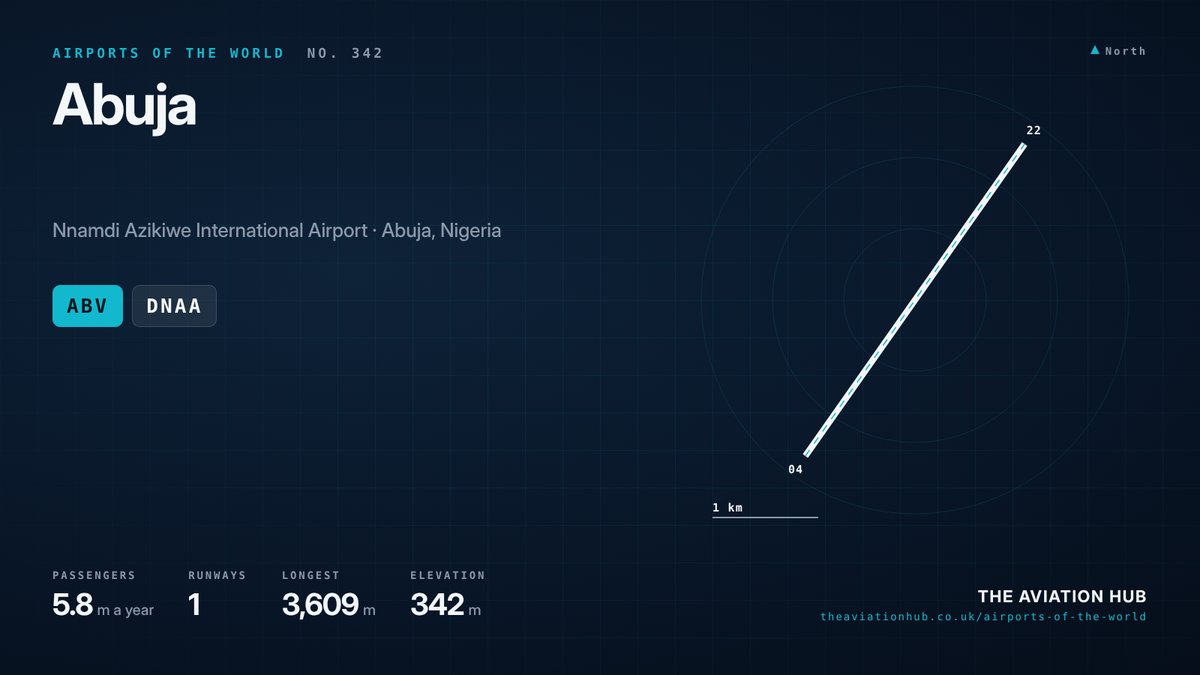
Abuja Airport, formally Nnamdi Azikiwe International Airport, is the air gateway to Nigeria’s purpose built capital and the second busiest airport in the country after Lagos. It lies in the Federal Capital Territory, roughly 25 miles (40 km) by road southwest of the city centre, on the plain below the granite hills that frame Abuja. Around 5.5 million passengers pass through each year, and the field is a key base for Nigeria’s fast growing domestic airlines.
Abuja Airport at a Glance
Abuja Airport uses the IATA code ABV and the ICAO code DNAA. It sits at 342 m (1,123 ft) above sea level and has a single asphalt runway, 04/22, which at 3,609 m (11,842 ft) is among the longest in West Africa. Passenger traffic reached about 5.48 million in 2024, with roughly 78,000 aircraft movements and a little over 9,000 tonnes of cargo.
A terminal commissioned in December 2018 now handles international flights, the original building serves domestic traffic, and the 2002 international terminal has been sidelined. Air Peace, Arik Air, Ibom Air, Aero Contractors and Overland Airways all base aircraft here. The Federal Airports Authority of Nigeria operates the airport, and flight information is published on the airport’s official website.
How the Capital’s Airport Came to Be
Abuja did not exist as a city until the late 1970s, when Nigeria decided to move its capital away from crowded Lagos to a neutral site in the centre of the country. The airport grew up alongside the new city in the early 1980s and expanded as ministries, embassies and the federal government moved north through the 1990s. It takes its name from Nnamdi Azikiwe, the nationalist leader who became Nigeria’s first president in 1963.
The international terminal of 2002 was the first big step up in quality. A 2006 concession deal to hand management to a private operator was revoked two years later, and the airport stayed in federal hands. The next turning point came in 2017, when the ageing runway, built for a 20 year life but in use for almost 40, was closed for about six weeks of emergency repairs. All flights, including international services, were diverted to Kaduna more than two hours away by road.
The Chinese financed terminal commissioned in December 2018 gave the airport a modern international building with jet bridges and far more gates. Together with the Abuja light rail link, which opened the same year, it marked the end of the field’s long period of catching up with the city it served.
Runways at Abuja Airport
Runway 04/22 is 3,609 m (11,842 ft) long and 60 m wide with an asphalt surface. Its length and the airport’s elevation of 342 m give heavy aircraft plenty of margin in the hot season, when temperatures above 35 degrees reduce engine performance. Boeing 777s and Airbus A350s on the European and Gulf routes operate without payload penalties.
Having only one runway is the airport’s main weakness. Any closure for repairs or an incident shuts the capital’s air link entirely, which is exactly what happened in 2017. A second parallel runway has been talked about for two decades. An earlier contract with Julius Berger was revoked on cost grounds, and later work by a Chinese contractor stalled in a pricing dispute. President Bola Tinubu gave the project fresh approval in April 2026, but no completion date has been set. Until it is built, Abuja Airport runs its single strip in both directions depending on wind, with an instrument landing system serving runway 22.
Terminals and Airlines
At Abuja Airport, the 2018 terminal handles international flights. It was built by a Chinese contractor as part of a wider programme that also delivered new terminals at Lagos, Port Harcourt and Kano, and its design is near identical to those buildings. Qatar Airways, Turkish Airlines, Ethiopian Airlines, Egyptair, Royal Air Maroc, Air France and British Airways are among the foreign carriers using it. Air Peace, the largest Nigerian airline, has flown from here to both London Heathrow and Gatwick since October 2025.
The 2002 international terminal lost its last foreign airline in April 2019, with plans to refurbish it for domestic use. The domestic terminal is the oldest of the three and is the busiest by number of passengers, since the home carriers run intensive shuttles to Lagos and other Nigerian cities. Air Peace, Arik Air, Ibom Air, Aero Contractors, Overland Airways, United Nigeria and ValueJet are the main names. All three alliances are present, with British Airways, Qatar Airways and Royal Air Maroc for oneworld, Turkish, Ethiopian and Egyptair for Star Alliance, and Air France for SkyTeam.
Routes and Destinations
Lagos is the dominant route from Abuja Airport by a wide margin, with flights departing throughout the day on Boeing 737s, Embraer E195-E2s and Airbus A320 family aircraft. Port Harcourt, Kano, Enugu, Owerri, Yola, Benin City and Asaba make up most of the rest of the domestic network. Demand swings with the political calendar, since the capital’s travel is heavily tied to government and business.
Internationally, London is the biggest market. British Airways serves Heathrow, and Air Peace flies to both Heathrow and Gatwick. Air France links Paris Charles de Gaulle, while Turkish Airlines, Qatar Airways and Ethiopian Airlines feed their hubs at Istanbul, Doha and Addis Ababa and carry much of the long haul transfer traffic to Asia and the Americas. Regional African links include Accra, Lome, Niamey, Entebbe, Cairo, Casablanca and Algiers. Emirates suspended its Dubai route over currency disputes, so the Gulf schedule has not always been stable.
Getting to and from Abuja Airport
The Abuja Light Rail opened in 2018 and links the airport with the Abuja Metro station in the central business district, with a stop at Idu for the standard gauge line to Kaduna. The service has had a stop start history, suspended for several years and relaunched in 2024, but when running it is the cheapest route into town. Check locally whether trains are operating before relying on it.
Most travellers use the road. The Airport Road, also known as the Umaru Musa Yar’Adua Expressway, runs straight into the city and takes 30 to 45 minutes in normal traffic. Taxis are plentiful at the terminal and ride hailing apps work, with fares to the centre typically in the range of ₦15,000 to ₦25,000 (roughly £8 to £13), though they rise sharply at night. Pre booked hotel transfers are a sensible choice for first time visitors. Car parks sit in front of both the domestic and international terminals.
Spotting and Photography
Spotting at Abuja Airport takes some care. Nigerian security staff are wary of cameras near airport infrastructure and there is no official viewing area, so the best approach is to work from inside the terminals. The departure lounges of the 2018 terminal have large windows onto the apron, and the domestic terminal gives views of the home carriers’ 737s and E2s turning round.
Light is strongest in the dry season months from November to March, although harmattan dust can turn the sky grey in December and January. Afternoon is the better time to photograph aircraft on runway 22. Military traffic from the Nigerian Air Force base on the field is off limits. Keep cameras discreet, never photograph security posts, and stay away from the perimeter fences, which are patrolled.
What Comes Next
The second runway remains the most important unfinished business. Without it the capital’s air connectivity hangs on a single strip that has already failed once. A general aviation terminal for private jets has also been planned to take business traffic away from the crowded main apron. The federal government has floated concessions for the major airports several times, and a private operator could eventually take over.
Traffic has grown steadily as Nigerian airlines add aircraft, and the airport’s long runway and new terminal leave headroom for more long haul services if the economy allows. The likely path is continued domestic growth and gradual recovery of the Gulf and European routes. Abuja Airport is heading in the right direction, provided the runway project finally moves. See how it compares with other African fields on our Airports of the World map.
Continue to follow The Aviation Hub for more analysis and insight.
Advertise with us Your brand, in front of an aviation audience Home page and in-article placements, sold directly, one advertiser per slot. From £250 a year. See the rates

