
Montego Bay Airport Guide: Jamaica’s Tourist Gateway
Montego Bay Airport, Sangster International, explained: the seaside runway, terminal, airlines, routes from the UK and US, transfers and spotting.
 By The Aviation Hub
6 min read
Updated October 20, 2026
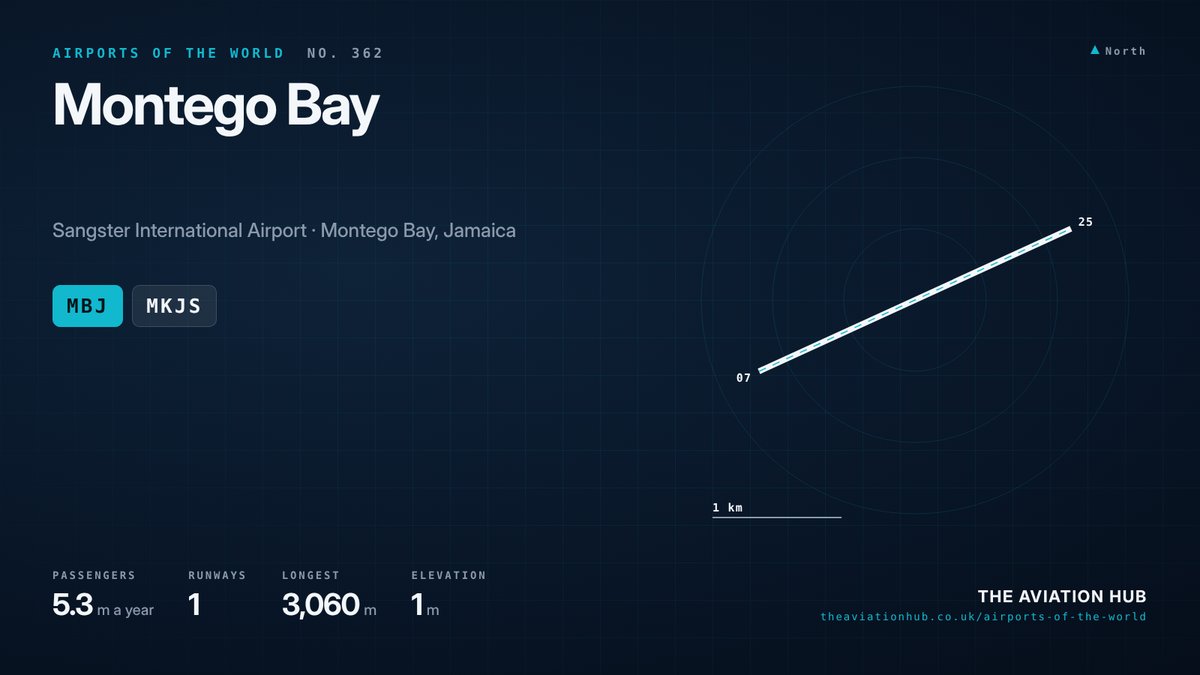
Montego Bay Airport, officially Sangster International, is where most holidaymakers first set foot in Jamaica. It sits on the north coast a short drive from the resort strip, with a single runway running right along the shoreline. In a normal year it handles around five million passengers, the majority of them tourists bound for Montego Bay, Negril and Ocho Rios. Its fortunes track the island’s hotel industry closely, for better and worse.
Montego Bay Airport at a Glance
Sangster International uses the IATA code MBJ and the ICAO code MKJS. It lies about three miles (4.8 km) east of central Montego Bay, at an elevation of just 4 feet (1 m). There is one runway and one main passenger terminal, with a small separate domestic facility. Arrivals guidance, parking and flight times are on the airport’s official website.
The Airports Authority of Jamaica owns the site, but MBJ Airports Limited has run it under a concession since privatisation in 2003. Mexico’s Grupo Aeroportuario del Pacifico is the leading shareholder, with Vantage Airport Group holding a minority stake. Traffic reached roughly 5.1 million passengers in 2024 before falling about 12 per cent to around 4.5 million in 2025. No airline is based at Montego Bay Airport, which depends on visiting carriers from North America and Europe.
How Montego Bay’s Airport Came to Be
Planners identified the site in 1936, and construction finished on 18 February 1947. Pan American Airways was the first international airline to fly in and ran the airport until the Jamaican government took control in September 1949. The original terminal, opened in July 1959, was built on the south side of the runway, where the modern complex still sits today.
The field was originally called Montego Bay Airport. It was later renamed after Sir Donald Sangster, the Jamaican prime minister who died in office in 1967. The name stuck, although many travellers and booking sites still use the city name.
A long expansion programme began in 2001. A new eastern concourse opened in December 2005, followed by a customs hall, arrivals lobby and transportation centre in March 2007. The relocated immigration hall and duty free mall were finished in September 2008. Together these works lifted stated capacity to around nine million passengers a year.
Runways at Montego Bay Airport
The single runway, 07/25, is 3,060 metres (10,039 feet) long and 45 metres wide, with an asphalt surface. That length handles wide body jets on nonstop flights to Europe, including the Boeing 787 and Airbus A330. A planned extension for heavier long haul aircraft was shelved indefinitely in 2012.
Easterly trade winds mean runway 07 is the usual choice for both landings and takeoffs. Arrivals come in low over the bay from the west, passing close to the resort strip, then touch down within sight of the beach. With no parallel runway, a single disabled aircraft can close Montego Bay Airport entirely.
The shoreline location carries real risk. A 2021 study placed the airport among the 20 international airports most exposed to rising sea levels. In October 2025 Hurricane Melissa tore sections off the terminal roof and caused flooding. The runway reopened for relief flights by 30 October, and limited commercial flights resumed on 1 November while repairs continued.
Terminals and Airlines
All international flights use the main terminal on the south side, with gates spread along the concourse and its eastern extension. Check in, immigration, customs and the duty free mall sit in the central building. Domestic flights use a smaller separate facility nearby.
The US majors provide most of the seats. American, Delta, United, JetBlue, Southwest and Frontier all serve Montego Bay Airport, alongside Air Canada, WestJet, Air Transat and Flair from Canada, with Porter due to start flights in late 2026. Copa, Wingo and LATAM Peru link the island with Latin America, while Cayman Airways and Bahamasair add seasonal island hops. On peak winter Saturdays the apron fills with Boeing 737s and Airbus A321s from across the eastern United States.
European flying is largely leisure. Virgin Atlantic and TUI connect the airport with the UK, while Condor and other carriers serve continental Europe. These flights bring wide body aircraft such as the 787 and A330 to an otherwise narrow body dominated field.
Routes and Destinations
The United States is by far the biggest market. Atlanta, Miami, Charlotte, New York JFK, Newark, Fort Lauderdale, Chicago and Dallas/Fort Worth all appear on the schedule, alongside seasonal links to many smaller cities. Toronto, Montreal, Calgary and Ottawa feed strong Canadian winter demand.
From Europe, London and Manchester are the core UK points, with Amsterdam and Frankfurt adding continental traffic. Those routes are among the longest from Montego Bay Airport, at more than 4,500 miles (7,200 km). Regional links reach Panama City, Bogota and Lima, giving useful connections into Latin America.
The pattern is strongly seasonal. Traffic peaks between December and April, when North Americans escape the cold, and dips during the late summer hurricane season. Easter and the summer school holidays bring smaller secondary peaks from the UK.
Getting to and from Montego Bay Airport
There is no rail link, so everyone travels by road. Most visitors use pre booked hotel transfers, which meet arrivals in the transportation centre outside customs. The Hip Strip and central Montego Bay are 10 to 15 minutes away. Negril takes around 90 minutes along the coast road, and Ocho Rios a similar time to the east via the North Coast Highway.
Licensed taxis operate from a regulated rank, with fixed fares to the main resort areas. Agree the price before setting off. Rental cars are available in the arrivals area, though driving is on the left and the roads can be demanding at night.
Knutsford Express coaches link Montego Bay with Kingston, Ocho Rios and Negril, and are the cheapest sensible long distance option. Kingston is roughly three to four hours away by road. Shared route taxis are cheaper still but better suited to confident travellers with light luggage.
Spotting and Photography
Montego Bay Airport is a favourite with photographers because arrivals cross the water so close to the shore. Dead End Beach, at the end of Kent Avenue near the western end of the runway, puts aircraft almost overhead as they land on 07. Morning light suits the approach, with the sun behind the camera until around midday.
Saturdays and Sundays in winter bring the best variety, with US, Canadian and European carriers arriving in quick succession. Long haul wide bodies usually land in the early afternoon. Occasional westerly winds reverse the flow, putting departures over the bay instead.
Respect the fencing, the beach users and the local police. Do not climb barriers or linger on the roadside in a way that blocks traffic. Keep valuables out of sight and stick to busy public spots.
What Comes Next
Temporary repairs after Hurricane Melissa have largely given way to permanent work on the roof, jet bridges and systems. Expansion projects halted by the storm have resumed, including a larger check in hall, bigger security and immigration halls and improvements to the East Concourse. A new western access road from Godfrey Dyer Boulevard is also planned.
Longer term, Montego Bay Airport has headroom inside its nine million passenger capacity, so growth depends on hotel building and airline confidence. Climate resilience will shape every major investment. Compare the airport with other Caribbean gateways on the Airports of the World map. The verdict: a busy tourist gateway rebuilding after a hard blow, with demand that historically bounces back.
Continue to follow The Aviation Hub for more analysis and insight.
Advertise with us Your brand, in front of an aviation audience Home page and in-article placements, sold directly, one advertiser per slot. From £250 a year. See the rates

