
Rome Ciampino Airport Guide: Airships, Aqueducts and Ryanair
Rome Ciampino Airport explained: its airship era origins, the single runway, Ryanair and Wizz Air, state flights, transport into the city and spotting.
 By The Aviation Hub
5 min read
Updated October 20, 2026
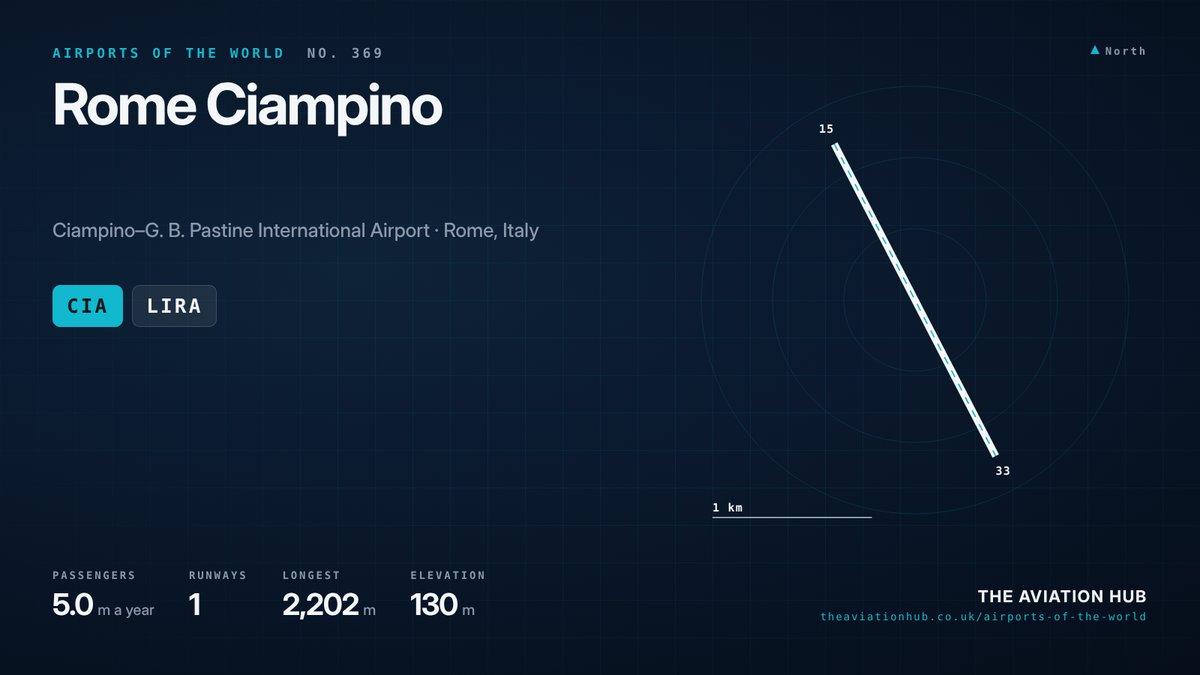
Rome Ciampino Airport is the Italian capital’s second airport, a compact field on the city’s south eastern edge. It is one of the oldest airports still in use anywhere, dating back to the First World War. Today it handles around four million passengers a year, almost all of them on low cost flights. It also hosts government flights, business jets and some of Rome’s most photogenic approaches.
Rome Ciampino Airport at a Glance
The airport carries the IATA code CIA and the ICAO code LIRA. It sits roughly 7.5 miles (12 km) south east of central Rome, just outside the Grande Raccordo Anulare ring road, at an elevation of 427 feet (130 m). There is one runway and a compact passenger terminal. Aeroporti di Roma, which also runs Fiumicino, manages the site.
Passenger numbers reached about four million in 2025, held in check by a cap of 65 commercial flights a day. Ryanair is by far the largest airline at Rome Ciampino Airport and flies almost every scheduled service. The Italian Air Force shares the field. Travel advice, parking and flight times are on the airport’s official website.
A Short History of Ciampino
Ciampino opened in 1916 as a base for military airships. Its full name honours Giovan Battista Pastine, an Italian airship pioneer. Between the wars it grew into Rome’s main airport, and it handled the city’s international traffic again after 1945.
The opening of Fiumicino in 1961 changed everything. Most airlines moved to the bigger, more modern site on the coast, and Ciampino became a quiet home for charters, state flights and the air force. For around four decades it was a backwater.
Low cost airlines revived it in the 2000s. Ryanair moved much of its Rome flying here, attracted by lower charges and quick turnarounds. Traffic soared, bringing noise complaints from nearby towns. Those complaints led to caps on daily commercial movements, which still shape the operation of Rome Ciampino Airport today.
Runways at Rome Ciampino Airport
A single asphalt runway, 15/33, handles all traffic. It is 2,202 metres (7,226 feet) long and 45 metres wide. That is ample for the Boeing 737 and Airbus A320 families, but short for heavy long haul aircraft.
Arrivals on runway 15 come in from the northwest, low over Rome’s south eastern suburbs and the Parco degli Acquedotti. Runway 33 brings aircraft in over the Alban Hills side, from the direction of Ciampino and Marino. Housing sits close to both ends, which explains the strict noise rules.
The airport has seen its share of drama. On 10 November 2008 a Ryanair Boeing 737-800 flew through a large flock of starlings on approach to runway 15. Both engines were damaged and the aircraft landed heavily, but nobody died. The incident remains a textbook bird strike case.
Terminals and Airlines
All commercial flights use the compact terminal area beside the main apron. Facilities are basic but adequate, and queues at security can build quickly when several departures cluster together. Many stands are remote, so passengers often walk across the apron or take a bus to the aircraft.
Ryanair dominates with its Boeing 737-800 and 737-8200 fleet, linking Rome with destinations across Europe. Wizz Air, once a major user, now appears only on a seasonal route to Olbia. No legacy alliance carrier has a significant presence, since they all concentrate on Fiumicino.
The Italian Air Force’s 31st Wing operates state and VIP transport aircraft from its own apron. Rome Ciampino Airport is also the capital’s main business aviation centre, with a steady stream of private jets serving government, fashion and finance.
Routes and Destinations
Almost the whole network is short haul within Europe. Domestic scheduled flying is thin, with Ryanair’s Cagliari service the main link to Sardinia. Internationally, Ryanair serves the UK, Ireland, Belgium, Poland, Morocco and many other countries.
Ryanair also flies to Romania, Bulgaria, Hungary and Albania, carrying migrant workers as well as tourists. London is among the most important international markets. The longest routes reach the edges of Europe and North Africa.
Summer and major Catholic events, such as the 2025 Jubilee, bring the busiest periods at Rome Ciampino Airport. Because daily flights are capped, the field never sees the extreme peaks Fiumicino handles, and spare slots are scarce. Courier and cargo operations are small.
Getting to and from Rome Ciampino Airport
There is no rail station at the terminal, but buses run to Ciampino station in a few minutes. Regional trains then reach Roma Termini in roughly 15 minutes, which is usually the fastest and cheapest sensible option. Cotral buses also link the airport with Anagnina, the terminus of metro line A.
Direct coach operators such as Terravision and SIT run to Termini, taking around 40 minutes in normal traffic. They are simple and cheap, with luggage space, though traffic can lengthen the trip. Book ahead in summer.
Taxis wait outside arrivals and charge a fixed fare to the historic centre within the Aurelian Walls. The drive takes around 30 minutes, more at rush hour. Car hire desks are close to the terminal, and the ring road and Via Appia Nuova give quick access to the rest of the region.
Spotting and Photography
Rome Ciampino Airport offers one of Europe’s classic spotting scenes. When runway 15 is in use, arrivals pass over the Parco degli Acquedotti, where ancient Roman aqueducts frame the aircraft. Afternoon light works well, and the park is free and open to all.
Closer to the airport, roads around the perimeter give views of the runway and the military apron. Business jets, state aircraft and occasional firefighting or civil protection types add variety to the Ryanair traffic.
The air force presence means photography of military areas can be sensitive. Stay on public land, respect fences and park rules, and follow any instructions from police or Carabinieri.
What Comes Next
Growth is limited by design. Noise caps and the surrounding housing mean the airport cannot expand traffic much, and future investment is likely to focus on quality rather than volume. Terminal upgrades, better passenger flows and improved road access are the realistic priorities.
Aeroporti di Roma treats Fiumicino as the growth airport and Ciampino as a specialist field for low cost, business and state aviation. Rome Ciampino Airport will stay important for budget travellers seeking quick access to the south of the city. Compare the two Rome airports on the Airports of the World map. The verdict: a historic, capped and crowded field that still earns its place.
Continue to follow The Aviation Hub for more analysis and insight.
Advertise with us Your brand, in front of an aviation audience Home page and in-article placements, sold directly, one advertiser per slot. From £250 a year. See the rates

