
Phu Quoc Airport Guide: Vietnam’s Island Gateway Grows Up
Phu Quoc Airport explained: its 2012 opening, runways, Vietnam Airlines and Sun PhuQuoc Airways, international routes, transfers and APEC 2027 expansion.
 By The Aviation Hub
5 min read
Updated October 20, 2026
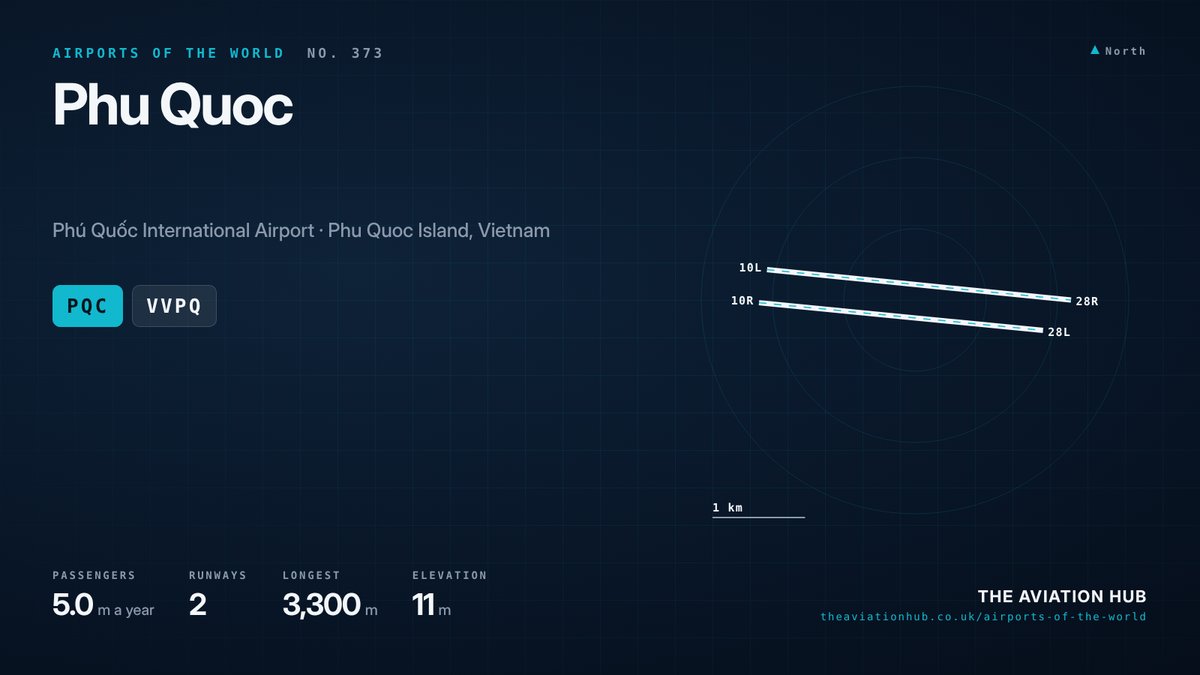
Phu Quoc Airport serves Vietnam’s largest island, a fast growing resort destination in the Gulf of Thailand. Opened in 2012 to replace a small town centre airstrip, it now links the island with Vietnamese cities and a long list of Asian and Central Asian markets. Traffic has climbed into the millions, driven by beach tourism and visa free entry. A huge expansion is under way ahead of the APEC summit in 2027.
Phu Quoc Airport at a Glance
The airport uses the IATA code PQC and the ICAO code VVPQ. It sits about 5.5 miles (9 km) south of Duong Dong, the island’s main town, at an elevation of 37 feet (11 m). There is one passenger terminal, and the field is being developed for two parallel runways. Sun Group, the resort developer behind much of the island’s tourism, took over ownership from Airports Corporation of Vietnam in November 2025.
Traffic reached about 3.7 million passengers in 2019 and has grown strongly since the pandemic, from 4.1 million in 2024 to nearly 5.9 million in 2025. Vietnam Airlines and Sun PhuQuoc Airways treat Phu Quoc Airport as a hub, while VietJet Air, Bamboo Airways and Vietravel Airlines operate bases. Flight and transfer information is on the airport’s official website.
How Phu Quoc’s Airport Came to Be
For decades the island relied on a small airport in Duong Dong, about 6 miles (10 km) from the current site. Its short runway and town centre location could not cope with the tourism boom the government wanted. Airports Corporation of Vietnam began building a replacement in 2008.
The new airport was completed in November 2012 and began operating in early December that year. The old airstrip closed, and the land became available for urban development. International flights followed as resort building accelerated along the island’s coasts.
Policy changes helped growth. Phu Quoc’s status as a special economic area allows most foreign visitors to stay for up to 30 days without a visa if they arrive directly. That rule turned Phu Quoc Airport into an international entry point in its own right, attracting charter flights from across Asia and beyond.
Runways at Phu Quoc Airport
Current airport data lists two parallel runways, both 45 metres wide, one asphalt and the newer one concrete. Runway 10R/28L measures 3,000 metres (9,843 feet), and runway 10L/28R measures 3,300 metres (10,827 feet). The original 3,000 metre runway carried all traffic for most of the airport’s life, and the second runway forms part of the expansion for APEC 2027.
The runways run east to west across the southern part of the island. The southwest monsoon, from roughly May to October, brings westerly winds and heavy rain, favouring runway 28. The northeast monsoon in the dry season tends to favour runway 10. Afternoon storms can bring short delays in the wet season.
The expansion plan also includes extending the first runway to 3,500 metres and upgrading the airport to ICAO 4E standard. That will make Phu Quoc Airport comfortable for long haul wide body jets at full weights.
Terminals and Airlines
Terminal 1 handles both domestic and international flights, with separate areas inside. It becomes crowded at peak times, especially when several international charters arrive together. New terminals are planned as part of the APEC programme.
Vietnam Airlines, a SkyTeam member, flies Airbus A321s and occasionally wide bodies from Hanoi and Ho Chi Minh City. VietJet Air operates a large A320 family network, while Sun PhuQuoc Airways, Sun Group’s own airline, is building services. Bamboo Airways and Vietravel Airlines add domestic flights.
International carriers and charter operators bring visitors from Korea, Taiwan, Singapore, Malaysia, Thailand and Central Asia. Russian and Kazakh holidaymakers form a notable winter market.
Routes and Destinations
Domestic routes carry most passengers. Ho Chi Minh City is the closest major link, a flight of under an hour, and Hanoi, around two hours away, is among the longest domestic routes. Da Nang, Nha Trang and Can Tho add further connections.
Internationally, Seoul Incheon is a key market, along with Singapore, Hong Kong, Kuala Lumpur, Taipei and Bangkok. Longer routes reach Moscow Sheremetyevo, Almaty and Astana, along with charter flights to Eastern Europe. Moscow, about 4,700 miles (7,600 km) away, is among the longest routes from Phu Quoc Airport.
The peak season runs from November to April, when the dry weather draws beach holidaymakers. Vietnamese public holidays, including Tet and the summer break, produce strong domestic peaks.
Getting to and from Phu Quoc Airport
There is no rail on the island, so road transport covers every journey. Taxis, including electric fleets, wait outside arrivals, and ride hailing apps also operate. The drive to the Long Beach resorts and Duong Dong takes around 15 to 20 minutes.
Many resorts provide pre booked transfers, especially those run by Sun Group and other major developers. Journeys to the southern resorts around An Thoi and Sunset Town take around 30 minutes. Public bus services connect the airport with key areas and are the cheapest sensible option for light travellers.
Car and motorbike hire is widely available, though inexperienced riders should think carefully before tackling island traffic. Ferries link Phu Quoc with Rach Gia and Ha Tien on the mainland.
Spotting and Photography
Phu Quoc Airport offers good variety for a resort field. Vietnam Airlines and VietJet narrow bodies mix with charter wide bodies from Russia, Kazakhstan and Korea. Sun PhuQuoc Airways adds a fresh livery to collect.
Roads around the perimeter and open land near the runway ends offer informal views of movements. Construction work for the new runway and terminals has changed access in places, so check before visiting. Morning light is generally kinder, before tropical haze and storms build.
Vietnamese authorities treat airports as sensitive sites. Stay well away from fences, never fly drones near the field and comply immediately with requests from police or security staff.
What Comes Next
The APEC 2027 programme is transforming the site. Sun Group was approved as the main investor in 2025, and plans include the second runway, a longer main runway, new terminals and more than 100 aircraft stands. Capacity is set to rise to about 18 million passengers a year.
That growth will reshape the island, with more international routes and larger aircraft. Phu Quoc Airport must balance that expansion with pressure on the island’s environment and infrastructure. See how it compares with other Southeast Asian resort airports on the Airports of the World map. The verdict: a resort airport rapidly turning into a major international gateway.
Continue to follow The Aviation Hub for more analysis and insight.
Advertise with us Your brand, in front of an aviation audience Home page and in-article placements, sold directly, one advertiser per slot. From £250 a year. See the rates

