
Bhubaneswar Airport Guide: Odisha’s Fast Growing Hub
Bhubaneswar Airport explained: Biju Patnaik's legacy, the runway, both terminals, IndiGo and IndiaOne Air, routes, city links and the planned Terminal 3.
 By The Aviation Hub
5 min read
Updated October 20, 2026
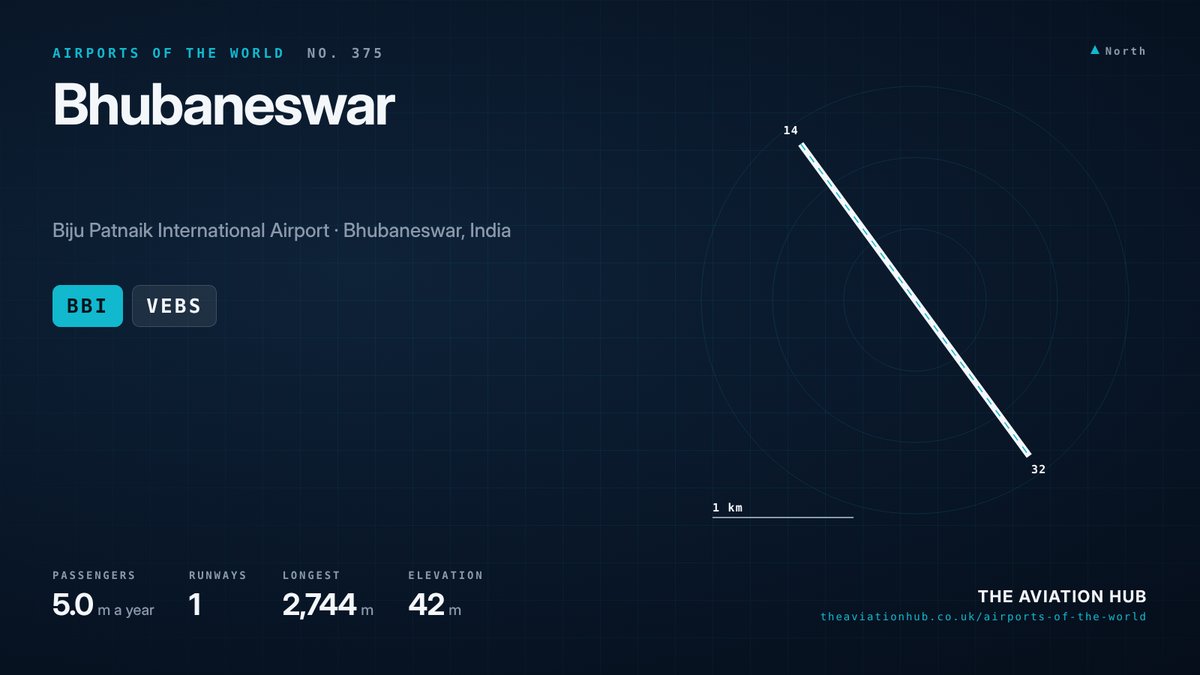
Bhubaneswar Airport, officially Biju Patnaik International, is the main air gateway to the Indian state of Odisha. It sits unusually close to the heart of the state capital, a few minutes from the railway station. Traffic passed five million passengers in the year to March 2026, driven by IndiGo’s growth and a busy regional network across Odisha. With a new terminal approved, the airport is preparing for its next phase of growth.
Bhubaneswar Airport at a Glance
The airport carries the IATA code BBI and the ICAO code VEBS. It lies about 3.7 miles (6 km) from the city centre, at an elevation of 138 feet (42 m). There is a single runway, which handles all traffic, and two linked terminals. The Airports Authority of India owns and operates the field.
Traffic reached about 5.13 million passengers in the financial year to March 2026, up 6% on the year before. IndiGo is the dominant airline at Bhubaneswar Airport, and regional carrier IndiaOne Air bases its fleet here. The Indian Coast Guard has operated an air enclave on site since 2014. Timetables and passenger services are listed on the airport’s official website.
How Odisha’s Airport Came to Be
The airport was dedicated to the people of Odisha on 17 April 1962, as the state’s first commercial airport. For decades it was a quiet domestic station with a handful of daily flights to Kolkata, Delhi and a few other cities.
Its name honours Biju Patnaik, a former Chief Minister of Odisha and a celebrated pilot. He flew transport aircraft during the Second World War and became famous for flying Indonesian independence leaders out of Java in 1947. The choice reflects his place in both Odisha’s politics and Indian aviation history.
Growth accelerated in the 2010s. A new domestic terminal opened in March 2013, and the airport gained international status in October 2013. The older building was then refurbished as the international terminal. A link building connecting the two opened in February 2024.
Runways at Bhubaneswar Airport
The airport’s only runway, 14/32, measures 2,744 metres (9,003 feet) long and 45 metres wide, with a bitumen surface. It carries every airline movement and suits the Airbus A320 family and Boeing 737 comfortably.
A shorter strip that crosses the runway was once listed as a second runway, but it no longer serves as one. It now works as a taxiway, used mainly by light aircraft. The city has grown right up to the airport boundary, which limits any lengthening of the runway.
Summer winds from the Bay of Bengal often favour runway 14, while winter northerlies bring more use of runway 32. Cyclones from the bay can halt flights, and Cyclone Fani caused a closure and damage at the airport in May 2019. In December 2007 an Indian Air Force Surya Kiran trainer crash landed on the runway during practice, with the pilot suffering minor injuries.
Terminals and Airlines
Terminal 1 handles domestic flights and opened with capacity for about four million passengers a year, a figure Bhubaneswar Airport has now outgrown. Terminal 2 serves international departures and arrivals. The link building lets passengers move between the two more easily.
IndiGo dominates with Airbus A320neo and A321neo jets, plus ATR 72 turboprops on regional routes. Air India and Air India Express also serve the city, linking it with Delhi, Mumbai and southern India. IndiaOne Air flies nine seat Cessna Caravan turboprops to towns across Odisha.
Bhubaneswar Airport has won recognition for service despite its crowding, including an ACI Airport Service Quality award for 2018 in its passenger category in the Asia Pacific region.
Routes and Destinations
Delhi, Mumbai, Bengaluru, Kolkata, Hyderabad and Chennai are the core domestic routes, carrying business travellers, students and workers. Ahmedabad, Guwahati, Patna, Raipur, Ranchi, Varanasi and Pune add further links. Delhi, about 800 miles (1,280 km) away, is among the longest regular domestic routes.
IndiaOne Air connects Bhubaneswar with Jeypore, Rourkela, Bhawanipatna and Malkangiri. International service has been patchy. IndiGo launched flights to Bangkok, Dubai and Singapore in 2023 and added Abu Dhabi in 2025, but all four were suspended during 2026. IndiGo plans to restore Bangkok from November 2026. Cargo flights have also served Dubai, Singapore and Bangkok.
Demand peaks around Durga Puja, Diwali and the Rath Yatra festival in nearby Puri, which draws huge crowds every summer.
Getting to and from Bhubaneswar Airport
The short distance to the city is a real advantage. Bhubaneswar railway station is about 2.5 miles (4 km) away, around 10 to 15 minutes by road. National Highway 16 passes close by, linking the city with Cuttack, Kolkata and Chennai.
Ama Bus, the city’s public bus network, serves the airport and is the cheapest sensible option for most travellers. Airport Express and double decker services run to Cuttack and Puri. Prepaid taxis and ride hailing apps such as Uber and Ola operate from the forecourt.
Puri, about 37 miles (60 km) away, and the Sun Temple at Konark are popular day trips from Bhubaneswar Airport. Both take around 90 minutes by road, depending on traffic. Car hire with a driver is widely available.
Spotting and Photography
Bhubaneswar Airport offers limited formal spotting. IndiGo jets dominate, with Air India and Air India Express aircraft, IndiaOne Air turboprops and Coast Guard aircraft adding variety. The terminal windows give some views of the apron.
The airport’s position within the city means aircraft pass low over nearby neighbourhoods on approach. Morning light is usually best, before haze builds in the heat of the day. Monsoon months bring dramatic skies but frequent rain.
Indian airports are high security zones guarded by the Central Industrial Security Force. Photography near the perimeter can attract attention, so stay on public land, avoid drones and follow every instruction from security staff.
What Comes Next
The Indian government approved a new Terminal 3 in 2025. It is planned to cover about 65,000 square metres, handle around 8.6 million passengers a year and add about six aerobridges, at an estimated cost of roughly ₹10 billion (about £90 million). Final sanction was still pending at last report, so construction dates remain uncertain.
Recent work has already added eight apron bays and a 4 megawatt solar plant. Bhubaneswar Airport will need Terminal 3 soon, as traffic already exceeds Terminal 1’s design capacity. Compare it with other Indian state capitals on the Airports of the World map. The verdict: a growing, well placed regional hub that urgently needs more terminal space.
Continue to follow The Aviation Hub for more analysis and insight.
Advertise with us Your brand, in front of an aviation audience Home page and in-article placements, sold directly, one advertiser per slot. From £250 a year. See the rates

