
Mineralnye Vody sits on the northern edge of the Caucasus, in the heart of a cluster of spa towns that Russians have visited for two centuries. Mineralnye Vody Airport is the gateway to that region, serving Pyatigorsk, Kislovodsk, Yessentuki and Zheleznovodsk as well as the ski slopes around Mount Elbrus. It handled close to five million passengers in 2024. That makes it one of the busiest regional airports in southern Russia, and a key link between the North Caucasus and Moscow.
Mineralnye Vody Airport at a Glance
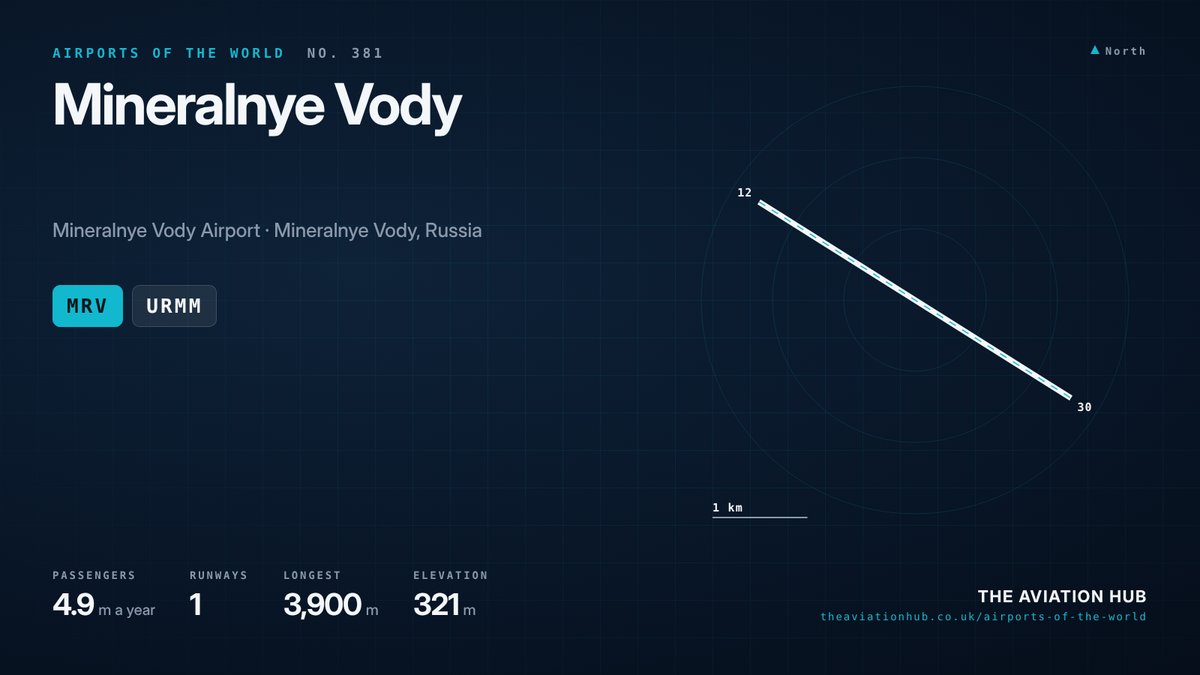
The airport carries the IATA code MRV and the ICAO code URMM. It lies about 2.5 miles (4 km) west of the town of Mineralnye Vody in Stavropol Krai, at an elevation of 321 m (1,054 ft). There is one runway and two terminals, one domestic and one international. Mineralnye Vody Airport handled almost five million passengers in 2024, according to its operator. Rossiya and the regional carrier Azimuth both run bases here. The owner is Novaport, the airport holding group that bought the site from Aeroinvest in 2016. More details sit on the airport’s official website.
A Short History of Mineralnye Vody
The name translates simply as Mineral Waters. It refers to the springs that made Pyatigorsk and Kislovodsk famous as resorts in the nineteenth century. The airfield grew up to serve that trade, and by the 1950s Aeroflot was flying the piston Lisunov Li-2 into the region, followed later by the Ilyushin Il-18 turboprop.
The Soviet era brought heavy jets and a long runway. The local carrier Kavminvodyavia flew Tupolev Tu-154 and Tu-204 aircraft from the field until it folded in the early 2010s. A Tu-154 maintenance facility still occupies the eastern side of the airfield. The worst accident here came in 1977, when Aeroflot Flight 5003 crashed during its initial climb with the loss of 77 lives.
The modern chapter began in July 2016, when Novaport took over Mineralnye Vody Airport. Investment followed, culminating in a new domestic terminal that opened on 14 May 2025. The older building was then turned over entirely to international flights.
Runways at Mineralnye Vody Airport
A single concrete runway, 12/30, does all the work. It measures 3,900 m (12,795 ft) long and 60 m wide, which is generous for a regional field of this size. That length allows fully loaded wide body jets to depart for distant leisure destinations without weight restrictions.
The width and length have attracted some heavy visitors. In 2014 Transaero flew a Boeing 747-400 here on peak summer Sundays, carrying up to 522 passengers. It remains the largest aircraft to have served the airport. Today the field sees mainly narrow body traffic, with Airbus A320 family jets, Boeing 737s and the Sukhoi Superjet 100 forming the bulk of movements. The isolated peak of Beshtau rises about 11 miles (17 km) to the south, a useful landmark on approach.
Terminals and Airlines
The new domestic terminal is the main building for most travellers. It opened in 2025 with five airbridges and handles every domestic flight. Aeroflot, Pobeda, Rossiya and S7 Airlines run frequent services from here.
The original terminal now handles international departures only. Azimuth is the most prominent airline at Mineralnye Vody Airport by number of destinations, using its Sukhoi Superjet 100 fleet on routes across Russia and abroad. Foreign carriers include flydubai, and charter airlines arrive seasonally with holiday traffic for Turkey and Egypt. Lounge provision is modest, so frequent flyers should not expect the facilities of a major hub.
Routes and Destinations
Moscow dominates the schedule. Flights run to Sheremetyevo, Vnukovo and Domodedovo, and Saint Petersburg is another important domestic link. Azimuth fills out the network with point to point services to a long list of regional cities.
The international map reflects Russia’s changed position since 2022. Dubai, Istanbul, Antalya, Tashkent and Tbilisi are all served, and Azimuth resumes flights to Sharm El Sheikh from 29 October 2026. Azur Air adds seasonal charters to Mattala in Sri Lanka from 8 November 2026. When several airports further west were closed in 2022, Mineralnye Vody Airport stayed open and picked up much of the regional demand. Traffic peaks in summer, when spa visitors and mountain hikers arrive, and again in winter for the ski season around Elbrus and Dombay.
Getting to and from Mineralnye Vody Airport
There is no rail link into the terminal. Local buses and minibuses run to the town centre and its railway station in around 15 minutes, which is the cheapest option. From the station, suburban trains continue along the line to Pyatigorsk, Yessentuki and Kislovodsk.
Most visitors heading to the resorts take a taxi or a pre booked transfer from Mineralnye Vody Airport. Pyatigorsk is about 15 miles (25 km) away and takes roughly 30 minutes by road. Kislovodsk is closer to 40 miles (65 km) and usually takes around an hour. The ski resorts at Elbrus and Dombay are a drive of three hours or more. Taxis wait outside arrivals, and parking is available beside both terminals.
Spotting and Photography
Russia is not a relaxed place for aircraft photography. Airports are treated as sensitive sites, and cameras near the perimeter can draw quick attention from police or security staff. Anyone planning to photograph at Mineralnye Vody Airport should stay in public areas, carry identification and stop immediately if asked.
The new terminal offers some views of the apron through its glass, which is the safest way to log movements. The mix of Superjets, Tupolev heritage on the maintenance ramp and occasional wide body charters makes the field interesting. The sun sits to the south for most of the day, so positions on that side keep it behind the camera. Respect fences, local laws and any instruction from staff, and never photograph military aircraft or installations.
What Comes Next
The opening of the domestic terminal solved the most pressing capacity problem. The next logical step is a refurbishment of the international building, which Novaport has yet to set out in detail. Growth will depend heavily on sanctions, the availability of aircraft parts and periodic airspace restrictions across southern Russia.
Demand for the spa towns and the mountains is steady and largely domestic, which gives Mineralnye Vody Airport a firm base. Expect it to remain the main air gateway to the North Caucasus, with growth tracking the wider fortunes of Russian aviation. For other airports in the series, explore the Airports of the World map.
Continue to follow The Aviation Hub for more analysis and insight.
Advertise with us Your brand, in front of an aviation audience Home page and in-article placements, sold directly, one advertiser per slot. From £250 a year. See the rates