
Cairns Airport Guide: Gateway to the Great Barrier Reef
Cairns Airport is the gateway to the Great Barrier Reef and tropical Queensland. Read about its history, runway, terminals, routes and transport options.
 By The Aviation Hub
5 min read
Updated October 20, 2026
Few airports sit closer to a natural wonder. Cairns Airport, on the coast of tropical far north Queensland, is the main entry point for visitors to the Great Barrier Reef and the Daintree rainforest. It handled close to 4.9 million passengers in 2025, most of them on domestic flights from Brisbane, Sydney and Melbourne. Built on reclaimed mangrove swamp just north of the city, it also plays a vital role for remote communities on Cape York and in the Torres Strait.
Cairns Airport at a Glance
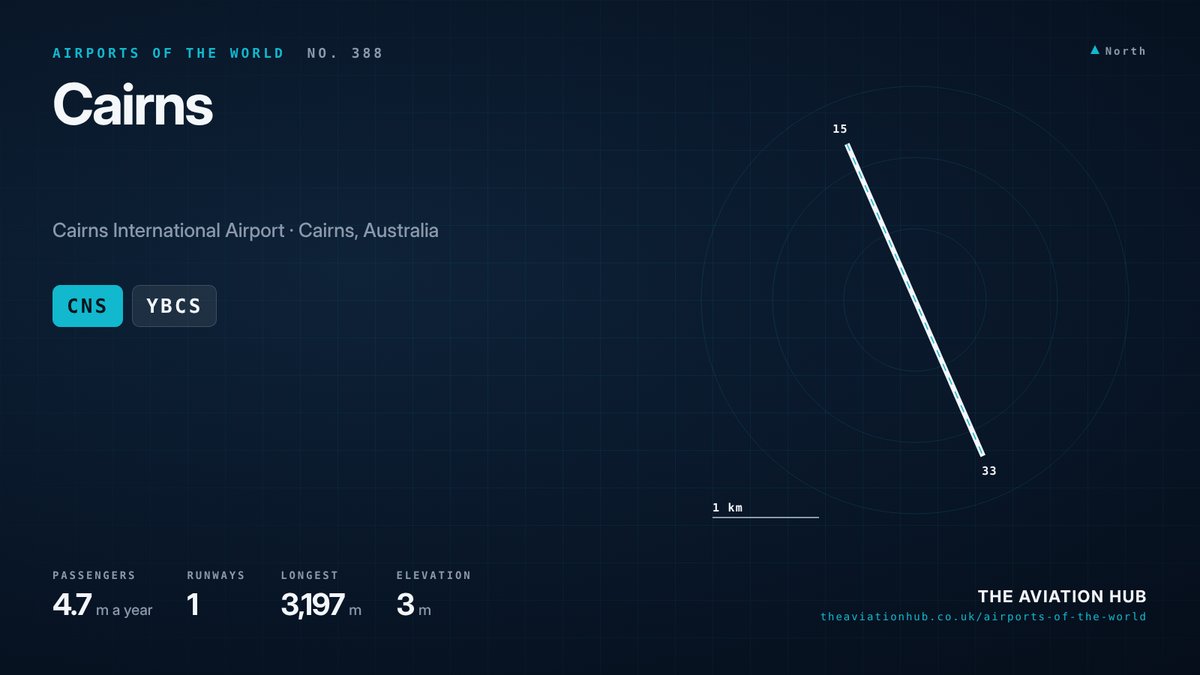
The IATA code is CNS and the ICAO code is YBCS. The airport lies about 4 miles (7 km) north of the Cairns city centre, at an elevation of just 3 m (10 ft). It has one main runway and two terminals, one international and one domestic. Cairns Airport recorded 4,875,498 passengers in 2025, most of them on domestic flights. Qantas, Jetstar and Virgin Australia carry most of the traffic. North Queensland Airports, which also runs Mackay, operates the site. Flight times and services appear on the airport’s official website.
How Cairns Took to the Air
The airfield served a small coastal town until the Second World War changed everything. The Australian Government acquired it for the Royal Australian Air Force, and in 1942 the US Army Air Forces used it as a transport base during the campaigns in New Guinea and the Coral Sea region.
After the war, Cairns developed as a tourist town, and Cairns Airport grew with it. The runway was extended in the 1980s to 2,600 m, at the time making it the longest in Queensland, and international flights from Japan and elsewhere followed. Qantas subsidiary Australian Airlines made the field its main base until the airline closed in June 2006.
The domestic terminal was rebuilt between 2007 and 2010 at a cost of around A$200 million (about £100 million). A short general aviation runway, 12/30, closed by April 2011. It became a helipad, and part of it now lies beneath a freight distribution centre.
Runways at Cairns Airport
The single main runway, 15/33, is 3,197 m (10,489 ft) long and 45 m wide with an asphalt surface. It comfortably handles wide body aircraft such as the Boeing 787 and Airbus A330. The south easterly trade winds blow for much of the year, so Runway 15 is often in use.
The northern flight path runs over the beaches north of the city, and the southern path crosses central Cairns and Trinity Inlet. Mountains rise steeply to the west, which shapes the approach and departure procedures. The low lying site is vulnerable to flooding. In December 2023 Tropical Cyclone Jasper brought torrential rain that closed Cairns Airport for several days, with aircraft and ground equipment left standing in water.
Terminals and Airlines
The two terminals sit side by side. The domestic terminal has five jet bridges and 17 gates, while the international terminal has six jet bridges and ten gates. An A$55 million domestic upgrade in 2019 and 2020 prepared the building for future growth.
Qantas and its regional arm QantasLink run the largest operation, serving capital cities and remote Queensland towns. Jetstar offers low cost flights both domestically and to Japan, and Virgin Australia competes on the trunk routes. Air Niugini links the airport with Port Moresby. The Royal Flying Doctor Service and Queensland Government rescue helicopters are also based at Cairns Airport, alongside reef tour operators flying helicopters and seaplanes.
Routes and Destinations
Cairns Airport serves around 27 domestic and 10 international destinations. Brisbane, Sydney and Melbourne are the busiest routes, with multiple daily services on each. Regional flights reach Horn Island in the Torres Strait, Weipa and other communities that have no practical road link.
Japan is the most important international market, with Jetstar flying to Tokyo and Osaka. Virgin Australia launched a service to Tokyo Haneda in June 2023, but cut it in February 2025 due to weak demand. Other links include Bali, Port Moresby and seasonal flights to New Zealand. Demand peaks in the dry season from May to October, when the reef and rainforest are at their best. The wet season brings quieter months and occasional cyclone disruption.
Getting to and from Cairns Airport
There is no rail link and no metro, though a future bus or rapid transit connection has been proposed. Taxis and ride share cars wait outside both terminals and reach the city centre in around ten minutes, traffic permitting. This short hop is the simplest option for most visitors.
Shuttle buses serve hotels in the city, the Northern Beaches, Palm Cove, Port Douglas and Cape Tribulation. The cheapest way to reach Port Douglas, about an hour north along the coast, is a shared shuttle rather than a private transfer. Car hire desks sit inside both terminals, and short and long term parking is available on site. The Captain Cook Highway passes the entrance to Cairns Airport, linking it with the city and the coast.
Spotting and Photography
Cairns is a rewarding stop for enthusiasts. A mix of domestic jets, international wide bodies, turboprops, helicopters and seaplanes makes for a busy and varied scene. The mangroves along Airport Avenue offer public vantage points near the field, and the Esplanade gives distant views of aircraft over Trinity Bay.
The tropical light is strong, so early morning and late afternoon give the best results. Humidity and heat haze can soften long lens shots by midday. Stay on public paths, respect the mangrove environment and its wildlife, and keep well clear of the fence at Cairns Airport. Follow any instruction from security staff and Australian Federal Police officers.
What Comes Next
An A$55 million upgrade of the international terminal began in 2023 and is being delivered in stages. The airport is also developing the Cairns Regional Trade Distribution Centre, a freight hub announced in 2022, and has committed to running on 100 per cent renewable energy. The freight hub is intended to help exporters send seafood and tropical produce straight to Asian markets from the far north.
Planning assumes around six million annual passengers from 2027. Rebuilding international routes, especially to Asia, is the main priority, as tourism from Japan and China has been slower to recover than domestic travel. Cairns remains essential to both tourism and remote communities, and its growth looks secure. Compare it with other gateways on the Airports of the World map.
Continue to follow The Aviation Hub for more analysis and insight.
Advertise with us Your brand, in front of an aviation audience Home page and in-article placements, sold directly, one advertiser per slot. From £250 a year. See the rates

