
Norfolk Airport Guide: Hampton Roads Gateway Explained
Norfolk Airport serves Hampton Roads and coastal Virginia. Read about its history, runways, airlines, busiest routes, transport links and upgrade plans.
 By The Aviation Hub
5 min read
Updated October 20, 2026
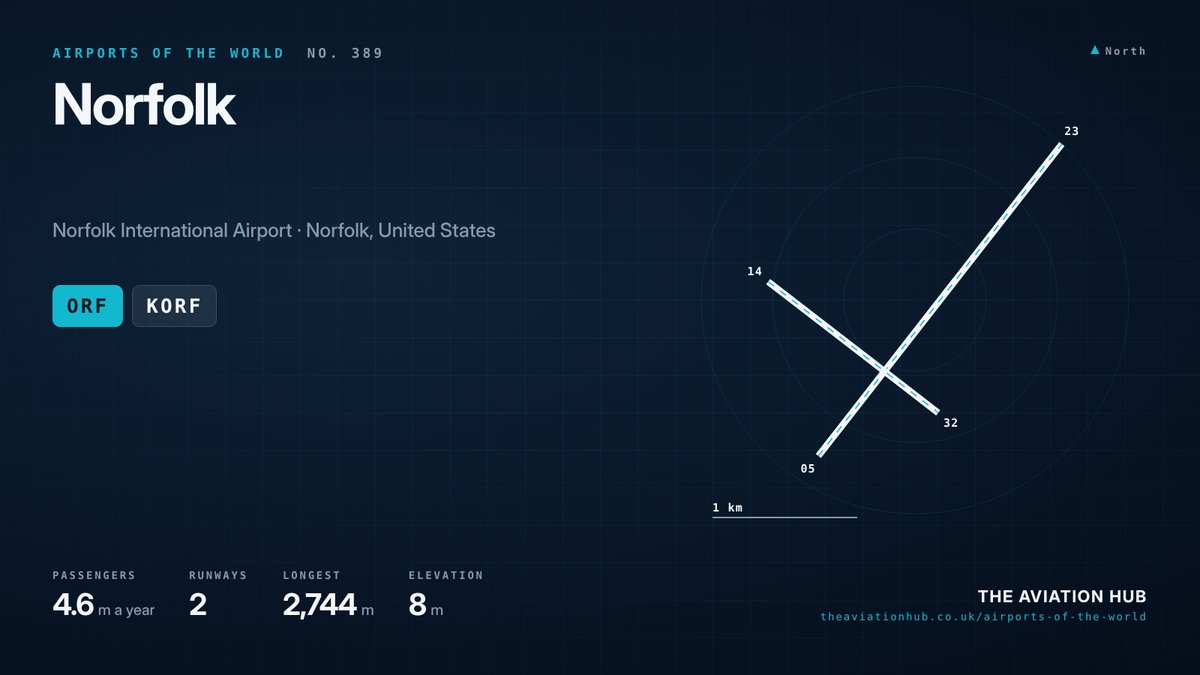
Hampton Roads is a metropolitan area of around 1.8 million people, home to Norfolk, Virginia Beach, Chesapeake and a huge concentration of US Navy bases. Norfolk Airport, formally Norfolk International Airport, is its main air gateway. It handled almost 4.9 million passengers in 2025. The field sits beside a botanical garden and a lake, and it is now midway through a billion dollar modernisation that has already brought back international flights.
Norfolk Airport at a Glance
The IATA code is ORF and the ICAO code is KORF. The airport lies about 7 miles (11 km) northeast of downtown Norfolk, at an elevation of just 8 m (26 ft). It has one active runway and a terminal complex with two concourses, A and B. Passenger numbers reached 4,892,594 in 2025, up 0.6 per cent on the previous year, and the FAA classes it as a small hub. Breeze Airways has a base here, while Delta, Southwest and American carry the largest shares. The Norfolk Airport Authority runs the site, and details of current services are on the airport’s official website.
How Norfolk’s Airport Came to Be
Commercial flying reached Norfolk in 1926, when the Mitten Line began a short lived service. The Great Depression then halted scheduled flights for about five years. Norfolk Municipal Airport opened in 1938 on the site of the former Truxton Manor Golf Course, and its first passenger terminal was completed in 1940.
The Second World War and the naval build up transformed demand. By the early 1950s Norfolk had more daily flights than New York LaGuardia. The airport became Norfolk Regional in 1968, recognising its role across the wider area. A new terminal was dedicated in 1974, and the international title followed around the same time.
Accidents have been rare. In 1967 a United Vickers Viscount struck a snow plough that had strayed onto the runway, and all 50 people aboard survived. Modern Norfolk Airport took shape in later decades, as a separate departures terminal was added and a large parking garage opened in 2002.
Runways at Norfolk Airport
The main runway, 05/23, measures 2,744 m (9,001 ft) long and 46 m wide, with an asphalt surface. It now handles every movement. It runs southwest to northeast and is long enough for any narrow body airliner, as well as the occasional wide body military charter.
The crosswind runway, 14/32, measured 1,486 m (4,876 ft). By the 2020s it handled only about one per cent of operations and was too short for most aircraft in service. Norfolk Airport closed it in August 2025. The land will make room for a de icing facility, cargo expansion and the straightening of Robin Hood Road. A rehabilitation of Runway 05/23 is part of the wider upgrade programme. Low lying ground and coastal weather mean fog and thunderstorms can cause delays.
Terminals and Airlines
Passengers check in at the departures terminal and pass through to two concourses. Concourse A, gates 1 to 9, hosts American Airlines and Southwest. Concourse B, gates 16 to 30, serves Breeze Airways, Delta, Frontier and United. A separate arrivals terminal handles baggage claim and ground transport.
Delta was the largest airline at Norfolk Airport in 2025 with about 18 per cent of passengers, ahead of Southwest at 16 per cent and American at 15 per cent. Breeze is the local success story. The airline chose Norfolk as an early base and uses mainly Airbus A220-300 jets on point to point routes that lacked nonstop service. International flights use Gate A1.
Routes and Destinations
Atlanta is the busiest route, with more than 442,000 passengers in 2025, reflecting Delta’s strength. Charlotte follows at about 248,000, then Baltimore, Dallas Fort Worth and Chicago O’Hare. Florida and New York routes are also important.
Breeze fills the gaps with nonstop flights to leisure cities and smaller markets. A new Breeze link to Southwest Florida has also been announced. In January 2026 Breeze began flying to Cancún, the first international commercial service from the airport since 2001. The large military population creates steady travel demand year round, as personnel and their families move between postings, while summer adds visitors heading for Virginia Beach and the Outer Banks.
Getting to and from Norfolk Airport
There is no rail or light rail link, and no bus enters the terminal area. The nearest Hampton Roads Transit stop, on Route 15, is about 1.5 miles (2.4 km) away, so public transport is not a realistic choice. Almost everyone travels by car.
Interstate 64 runs close to the airport, and downtown Norfolk is about 15 minutes away. The Virginia Beach Oceanfront takes 25 to 30 minutes outside rush hour. Taxis, Uber, Lyft and an authorised shared shuttle collect from the arrivals terminal, where rental car counters are also located. A nine level garage opened in 2002 with 2,800 covered spaces, and total parking at Norfolk Airport runs to around 7,000 vehicles. The economy lots offer the cheapest sensible option for longer trips.
Spotting and Photography
The setting is unusually green. The Norfolk Botanical Garden borders the airfield, and visitors to the garden can catch aircraft from some of its paths. Lake Whitehurst lies beside the runway, giving open views across the water on approach.
The fleet mix is mainly regional jets, Airbus A320 family types, Boeing 737s and Breeze A220s, with occasional military charters linked to the naval bases. Morning light suits the southern side of the field. Stay on public land and inside the garden’s rules, do not stop on airport roads, and follow any request from Norfolk Airport police without argument.
What Comes Next
The Transform ORF programme began in 2018 and has more than one billion dollars allocated for capital projects. Planned work includes a new Sky Bridge with moving walkways, a unified ticketing hall, an expanded Concourse A, renovated arrivals areas and a consolidated rental car facility. A new customs and border facility will support international growth, and a Courtyard by Marriott hotel is planned on site.
The return of international flights marks a turning point. Breeze’s continued expansion is the biggest variable for new routes at Norfolk Airport, and the new customs facility will decide how far the international network can grow beyond Cancún. With steady military and leisure demand, the airport looks set for gradual and well funded growth. See how it compares on the Airports of the World map.
Continue to follow The Aviation Hub for more analysis and insight.
Advertise with us Your brand, in front of an aviation audience Home page and in-article placements, sold directly, one advertiser per slot. From £250 a year. See the rates

