
Tbilisi Airport Guide: Georgia’s Gateway Between Continents
Tbilisi Airport is the main gateway to Georgia and the Caucasus. Explore its Soviet roots, runway, airlines, busiest routes and links to the city centre.
 By The Aviation Hub
5 min read
Updated October 20, 2026
Georgia’s tourism boom has been one of the big travel stories of the past decade, and its capital’s airport has grown with it. Tbilisi Airport, officially Shota Rustaveli Tbilisi International Airport, lies on the eastern edge of the city on the road to the Kakheti wine country. It handled more than 4.75 million passengers in 2024, a jump of a quarter in a single year. Its network now stretches from Europe to the Gulf and Central Asia.
Tbilisi Airport at a Glance
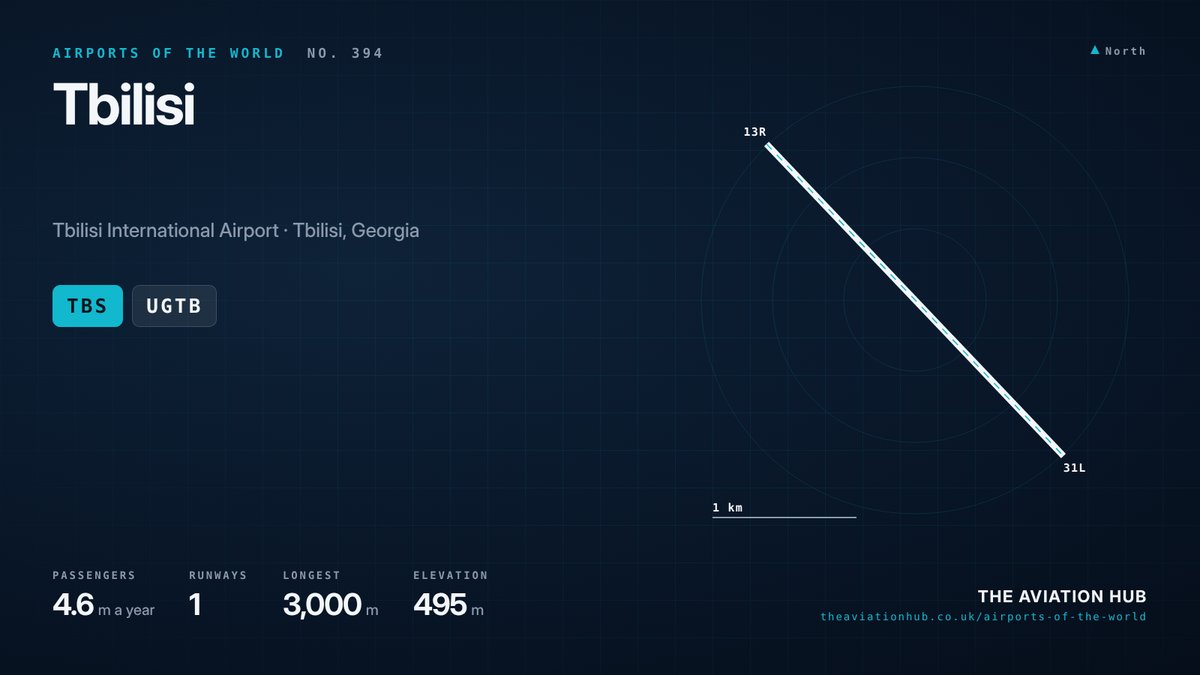
The IATA code is TBS and the ICAO code is UGTB. The airport lies about 11 miles (17 km) southeast of central Tbilisi, at an elevation of 495 m (1,624 ft). It has one active runway, a second runway that is closed, and a terminal complex built around a 2007 international building. Tbilisi Airport recorded 4,750,830 passengers in 2024, up 25 per cent on 2023, making it the busiest international airport in Georgia. Georgian Airways and MyWay Airlines use it as a hub, and the cargo carriers Camex and Geosky are based here. TAV Airports runs the site through TAV Urban Georgia, under a concession extended to at least 2027.
A Short History of Tbilisi Aviation
The oldest surviving building dates from 1952. Built in the grand Stalinist style, that first terminal now serves as a VIP lounge. A second terminal opened in 1968 as Soviet air travel boomed, and by 1981 Tbilisi was the twelfth largest airport in the Soviet Union.
Independence brought collapse. Civil war and economic crisis cut traffic to just 230,000 passengers by 1998. The early 1990s were also dangerous years for aviation here. In 1992 an overloaded Tupolev Tu-154 cargo flight, carrying about 20 tonnes of tea, overran the runway on take off and crashed, killing 24 people aboard and four on the ground.
Recovery began with a 90.5 million dollar reconstruction led by TAV, which delivered a new international terminal, apron, taxiway and runway work in 2007. In 2015 the city assembly named the airport after Shota Rustaveli, Georgia’s great medieval poet. A new arrivals terminal of about 12,000 square metres followed in 2017, lifting capacity at Tbilisi Airport to around 3.5 million passengers a year.
Runways at Tbilisi Airport
The active runway is 13R/31L, a concrete strip 3,000 m (9,843 ft) long and 45 m wide. It was renovated in 2016, when the navigation lighting was also upgraded. The length comfortably handles narrow body jets and wide body aircraft on routes to the Gulf and Europe.
A parallel runway, 13L/31R, measures 2,500 m (8,202 ft) with an asphalt surface but is closed. Plans exist to rebuild it to international standards for the largest aircraft types, though no timeline has been set. The field lies on an open plateau east of the city, with the Greater Caucasus visible to the north on clear days. Hot summers reduce aircraft performance at this elevation, which can matter for heavier departures.
Terminals and Airlines
Passengers use an integrated complex. The 2007 international terminal handles departures, and the 2017 extension added a dedicated arrivals hall. The 1968 building is no longer in public use, while the 1952 original survives as a VIP facility.
Georgian Airways, the national flag carrier, flies a small fleet of Boeing and Embraer jets from its Tbilisi Airport base. MyWay Airlines adds Georgian capacity to Europe and the Middle East. Foreign carriers do most of the flying, with Turkish Airlines and Pegasus on the busy Istanbul routes, flydubai and Qatar Airways from the Gulf, and Lufthansa and LOT among the European airlines. Azerbaijan Airlines serves Baku, and Israeli carriers fly to Tel Aviv.
Routes and Destinations
Istanbul is the dominant route from Tbilisi Airport, with around 52 flights a week. Tel Aviv, Dubai, Baku and Yerevan follow with about 21 to 23 weekly services each. The network reaches more than 25 countries across Europe, the Middle East and Central Asia.
Politics shapes the map. Russia banned flights to and from Georgia in July 2019, and services were suspended for years before a limited resumption. Traffic collapsed by 84 per cent in 2020 when Georgian airspace was closed for much of the year. The recovery since has been striking, driven by tourism, the Georgian diaspora and travellers relocating from neighbouring countries. Summer peaks are pronounced, as visitors head for the mountains, the Black Sea coast and the vineyards of Kakheti.
Getting to and from Tbilisi Airport
The main road link is George W. Bush Avenue, part of the Kakheti Highway, which runs directly into the city. Taxis and app based cars reach the centre in around 25 to 30 minutes outside rush hour, and fares are low by European standards. Using an app avoids haggling.
The cheapest option is the city bus, which runs from the terminal to central Tbilisi and the main railway station. A rail link exists, but with only two trains a day in each direction it is of little practical use. A planned metro extension to Tbilisi Airport was announced in 2018 but effectively abandoned in 2021. Car hire desks sit in the arrivals hall, and further information is on the airport’s official website.
Spotting and Photography
Georgia is generally relaxed towards visitors, but airports remain secure sites and caution is wise. The open land around the field offers views of arrivals and departures, and the terminal provides glimpses of the apron.
The mix is interesting, with Georgian Airways Embraers, Turkish narrow bodies, Gulf carriers and freighters from Camex and Geosky. Many flights arrive and depart in the small hours, so night photography is part of the routine. Stay on public land around Tbilisi Airport, avoid any military or government areas and stop immediately if asked by police or security staff.
What Comes Next
With traffic already well above the 3.5 million capacity set in 2017, the terminal is under pressure. Rebuilding the second runway would give the airport room for long haul growth. The TAV concession runs to at least 2027, and the shape of any longer term deal will decide how quickly new capacity arrives.
Georgia’s tourism boom shows little sign of fading. Kutaisi, in western Georgia, hosts Wizz Air’s main Georgian base and absorbs much of the low cost demand, so the two airports serve different markets to a degree. Expect Tbilisi Airport to remain the country’s main international gateway, with growth limited mainly by terminal space. Explore more airports on the Airports of the World map.
Continue to follow The Aviation Hub for more analysis and insight.
Advertise with us Your brand, in front of an aviation audience Home page and in-article placements, sold directly, one advertiser per slot. From £250 a year. See the rates

