
Nassau Airport Guide: The Bahamas’ Main Island Gateway
Nassau Airport is the main gateway to the Bahamas. Discover its wartime origins, runways, terminals, airlines, US preclearance, routes and transport.
 By The Aviation Hub
5 min read
Updated October 20, 2026
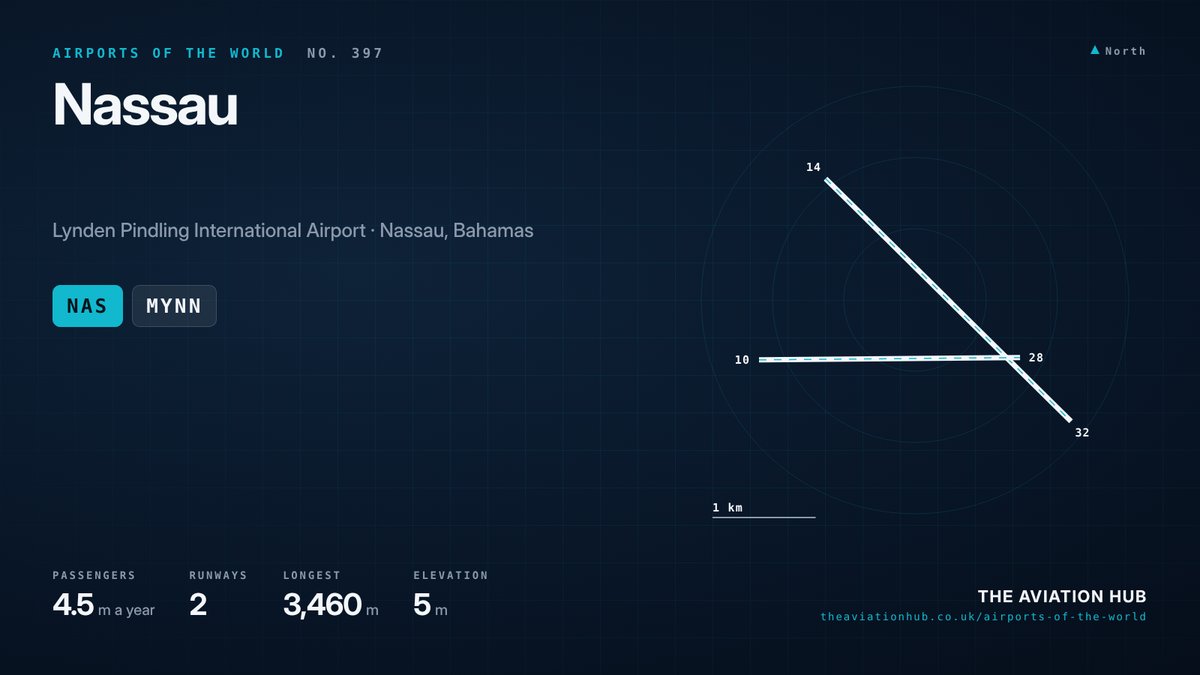
For most visitors to the Bahamas, the holiday begins on the western side of New Providence island. Nassau Airport, officially Lynden Pindling International Airport, is the country’s largest airport and its main international gateway. It handles more than four million passengers a year, most of them flying in from the United States and Canada. It is also the hub for domestic flights to dozens of Family Islands, making it the centre of a scattered island nation’s air network.
Nassau Airport at a Glance
The IATA code is NAS and the ICAO code is MYNN. The airport lies about 8 miles (13 km) west of downtown Nassau, at an elevation of 5 m (16 ft). It has two runways and a terminal complex split into US departures, international departures, a combined US and international arrivals building and a domestic terminal. Nassau Airport handled about 4.1 million passengers in 2019 and has grown since. Bahamasair is the national airline and main hub carrier, with Pineapple Air, Western Air, Flamingo Air and Southern Air Charter also based here. The Nassau Airport Development Company manages the site.
How Nassau’s Airport Came to Be
The field began as a wartime Royal Air Force station. On 30 December 1942 it was named Windsor Field, after the Duke of Windsor, who was then Governor of the Bahamas. The RAF used it for training and ferry flights until 1946, when it returned to civilian hands.
For years the main airport was Oakes Field, closer to the city and named after the gold magnate Sir Harry Oakes. That changed in November 1957, when Nassau International Airport opened on the Windsor Field site and took over all scheduled flights. Oakes Field later became the Thomas Robinson Stadium. Tourism boomed through the jet age, and the airport grew with it.
On 6 July 2006 the airport was renamed after Sir Lynden Pindling, the first Prime Minister of the Bahamas, who led the country from 1967 to 1992. That year the Nassau Airport Development Company took over management, signing a ten year agreement with YVR Airport Services, now Vantage Airport Group. By 2011 Nassau Airport had passed its design capacity, which set the stage for a major rebuild.
Runways at Nassau Airport
Two asphalt runways cross the field. The main runway, 14/32, measures 3,460 m (11,353 ft) long and 46 m wide. It handles wide body jets from Europe and the bulk of airline traffic. The secondary runway, 10/28, is 2,522 m (8,273 ft) long and also 46 m wide.
The easterly trade winds that blow across the Bahamas for much of the year mean the east to west runway, 10/28, sees regular use, especially by smaller domestic aircraft. Both runways sit barely above sea level on flat limestone ground. Summer thunderstorms and the hurricane season from June to November bring the main weather risks. When major storms approach, airlines often pull aircraft out and the airport may close for a period.
Terminals and Airlines
The redevelopment came in three stages. A new US Departures Terminal opened first, followed by a renovated US and International Arrivals Terminal, and finally a new domestic terminal and an international departures building. The first stage was completed in March 2011, with total investment of around 409.5 million dollars (roughly £320 million).
US Customs and Border Protection runs preclearance at Nassau Airport, so passengers bound for the United States clear immigration before departure and arrive as domestic travellers. American Airlines, Delta, United, JetBlue and Southwest provide the bulk of US flights. Air Canada, WestJet and Porter serve Canada, British Airways flies to London Heathrow and Copa links Nassau with Panama City. Breeze has also added routes.
Routes and Destinations
Florida dominates. Miami, Fort Lauderdale and Orlando have the most frequent services, many of them short hops of under an hour. Atlanta, Charlotte, New York JFK, Newark, Boston, Philadelphia and Houston connect the islands with the wider United States.
Toronto and Montreal are the key Canadian links, especially in winter, when the season peaks between December and April. Christmas and the spring break weeks bring the heaviest loads of the year. London Heathrow, served by British Airways, is the long haul highlight at more than 4,000 miles (6,400 km). Domestic flights are vital. Bahamasair and the smaller local airlines fly from Nassau Airport to Grand Bahama, Exuma, Eleuthera, Abaco, Andros and many other islands, often in turboprops and light twins.
Getting to and from Nassau Airport
There is no rail on New Providence. Taxis are the standard option, with government set fares by zone for the trip to Cable Beach, downtown Nassau and Paradise Island. Cable Beach takes about 15 minutes, while downtown is roughly 25 to 30 minutes.
Paradise Island, home to the large resorts, is usually 35 to 45 minutes away depending on traffic. The local jitney buses are the cheapest choice for the budget minded, though they generally do not serve the terminal directly and require a walk to the main road. Many hotels arrange transfers, and car hire desks sit in the arrivals hall. Driving is on the left. Check current information on the airport’s official website.
Spotting and Photography
Nassau offers a colourful mix of traffic. US airline narrow bodies dominate, but British Airways wide bodies, Bahamasair ATRs and a crowd of small domestic turboprops keep things varied. The turquoise water and bright sky make for striking images on approach.
Public viewing options are limited, so the terminal windows are the easiest place to log movements at Nassau Airport. Some roads near the perimeter give views of arrivals. Strong midday sun can flatten images, so early morning and late afternoon light works best. Stay on public land, avoid restricted areas, and follow any instruction from the police or airport staff.
What Comes Next
The redevelopment was designed for around 5.2 million passengers a year by 2020, and traffic is approaching that level. New routes from Porter, Delta, Breeze and United show continued airline confidence, and further terminal improvements will be needed to keep pace. Private aviation is another growth area, with fixed base operators handling a steady flow of business jets from the United States.
Tourism is the backbone of the Bahamian economy, and Nassau Airport is its front door. Expect steady growth led by North American leisure demand, with hurricane season the main source of disruption. Explore more airports on the Airports of the World map.
Continue to follow The Aviation Hub for more analysis and insight.
Advertise with us Your brand, in front of an aviation audience Home page and in-article placements, sold directly, one advertiser per slot. From £250 a year. See the rates

