Few airports have a reputation quite like this one. Madeira Airport, officially Cristiano Ronaldo International Airport, clings to the southeast coast of the Portuguese island, with part of its runway resting on concrete pillars above the shoreline. Pilots need special training to land here, and the approach is one of the most talked about in Europe. It is also booming, with around 5.65 million passengers in 2025, as Madeira’s year round climate draws visitors from across the continent.
Madeira Airport at a Glance
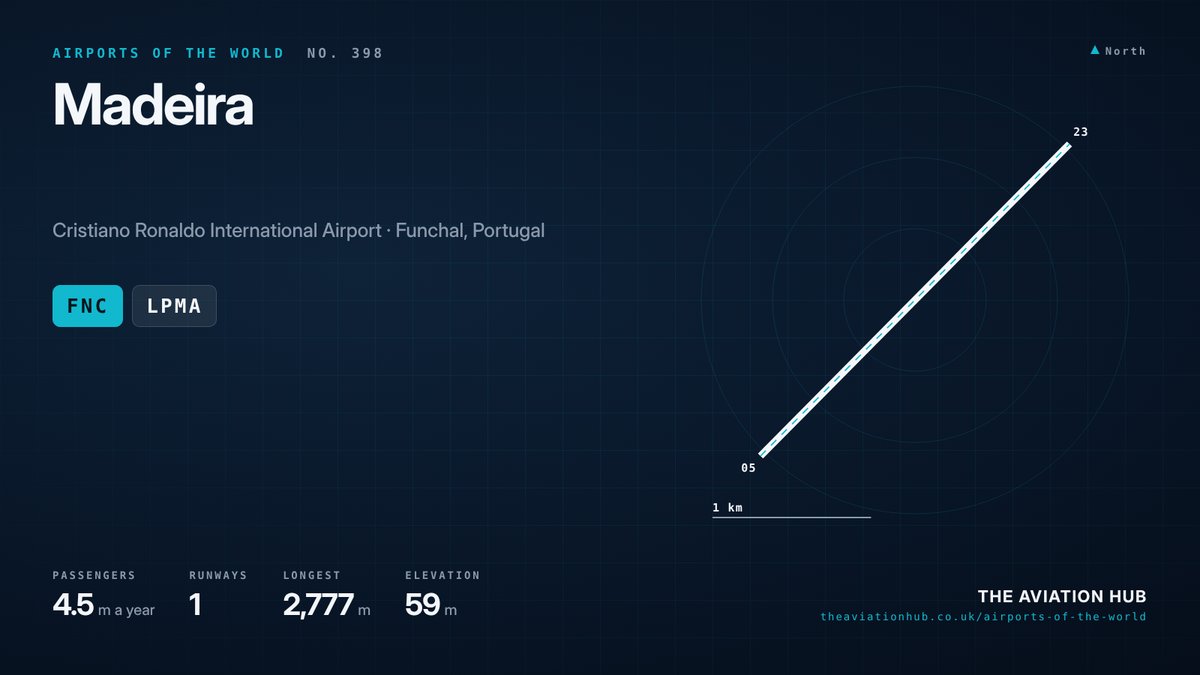
The IATA code is FNC and the ICAO code is LPMA. The airport lies at Santa Cruz, about 8 miles (13 km) northeast of Funchal, at an elevation of 59 m (192 ft). It has one runway and one passenger terminal. Madeira Airport handled about 5,653,000 passengers and 38,742 aircraft movements in 2025, up 12 per cent on 2024. That made it Portugal’s fourth busiest airport. TAP Air Portugal treats it as a focus city and Ryanair runs a base. ANA Aeroportos de Portugal, part of the VINCI Airports group, operates the site.
How Madeira’s Airport Came to Be
Madeira Airport opened on 8 July 1964 as Santa Catarina Airport, with a runway of just 1,600 m. The first landing was a TAP Lockheed Constellation carrying 80 passengers. A terminal followed in 1973, but the short runway left little margin for error.
The worst disaster came on 19 November 1977, when TAP Flight 425, a Boeing 727, overran the runway in heavy rain and fell onto the beach below. Of the 164 people aboard, 131 died. Weeks later, SATA Flight 730 crashed into the sea on approach, killing 36 of 57. A Caravelle had also been lost in 1973, and a Beechcraft crashed after take off in 2003.
The runway was extended in 2000 on a vast platform built partly over the ocean, and a new terminal followed. The structure won the Outstanding Structure Award in 2004. In 2016 the government announced that the airport would honour Cristiano Ronaldo, born in Funchal, and the new name was official by 2017. The accompanying bust of the footballer drew ridicule worldwide.
Runways at Madeira Airport
A single asphalt runway, 05/23, handles every flight. It measures 2,777 m (9,110 ft) long and 45 m wide. This is a tabletop runway, with steep drops at both ends, and the 23 end sits on a platform supported by tall concrete pillars beside the sea.
The approach is what makes Madeira Airport famous among pilots. There is no instrument landing system, so crews fly a visual approach. Landing on Runway 05 involves a sharp turn onto a very short final, with mountains close by on one side and the ocean on the other. Captains need additional airport specific training. Wind shear and gusts from the mountains frequently exceed limits, and diversions to Porto Santo, Lisbon or the Canary Islands are common in strong winds. The airport is sometimes compared with Hong Kong’s old Kai Tak.
Terminals and Airlines
The terminal, renovated in 2016 at a cost of about €11 million (roughly £9.5 million), has 40 check in desks, 16 gates and seven baggage belts. There are no air bridges, so passengers walk or take a bus to the aircraft. It can process up to 1,400 passengers an hour.
TAP and easyJet carry large shares of traffic, with Ryanair, Jet2 and TUI also prominent. Binter links Madeira Airport with Porto Santo and the Canary Islands. A long list of European airlines serve the island, including British Airways, Transavia, Eurowings, Condor, Edelweiss, Finnair, Luxair, Austrian, airBaltic, Smartwings and Wizz Air. United has added a seasonal link with the United States.
Routes and Destinations
Lisbon is the busiest route from Madeira Airport by a wide margin, carrying more than 1.35 million passengers in 2023. Porto followed with almost 627,000, and London Gatwick was third at about 206,000. Madeira’s status as an autonomous region of Portugal keeps demand to the mainland strong all year.
Unlike most southern European holiday islands, Madeira has a gentle climate year round, so winter is a busy season rather than a lull. British, German, Dutch, Scandinavian and Polish visitors arrive in large numbers. Jet2 starts a seasonal London Gatwick service from 26 October 2026, adding more competition on a key route. Swiftair operates cargo flights to Lisbon. Neighbouring Porto Santo is also reachable by ferry from Funchal, but the Binter hop takes only around 20 minutes against more than two hours by sea.
Getting to and from Madeira Airport
There is no rail on Madeira. The fast VR1 expressway runs along the south coast, and a taxi to central Funchal usually takes 20 to 25 minutes from the rank outside arrivals.
The cheapest option is the bus, with regular services, including those run by SAM, linking the terminal with Funchal and the eastern towns in around 30 to 45 minutes. Many hotels arrange transfers. Car hire is popular, as the island’s mountain roads and viewpoints are best explored independently. Machico and Santa Cruz are only a few minutes from Madeira Airport. Parking sits directly in front of the terminal, and flight information is available on the airport’s official website.
Spotting and Photography
The airport is a magnet for enthusiasts. Viewpoints on the hills above the runway, and roads around Santa Cruz and Machico, look down on aircraft turning onto final. From below, the forest of pillars supporting the runway extension is a striking sight in its own right.
Windy days bring go arounds and dramatic landings at Madeira Airport, which draw photographers in numbers. The sun sits behind the aircraft for much of the day when seen from the hills, so early and late light work best. Stay on public land, do not stop on the expressway, and follow any instruction from the police or airport staff.
What Comes Next
Traffic keeps setting records, and the terminal is under pressure at peak times. The runway cannot easily grow again given the terrain and sea, so improvements will focus on the terminal, apron and wind forecasting tools to cut diversions.
Madeira’s year round appeal and strong links with mainland Portugal give Madeira Airport a firm future. Expect continued growth from low cost carriers, balanced against the limits set by geography and wind. Compare it with other dramatic approaches on the Airports of the World map.
Continue to follow The Aviation Hub for more analysis and insight.
Advertise with us Your brand, in front of an aviation audience Home page and in-article placements, sold directly, one advertiser per slot. From £250 a year. See the rates