
Jakarta Halim Airport Guide: The Capital’s Second Gateway
Jakarta Halim Airport mixes air force jets, state visits and Batik Air flights. Read our guide to its runway, terminals, routes and the Whoosh rail link.
 By The Aviation Hub
6 min read
Updated October 20, 2026
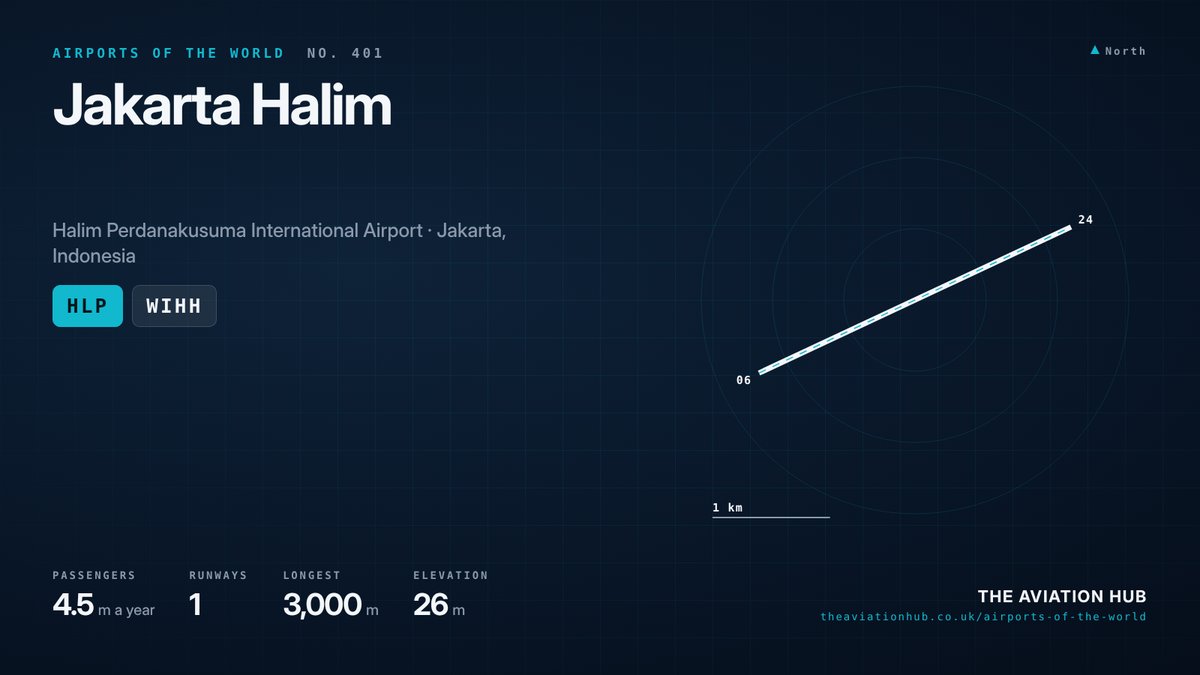
Halim Perdanakusuma sits in East Jakarta, a working air force base that doubles as the Indonesian capital’s second commercial airport. Jakarta Halim Airport handled around 3.4 million passengers in 2024, a fraction of the traffic at Soekarno Hatta, but its location inside the city wins it loyal business travellers. It also handles state visits, VIP flights and a busy military schedule. Presidential jets, Hercules transports and low cost A320s share one runway, and that mix is what makes Halim distinctive.
Jakarta Halim Airport at a Glance
The IATA code is HLP and the ICAO code is WIHH. The airfield lies roughly 7.5 miles (12 km) southeast of central Jakarta, at an elevation of 26 metres (84 feet). It has one runway and a single main passenger terminal, plus separate VIP and VVIP terminals for government traffic. Jakarta Halim Airport recorded about 3.43 million passengers in 2024, down almost 10 per cent on 2023, along with roughly 55,000 tonnes of cargo.
Batik Air uses the field as a hub, Citilink runs a sizeable operation and Susi Air flies light aircraft into West Java. The Indonesian Air Force owns the base. Civil operations fall to the state airport operator Angkasa Pura, now part of the InJourney group. Timetables, parking details and terminal maps are on the airport’s official website.
How Jakarta’s Second Airport Came to Be
The site began around 1924 as Tjililitan Airfield, named after the surrounding district of Dutch ruled Batavia. Civil flying started in 1928 when the colonial airline KNILM moved in. A year later a KLM flight from the Netherlands set an intercontinental record on arrival here. Japanese forces attacked the field in February 1942 as Allied forces tried to hold Java.
After independence the base was renamed on 17 August 1952 for Halim Perdanakusuma, an air force officer and national hero who died in 1947. In 1965 it served as the headquarters of the 30 September Movement plotters until the army retook it on 2 October. International flights moved in from crowded Kemayoran in 1974. Once Soekarno Hatta opened in 1985, the airlines left and Halim reverted largely to military, charter and VIP use.
The turning point came in January 2014, when scheduled domestic flights returned to relieve Soekarno Hatta. Citilink led the way and Batik Air followed. A renovation in 2022 cost about 500 billion rupiah (roughly £24 million) and moved commercial flights away from Jakarta Halim Airport while it ran. The work enlarged the apron, grew the arrivals hall by around 30 per cent and added a third baggage belt.
Runways at Jakarta Halim Airport
Everything happens on a single strip, Runway 06/24. It measures 3,000 metres (9,843 feet) long and 45 metres wide, with an asphalt surface. Five taxiways link it to a northern and a southern apron. The length comfortably suits the Airbus A320 and Boeing 737 family jets that dominate civil traffic, as well as wide body aircraft on state visits.
Jakarta Halim Airport has no parallel runway, so military sorties, VIP movements and scheduled flights all share the same pavement. A state arrival can briefly hold up airline traffic. The runway also earned a place in aviation history on 24 June 1982. British Airways Flight 9, a Boeing 747, lost all four engines in volcanic ash from Mount Galunggung, restarted them and landed safely here on three engines.
Terminals and Airlines
Airline passengers use one main terminal, compact by Jakarta standards and quick to navigate. The Naratama VIP terminal and the Naratetama VVIP terminal stand apart and process government delegations, heads of state and senior officials. Military units work from their own facilities around the airfield, including squadrons flying the Lockheed C-130 Hercules.
Batik Air, the full service arm of Lion Group, is one of the two main civil operators and flies Airbus A320 family jets. Citilink, the low cost subsidiary of Garuda Indonesia, uses A320 and ATR 72 aircraft. Smaller players include FlyJaya, Susi Air with its Cessna Caravans, and Pelita Air on charter work. Neither Batik Air nor Citilink belongs to a global alliance, so most journeys from Jakarta Halim Airport are simple point to point trips.
Routes and Destinations
The network is domestic and short to medium haul. Batik Air links Halim with Denpasar, Surabaya, Malang and Palembang. Citilink covers Denpasar, Surabaya, Yogyakarta, Padang, Pekanbaru and Malang, plus smaller Sumatran points such as Pagar Alam and Way Kanan. In August 2025 about half of Halim’s scheduled flights moved to Soekarno Hatta, so check which airport your booking uses. Even the longest sectors, to Bali and Padang, take under two hours.
FlyJaya serves Ketapang, Jember and Yogyakarta, while Susi Air hops to Bandung and the coastal resort of Pangandaran. Pelita Air flies charters to Matak in the Anambas Islands for the oil and gas industry. Jakarta Halim Airport also sees frequent ad hoc movements, from foreign air force jets to corporate aircraft. Cargo is modest but growing, with tonnage up almost 17 per cent in 2024.
Getting to and from Jakarta Halim Airport
Rail access was transformed in 2023. Halim station, a short shuttle bus ride from the terminal, is the Jakarta terminus of the Whoosh high speed line to Bandung and a stop on the Jabodebek LRT. Whoosh reaches the Bandung area in about 45 minutes. The LRT runs into central Jakarta through Kuningan towards Dukuh Atas.
The JakLingko JAK20 minibus stops about three minutes’ walk from the terminal, and DAMRI coaches run to Bogor and Bekasi. The Jagorawi toll road and the inner city toll ring meet close by at Cawang. A car to Sudirman takes around 30 minutes on a quiet day and well over an hour at rush hour. Inside the terminal only air force approved taxis may pick up, a policy often criticised for high fares. Bluebird cabs, Grab and Gojek collect outside. For most visitors to Jakarta Halim Airport, the shuttle plus LRT is the cheapest sensible option.
Spotting and Photography
Spotting here comes with a caveat. Jakarta Halim Airport is an active military base, and photographing air force aircraft or installations can draw unwelcome attention. Stick to public areas, keep long lenses discreet and stop immediately if security staff ask. Never climb fences or loiter near gates.
The rewards are unusual. A single afternoon can bring Citilink and Batik Air jets, C-130s, the presidential Boeing 737 and visiting government aircraft from across Asia. Departure lounge windows give the easiest legal views of the civil apron. Runway direction follows the monsoon winds, so check a live flight tracker before choosing a spot. The equatorial sun sits high at midday, so early morning and late afternoon give the best light.
What Comes Next
The 2022 works lifted terminal capacity to around 7 to 8 million passengers a year, more than twice recent traffic. Growth now depends less on concrete than on policy. Commercially, Jakarta Halim Airport exists to relieve Soekarno Hatta, and the government periodically shifts flights between the two. A 33 km express rail link between them remains at the planning stage.
The gradual move of government functions to Nusantara, the new capital in East Kalimantan, could reshape the VIP traffic over time. For now, Halim’s appeal is its location and its unhurried terminal. Expect a steady domestic airport whose value lies in convenience rather than scale. Compare it with other gateways on our Airports of the World map.
Continue to follow The Aviation Hub for more analysis and insight.
Advertise with us Your brand, in front of an aviation audience Home page and in-article placements, sold directly, one advertiser per slot. From £250 a year. See the rates

