
Goa Mopa Airport Guide: India’s Greenfield Beach Gateway
Goa Mopa Airport opened in 2023 to ease pressure on Dabolim. Our guide covers its long runway, airlines, winter charters and how to reach the beaches.
 By The Aviation Hub
6 min read
Updated October 20, 2026
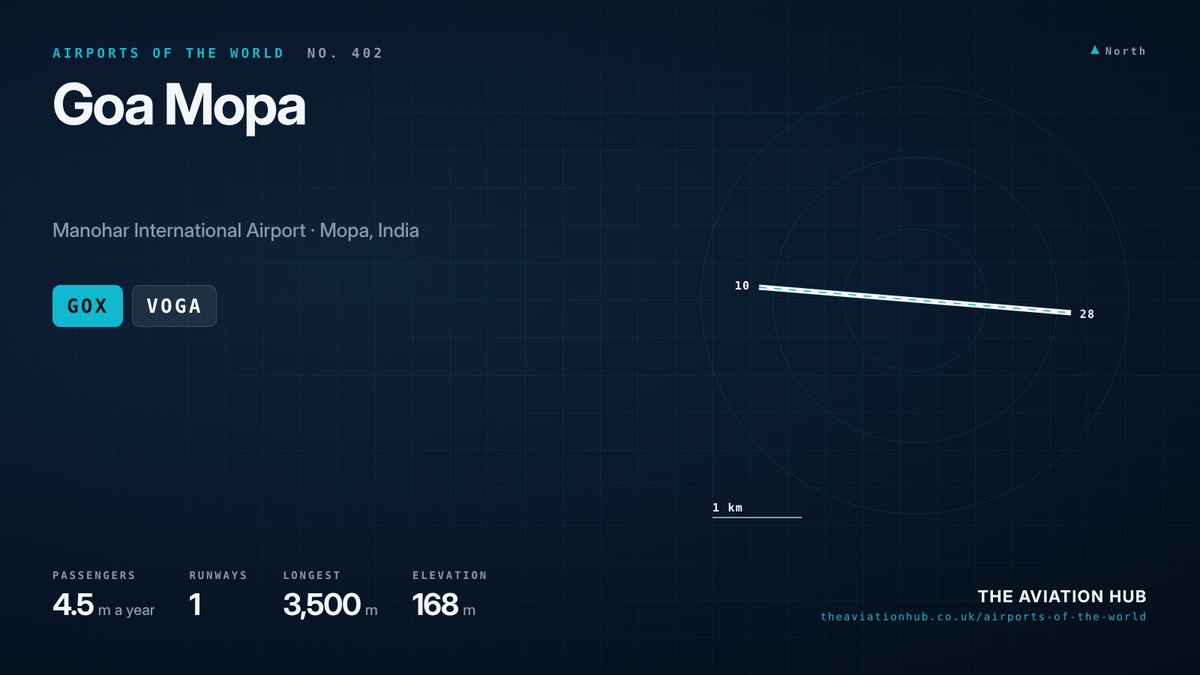
Manohar International Airport opened in January 2023 on a laterite plateau in Pernem, at the northern tip of India’s smallest state. Goa Mopa Airport was built to take pressure off Dabolim, the older field that shares its runway with the Indian Navy. In its third full year it handled more than 5 million passengers. It now sits at the heart of Goa’s tourism economy, from domestic weekenders to winter charters out of Europe and Central Asia.
Goa Mopa Airport at a Glance
The IATA code is GOX and the ICAO code is VOGA. The airport lies roughly 22 miles (35 km) north of Panaji by road, at an elevation of 168 metres (552 feet). It has one runway and one integrated passenger terminal. Goa Mopa Airport handled around 5.4 million passengers in the year to March 2026, up almost 16 per cent, according to Airports Authority of India figures.
IndiGo is the largest carrier, while regional start up Fly91 uses the airport as its home base. GMR Goa International Airport Limited, part of the GMR Airports group, runs the site under a long term concession with the state government. Flight information and transport details are on the airport’s official website.
How Goa’s New Airport Came to Be
The idea is older than the terminal suggests. A second Goan airport won approval in principle from the Vajpayee government in March 2000. Land disputes and litigation then stalled it for around 14 years. The core problem never went away: Dabolim is a naval air station, and civil flights there compete with military flying for slots and apron space.
GMR won the bid in 2016 and signed the concession on 8 November that year. Prime Minister Narendra Modi laid the foundation stone five days later. In January 2019 the Supreme Court halted work over environmental concerns, and construction only resumed in January 2020. The pandemic and labour shortages added more delay.
Modi inaugurated the airport on 11 December 2022 and named it after Manohar Parrikar, the former Goa Chief Minister and Defence Minister. IndiGo flew the first commercial service, from Hyderabad, on 5 January 2023. Air India launched a direct London Gatwick route that July, giving Goa Mopa Airport its first scheduled long haul link. Air India suspended that route in June 2025.
Runways at Goa Mopa Airport
A single runway, 10/28, handles all traffic. It measures 3,500 metres (11,483 feet) long and 45 metres wide, with an asphalt surface. That length gives wide body jets such as the Boeing 787-8 and Airbus A330 plenty of margin for long sectors, even in the heat of April and May.
The elevated plateau site keeps Goa Mopa Airport clear of the dense coastal development that hems in Dabolim. Approaches cross open countryside and cashew plantations rather than rooftops. There is no parallel runway, so departures and arrivals are sequenced on the same strip. With no naval flying to work around, airlines enjoy far more freedom over slot timings than at the older field.
Terminals and Airlines
Everything runs through one integrated terminal that handles domestic and international flights under the same roof. Phase one was designed for around 4.4 million passengers a year, a figure traffic has already passed. Contact stands connect the terminal to the apron by jet bridge, while remote stands handle overflow at peak times.
IndiGo dominates with its Airbus A320neo and A321neo fleet. Air India, Air India Express and Akasa Air provide the main competition, and Star Air adds regional links. Fly91, based here, flies ATR 72-600 turboprops to smaller cities. Foreign carriers include Oman Air, Qatar Airways, Air Arabia, Uzbekistan Airways and Aeroflot. TUI Airways brings seasonal Boeing 787 Dreamliner flights from the UK, and FlyArystan has flown winter charters.
Routes and Destinations
Domestic traffic carries the airport. The heaviest flows run to Delhi, Mumbai, Bengaluru and Hyderabad, with further links to Chennai, Pune, Kolkata and Ahmedabad. Fly91 fills in smaller points that the big carriers ignore. Goa Mopa Airport also serves as a convenient gateway for travellers from southern Maharashtra and northern Karnataka.
Internationally, Gulf routes to Muscat, Doha and Sharjah run year round and feed onward connections. Tashkent, Novosibirsk and Yekaterinburg links reflect Goa’s strong appeal to Russian and Central Asian holidaymakers. Seasonal UK services to London Gatwick and Manchester are the longest on the board, at around ten hours. The calendar is sharply seasonal. October to March is peak season, while the June to September monsoon brings heavy rain and far fewer tourists.
Getting to and from Goa Mopa Airport
Road is the only practical choice. A six lane elevated link, NH166S, opened in July 2024 and connects the terminal directly to the NH66 coastal highway. Allow around an hour to Panaji, a little less to the beaches of Calangute and Baga, and two hours or more to South Goa resorts such as Colva.
The state run Kadamba Transport Corporation operates buses to Panaji, Mapusa and Margao, the cheapest sensible option for travellers with light luggage. Prepaid taxi counters sit outside arrivals, and the state backed GoaMiles app also serves the terminal. There is no rail link. The nearest station is Pernem on the Konkan Railway, a short taxi ride from Goa Mopa Airport. Short and long stay car parks sit in front of the terminal.
Spotting and Photography
The rural setting suits enthusiasts better than crowded Dabolim. Quiet roads around the plateau give glimpses of aircraft on approach, and the open landscape means few obstructions. There is no official viewing terrace, so terminal windows offer the easiest legal views of the apron. Indian airport security is strict, and visitors near the boundary at Goa Mopa Airport should expect to be questioned.
Keep well away from fences, avoid restricted signage and stop photographing if officials ask. Sea breezes off the Arabian Sea often favour westerly operations on Runway 28, though a live tracker settles it. Winter brings the most variety, with TUI Dreamliners, Aeroflot jets and Central Asian charters alongside the IndiGo fleet. Clear skies in the dry season also deliver the best light.
What Comes Next
The concession runs in four phases. Capacity is planned to grow from 4.4 million to around 13.1 million passengers a year by the end of phase four. With traffic already ahead of the phase one design figure, the next terminal expansion looks overdue rather than optional. A 232 acre city side development for hotels and commercial space is also part of the plan.
Road links should improve further if the proposed Nagpur to Goa expressway reaches the area. The bigger question is how airlines split flying between Goa Mopa Airport and Dabolim, which remains open. The verdict is clear enough: Mopa is the long term future of Goan aviation. See how it compares with other Indian gateways on our Airports of the World map.
Continue to follow The Aviation Hub for more analysis and insight.
Advertise with us Your brand, in front of an aviation audience Home page and in-article placements, sold directly, one advertiser per slot. From £250 a year. See the rates

