
Kona Airport Guide: Open Air Gateway to Hawaii’s Big Island
Kona Airport was blasted out of an old lava flow on Hawaii's Big Island. Our guide covers its runway, open air terminals, airlines, routes and access.
 By The Aviation Hub
5 min read
Updated October 20, 2026
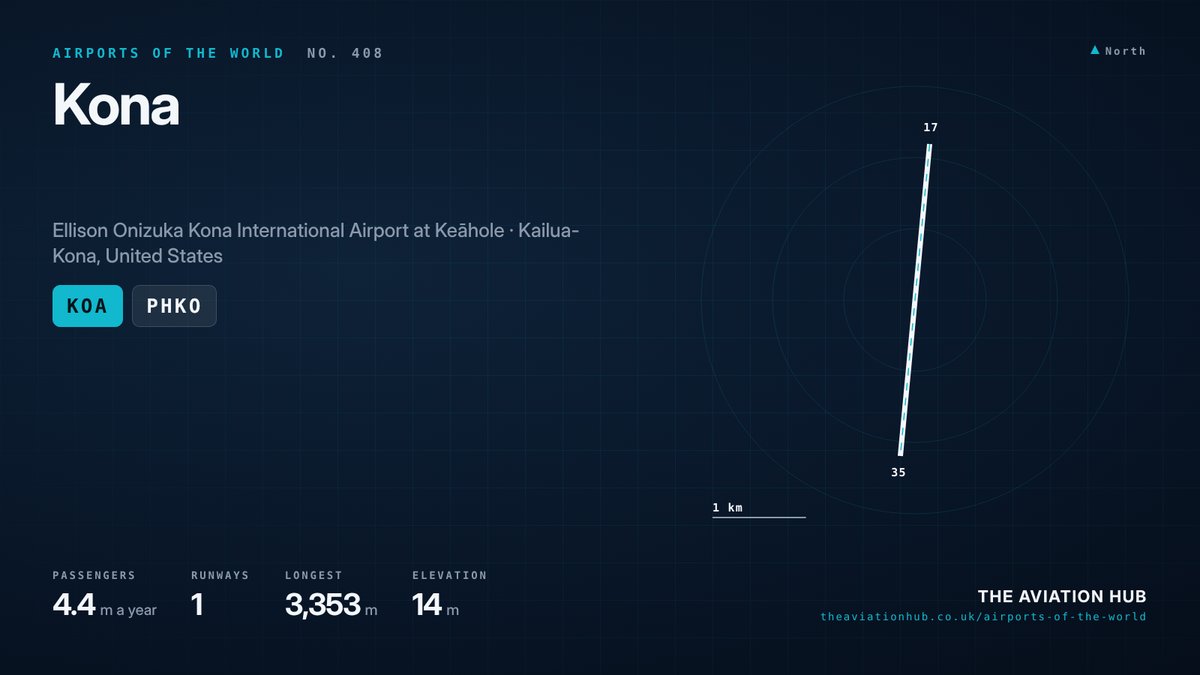
Ellison Onizuka Kona International Airport at Keahole sits on a black lava field on the west coast of Hawaii’s Big Island. Kona Airport handled about 4.2 million passengers in 2025 and is the main gateway to the island’s resort coast. Its open air terminals, with no jet bridges and tropical breezes at the gate, feel very different from a mainland hub. The approach over lava, ocean and the slopes of Hualalai is spectacular.
Kona Airport at a Glance
The IATA code is KOA and the ICAO code is PHKO. The airport lies about 7 miles (11 km) north of Kailua Kona town, at an elevation of 14 metres (47 feet). It has one runway and three terminal areas. Kona Airport recorded roughly 4.17 million passengers, 99,000 aircraft movements and over 57,000 tons of cargo in 2025.
Alaska Airlines carries the largest share of passengers, ahead of United, Southwest and Hawaiian. Hawaiian Airlines and the commuter carrier Mokulele Airlines both treat the field as a hub. The Hawaii Department of Transportation operates the site. Flight and parking information is on the airport’s official website.
How Kona’s Airport Came to Be
Before 1970 the west side relied on a small airstrip in Kailua town, now a beach park. Hilo, on the opposite coast, handled the bigger flights and was a two hour drive away. The state wanted to shift tourism west, so it chose a site on the 1801 Huehue lava flow from Hualalai. That eruption had pushed the shoreline out by about a mile and created Keahole Point.
Building on raw lava was brutal work. Bechtel crews used around three million pounds of dynamite to flatten the flow, which was riddled with lava tubes, in just 13 months. The airport opened on 1 July 1970 with a 6,500 foot runway and handled more than 515,000 passengers in its first full year. The plan worked: by 2005, 86 per cent of the island’s visitor accommodation stood on the west side.
The runway was extended in 1994 to its current length. The name changed several times, from Keahole Airport to Kona International Airport at Keahole in 1997. On 8 January 2017 it was renamed to honour Ellison Onizuka, the Kona born astronaut who died in the Challenger disaster. Most travellers still simply call it Kona Airport.
Runways at Kona Airport
A single runway, 17/35, handles all traffic. It measures 3,353 metres (11,000 feet) long and 46 metres wide, with an asphalt surface. It is the second longest runway in the Hawaiian Islands after Honolulu. That length allows wide body jets to depart with full fuel for the mainland and Asia.
A major rehabilitation temporarily shortened the usable runway to about 7,000 feet, with full length operations restored on 1 October 2025. Pilots must watch for gusty winds, volcanic haze known as vog, and building cumulus over the mountains in the afternoon. The lava surrounding the runway leaves little margin for error, but the approaches are straightforward in good weather.
Terminals and Airlines
The complex is laid out as a collection of low, open air pavilions in a tropical style. Terminal 1 has gates 1 to 5 and Terminal 2 has gates 6 to 10, while Terminal 3 serves small commuter aircraft. A modernisation that began in 2017 merged the main terminals behind a single central security checkpoint. Passengers still board by mobile stairs or ramps, which makes boarding at Kona Airport unusually scenic.
Alaska Airlines flies Boeing 737 jets to Seattle, Portland, San Francisco, Los Angeles and San Diego. Hawaiian, now part of the Alaska Air Group, runs interisland Boeing 717 flights and links to California. United, American, Delta and Southwest serve their mainland markets. WestJet and Air Canada add seasonal Canadian flights, and a new international arrivals facility opened during the pandemic years.
Routes and Destinations
Honolulu is the busiest route, with about 705,000 passengers in the year to June 2026. Los Angeles follows at around 244,000, then Seattle, San Francisco and Kahului on Maui. Interisland flights from Kona Airport take around 40 minutes, while West Coast routes run five to six hours. Southwest also links the Big Island with Las Vegas and Sacramento.
Seasonal routes stretch further. United flies to Chicago O’Hare, more than 4,000 miles (6,400 km) away, and American adds Dallas Fort Worth in peak periods. Vancouver and Calgary are the leading international routes, filled with Canadian sun seekers in winter. Japan links have come and gone, including Japan Airlines flights to Tokyo Narita that resumed in 2022. Cargo matters too, with Amazon Air and Atlas Air flights.
Getting to and from Kona Airport
Most visitors hire a car, and the rental desks sit a short walk or shuttle ride from the terminals. Queen Kaahumanu Highway runs past the entrance, linking the airport with Kailua Kona to the south and the Waikoloa and Mauna Lani resorts to the north. Kailua Kona is about 15 minutes away, the main resorts 25 to 40 minutes, and Hilo around two hours via the Saddle Road.
Taxis, ride hailing and pre booked shuttles also serve the kerbside. Hawaii County’s Hele On buses provide limited service along the coast, the cheapest sensible option but slow and infrequent. Parking is close to the terminal at Kona Airport. Allow extra time when returning a rental car before an evening flight to the mainland.
Spotting and Photography
The open air design is a gift for enthusiasts. Gate areas look straight onto the apron, so 737s, 717s and visiting wide bodies can be seen from a few metres away. Black lava, blue ocean and the green slopes of Hualalai make a striking backdrop. Sunset departures over the Pacific offer the best light of the day.
Public roads near the airport perimeter give views of arrivals, but the lava terrain is rough and unshaded. Carry water, wear sturdy shoes and never cross fences or enter restricted land. Local sea breezes, rather than the trade winds, often decide the runway in use at Kona Airport. A flight tracker is the easiest way to pick the right end.
What Comes Next
With the runway rehabilitation complete, attention at Kona Airport turns to the terminal. The consolidated security checkpoint has eased congestion, and the international arrivals facility opens the door to more Canadian and Asian flights. Further improvements are expected to keep the open air character while adding capacity.
Demand depends on tourism, which rebounded strongly after the pandemic. Expect steady growth and more mainland routes as Alaska and Hawaiian integrate their networks. Explore other island gateways on our Airports of the World map.
Continue to follow The Aviation Hub for more analysis and insight.
Advertise with us Your brand, in front of an aviation audience Home page and in-article placements, sold directly, one advertiser per slot. From £250 a year. See the rates

