
Krasnoyarsk Airport Guide: Siberia’s Rising Transit Hub
Krasnoyarsk Airport is a key Siberian hub for Aeroflot, Rossiya and NordStar. Our guide covers its long runway, new terminal, routes, history and access.
 By The Aviation Hub
5 min read
Updated October 20, 2026
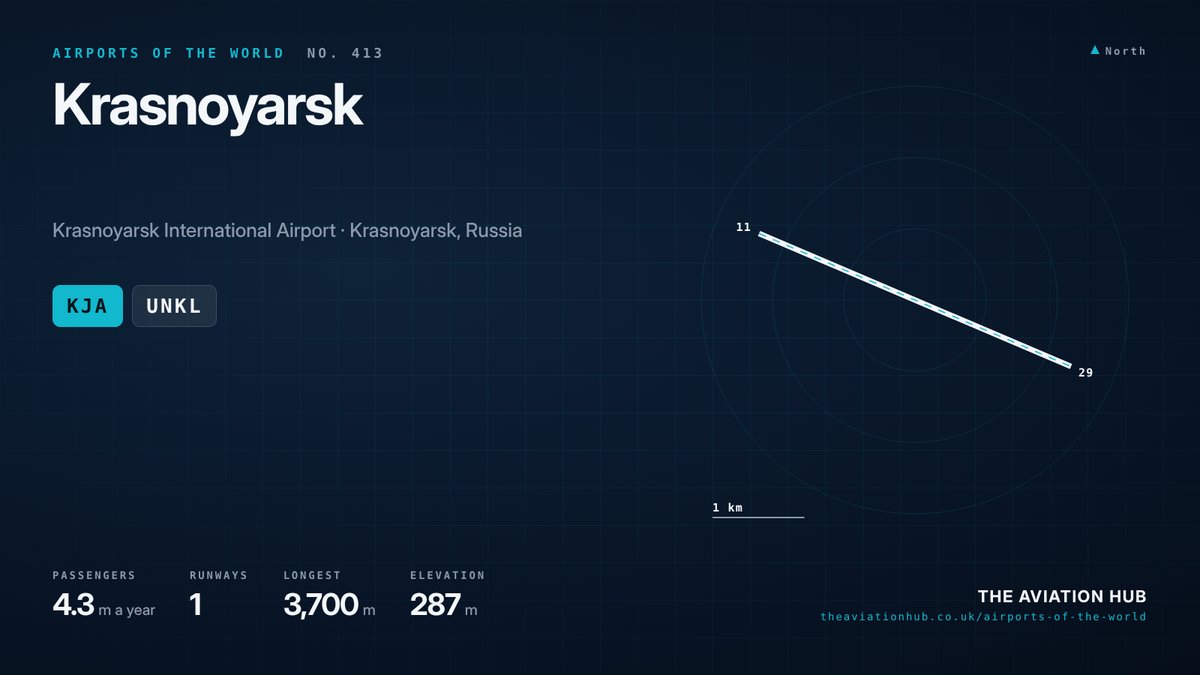
Yemelyanovo airport sits on rolling countryside northwest of Krasnoyarsk, the largest city in central Siberia. Krasnoyarsk Airport handled around 4.3 million passengers in 2025, making it the second busiest airport in Siberia. It links the Yenisei region with Moscow, the Arctic north and Asia. A modern terminal, a very long runway and a central position on the Eurasian map give it ambitions well beyond its regional role.
Krasnoyarsk Airport at a Glance
The IATA code is KJA and the ICAO code is UNKL. The airport lies about 17 miles (27 km) northwest of Krasnoyarsk city centre, at an elevation of 287 metres (942 feet). It has a single runway and one main passenger terminal, opened in 2017. Krasnoyarsk Airport recorded around 4.3 million passengers in 2025, well up on the 2.6 million it handled in 2018.
Rossiya, NordStar and the regional carrier KrasAvia use the airport as a hub, and Aeroflot launched hub operations here in 2021. S7 Airlines, Ural Airlines, Azur Air and IrAero also run significant schedules. Flight information and transport details are on the airport’s official website.
How Siberia’s Central Airport Came to Be
Krasnoyarsk once relied on Severny, an older airfield on the edge of the city that struggled with the larger jets of the late Soviet era. Construction of a new airport at Yemelyanovo began in 1970, and it opened for operations in 1980. Severny lingered on for smaller aircraft for years before closing, and its land has since been redeveloped.
Tragedy struck on 23 December 1984. Aeroflot Flight 3519, a Tupolev Tu-154, suffered an engine fire shortly after take off and crashed during an emergency landing attempt. Only one of the 111 people aboard survived.
A new chapter began in the 2000s. Terminal 2 opened in 2005 for international and transit passengers, and a large modern terminal opened on 26 December 2017, ahead of the 2019 Winter Universiade in Krasnoyarsk. Its jet bridges entered service in March 2018. In 2019 the field was named after the Krasnoyarsk born baritone Dmitri Hvorostovsky, though most travellers still call it Krasnoyarsk Airport.
Runways at Krasnoyarsk Airport
A single runway, 11/29, handles all traffic. It measures 3,700 metres (12,139 feet) long and 60 metres wide, with an asphalt surface. Runway 29 is certified for Category II instrument landings, which matters in a region known for winter fog and heavy snow.
The length and width allow almost any aircraft to operate, including the Boeing 777, the Boeing 747 and the giant Antonov An-124. More than 50 aircraft types are approved. One quirk catches crews out. The nearby Cheremshanka airfield has a runway on the same bearing, and no taxiway links the two, so only the shorter length gives it away. Pilots approaching Krasnoyarsk Airport must take care not to line up on the wrong field.
Terminals and Airlines
The 2017 terminal handles nearly all passenger flights, domestic and international, with jet bridges and modern check in halls. Terminal 1, the original Soviet era building, closed to regular passengers in 2017 and was earmarked for conversion into a VIP and conference facility. Terminal 2 served international flights until the move into the new building.
Rossiya, part of the Aeroflot Group, flies the widest network, with Airbus A320 family and Boeing 737 jets. NordStar, owned by the Norilsk Nickel group, links Krasnoyarsk with Norilsk, Moscow Domodedovo and Sochi. KrasAvia flies turboprops to remote Siberian and Arctic settlements such as Igarka, Turukhansk and Tura, many of which have no year round road. Aeroflot, S7 and Ural add trunk routes, while Azur Air flies holiday charters.
Routes and Destinations
Moscow is the most important route, with frequent flights to Sheremetyevo and other Moscow airports. Novosibirsk, Irkutsk, Yekaterinburg, Sochi and Krasnodar are key domestic links. St Petersburg is another major destination, and Nordwind adds its own service from 21 October 2026. NordStar’s link to Norilsk, inside the Arctic Circle, is a lifeline for the mining city. Norilsk is closed to foreigners without special permission, so most passengers on the route are residents and industry workers.
Internationally, Rossiya serves Beijing Daxing, Shanghai Pudong, Guangzhou and Harbin, along with Almaty. Seasonal flights head to Thailand and other Asian holiday spots. KrasAvia reaches Ulaanbaatar in Mongolia. Since 2022, Western sanctions and airspace closures have cut direct links with Europe, shifting the network firmly east and south. Cargo once mattered greatly when AirBridgeCargo used Krasnoyarsk Airport as a transit point between Asia and Europe.
Getting to and from Krasnoyarsk Airport
Road is the only option. The airport sits close to the main federal highway west of Krasnoyarsk, and the drive to the city centre takes around 40 minutes to an hour, depending on traffic and weather. Winter conditions can add significantly to journey times.
Express and city buses link the terminal with the city centre and the main bus station, the cheapest sensible option for most travellers. Taxis and app based ride services wait outside arrivals, and fares should be agreed or booked through an app. A commuter rail link was once planned before 2019, but it has not been built. Parking is available beside the terminal at Krasnoyarsk Airport.
Spotting and Photography
Russian law and practice make airport photography risky for visitors. Security staff and police may question anyone with a camera near the perimeter, and military or sensitive sites are strictly off limits. Foreign enthusiasts should check current rules carefully, carry identification and avoid the boundary altogether.
From inside the terminal, the variety is notable. Aeroflot Group jets, NordStar 737s, KrasAvia turboprops and occasional heavy freighters share the apron. Winter brings dramatic scenes, with de icing crews working in temperatures that can fall below minus 30C. Long summer evenings give the best light. Respect every instruction from staff at Krasnoyarsk Airport.
What Comes Next
Aeroflot’s 2021 hub launch was designed to let Siberians fly between regions without routing through Moscow. That strategy continues to drive growth, and the airport’s central location suits flights linking the Far East with western Russia. The new terminal provides plenty of capacity for further expansion.
Sanctions limit the fleet and international options, but domestic and Asian demand remains strong. Expect continued growth as a Siberian transfer hub, with China and Central Asia offering the biggest international prospects. Compare it with other Siberian fields on our Airports of the World map.
Continue to follow The Aviation Hub for more analysis and insight.
Advertise with us Your brand, in front of an aviation audience Home page and in-article placements, sold directly, one advertiser per slot. From £250 a year. See the rates

