Kyrgyzstan’s capital sits beneath the snow capped peaks of the Kyrgyz Range, and most visitors first see those mountains from the air. Bishkek Airport, officially Manas International Airport, is the country’s main gateway and handles around four million passengers a year. It has served as a Soviet showpiece, a US military transit hub and now a busy link between Central Asia, Russia, Turkey, the Gulf and China. A modernisation programme is reshaping its terminal.
Bishkek Airport at a Glance
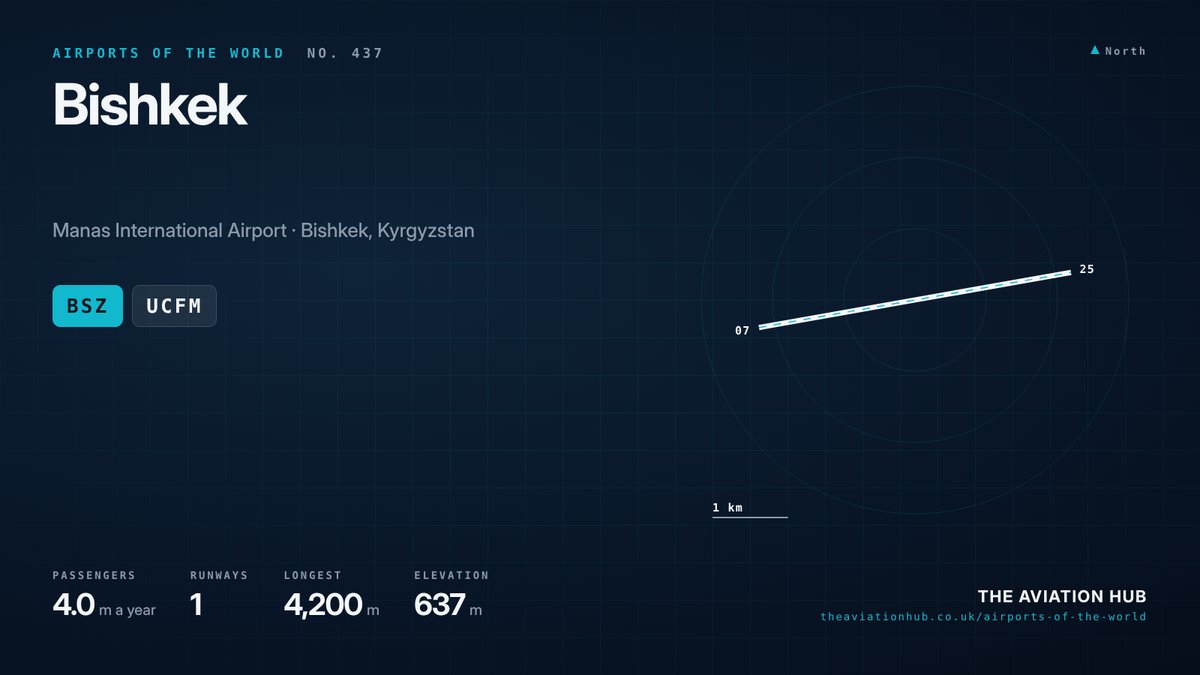
Bishkek Airport carried the IATA code FRU for decades, a reference to Frunze, the Soviet era name of the city. On 9 August 2025 the code changed to BSZ, although many travellers and systems still recognise FRU. The ICAO code is UCFM. The field lies about 16 miles (25 km) northwest of central Bishkek, at an elevation of 2,090 feet (637 metres). It has one runway and one main passenger terminal.
The last full annual figure published is about 3.6 million passengers in 2017, and traffic has grown since. Aero Nomad Airlines, Avia Traffic Company and Asman Airlines are based here. A state controlled company operates the site. Flight information appears on the airport’s official website.
How Bishkek’s Airport Came to Be
The new airport replaced Frunzensky Airport, which sat close to the city’s southern edge. The first aircraft landed in October 1974, carrying Soviet Premier Alexei Kosygin. Aeroflot began scheduled flights to Moscow Domodedovo on 4 May 1975. The writer Chinghiz Aitmatov suggested the name Manas, after the hero of the great Kyrgyz epic poem.
The 1990s were hard. After independence, traffic collapsed and around 60 derelict Soviet era aircraft were left on the ramp. Recovery began after 2001, when US forces set up a base at the airport to support operations in Afghanistan. The facility, later known as the Transit Center at Manas, brought tankers, transports and a sprawling tent city until it closed in 2014.
Bishkek Airport has seen serious accidents. In 2006 a Kyrgyzstan Airlines Tu-154 collided with a US Air Force KC-135 tanker on the runway, and the tanker burned, though nobody was hurt. In 2008 Iran Aseman Airlines Flight 6895 crashed near the field, killing 68. In January 2017 a Boeing 747 freighter operating for Turkish Cargo missed the runway in fog and struck a nearby village, killing at least 38 people.
Runways at Bishkek Airport
A single concrete runway, 07/25, measures 4,200 metres (13,780 feet) long and 55 metres (180 feet) wide. That length dates from the Soviet era and allows fully loaded wide body aircraft to take off even in summer heat. It made the field ideal for heavy US tankers during the military years.
The instrument landing system meets ICAO Category II standards, which matters in winter. Freezing fog often settles over the Chüy valley in the colder months and can cut visibility sharply. The 2017 freighter crash happened in exactly those conditions.
China Road and Bridge Corporation began a modernisation of the runway, apron and lighting on 7 March 2025. The upgrade is designed to handle larger traffic volumes and bring airfield lighting and surfaces up to current international standards.
Terminals and Airlines
The passenger terminal was expanded in 2004 and renovated in 2007. A larger project is now increasing its floor area from about 38,900 to 56,900 square metres. A new western wing opened on 14 May 2026, and the main entrance reopened on 12 July 2026. Interior work on the older section continues, alongside new check in counters, waiting areas, lounges and a covered walkway.
Local carriers Aero Nomad, Avia Traffic Company and Asman Airlines fly to Russia, Central Asia and domestic points. Russian airlines including Aeroflot provide many of the flights to Moscow. Turkish Airlines, AJet and Pegasus link Bishkek Airport with Istanbul, while flydubai connects with Dubai. Chinese carriers serve Beijing and Guangzhou, and Uzbek and Kazakh airlines fly to Tashkent and Almaty.
Routes and Destinations
Moscow dominates the network, with flights to Sheremetyevo, Domodedovo and Vnukovo. Hundreds of thousands of Kyrgyz citizens work in Russia, so routes to Moscow, St Petersburg, Novosibirsk, Yekaterinburg and other Russian cities carry heavy traffic. Istanbul and Dubai are the key links to the wider world.
Domestic flights connect with Osh in the south, Karakol near Lake Issyk Kul and smaller towns such as Batken and Naryn. Summer brings trekkers and mountaineers heading for the Tian Shan, while winter adds skiers. Chinese routes are growing as trade with China expands, and cargo flights use Bishkek as a transit point between China and markets further west.
Getting to and from Bishkek Airport
Taxis and app based rides reach central Bishkek in around 30 to 40 minutes. Apps such as Yandex Go usually offer lower fares than taxis touting in the arrivals hall. Agree the fare before setting off if using an unofficial driver.
Minibuses, known as marshrutkas, have long linked the terminal with the city centre, with route 380 the best known. They are the cheapest option for light travellers, though services can be infrequent and space for luggage is limited. Car hire desks operate in the terminal, and a car park sits in front of the building. There is no rail link.
Spotting and Photography
Bishkek Airport offers a dramatic setting, with the Kyrgyz Range rising to the south. Its traffic mix of Russian airliners, Central Asian carriers and Gulf jets is unusual for western enthusiasts. The derelict Soviet aircraft once lined up on the ramp have largely gone, but older types still appear.
The sun sits to the south, so shots facing the mountains are against the light for much of the day. Early mornings and clear winter afternoons work best. Fog can ruin winter sessions.
Airport photography in Central Asia can attract unwelcome attention. Stay on public land, keep away from fences, carry your passport and follow any instruction from police or security staff.
What Comes Next
The terminal expansion and airfield modernisation should give Bishkek Airport the capacity and comfort it has long lacked. The new BSZ code signals a fresh identity, even if FRU lingers in many minds. Growing links with China and the Gulf, plus tourism to the mountains and Issyk Kul, should support steady growth.
Regional politics and Russian labour migration rules remain key risks for traffic. Compare the field with other Central Asian airports on our Airports of the World map. The verdict: Bishkek Airport is modernising fast and has the runway for much more traffic, putting it in a strong position to grow.
Continue to follow The Aviation Hub for more analysis and insight.
Advertise with us Your brand, in front of an aviation audience Home page and in-article placements, sold directly, one advertiser per slot. From £250 a year. See the rates