
El Paso Airport Guide: Desert Hub on the Mexican Border
El Paso Airport serves West Texas and the border region from a high desert site. Read its history, three runways, airlines, routes and access.
 By The Aviation Hub
5 min read
Updated October 20, 2026
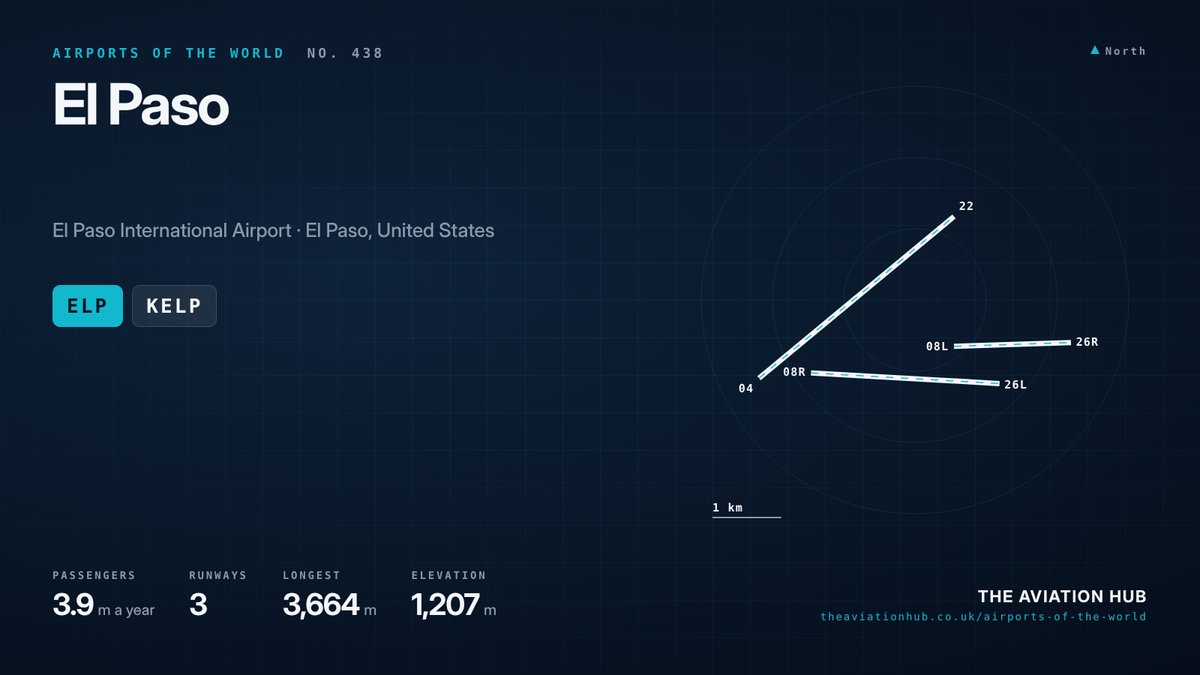
El Paso sits in the far western corner of Texas, facing Ciudad Juárez across the Rio Grande. The two cities form one of the largest cross border metropolitan areas in the Americas. El Paso Airport, officially El Paso International Airport, handled about 3.8 million passengers in 2025 after a record of just over four million in 2024. It serves West Texas, southern New Mexico and many travellers from northern Mexico, all from a high desert site beside Fort Bliss.
El Paso Airport at a Glance
The IATA code is ELP and the ICAO code is KELP. El Paso Airport lies about 4 miles (6 km) northeast of downtown El Paso. It sits 3,959 feet (1,207 metres) above sea level. There are three runways and one terminal with two concourses and 15 gates.
Traffic reached roughly 3.84 million passengers in 2025, down from about 4.04 million in 2024. Southwest Airlines carries more than half of all passengers. American, Delta, United, Alaska, Frontier and Allegiant make up the rest. The City of El Paso owns and runs the field through its aviation department. Parking, flight and terminal information sits on the airport’s official website.
How El Paso’s Airport Came to Be
The city built its first municipal airport in 1928. A year later Standard Airlines opened its own field, Standard Airport, on the present site to carry transcontinental airmail. In 1936 American Airlines and the city swapped airports, and the Standard site became the city’s main field, later known as El Paso International.
The Second World War brought Army Air Forces training to the airfield. In 1957 a US Air Force C-124 crashed on approach in poor weather, killing five of the 15 people aboard. In 1961 El Paso Airport was the final stop of the first major hijacking of a US jetliner, a Continental Boeing 707, which ended on the ground here.
The terminal has been reworked many times since. Recent renovations, designed by MNK Architects, refreshed the concourses and public spaces over several years.
Runways at El Paso Airport
The main runway, 04/22, measures 3,664 metres (12,020 feet) long and 46 metres (151 feet) wide. Runway 08R/26L is 2,751 metres (9,025 feet) long and 46 metres wide. The short runway, 08L/26R, is 1,676 metres (5,499 feet) long and 23 metres (75 feet) wide, used mainly by light aircraft. The two longer runways are asphalt, while the short one is concrete.
Altitude and heat explain the long main runway. At almost 4,000 feet, summer temperatures above 38°C sharply reduce aircraft performance, so heavy jets need long takeoff runs. Westerly and southwesterly winds favour runways 22 and 26L. Spring brings strong winds and dust storms that can disrupt operations.
On 10 February 2026 the FAA closed most of El Paso’s airspace for what it called special security reasons. The restriction was lifted in less than eight hours after a reported cartel drone incursion, though that explanation could not be independently confirmed. Seven arrivals and seven departures were cancelled.
Terminals and Airlines
The single terminal uses a pier and satellite layout. Concourse A, on the west side, has four gates used only by American Airlines and American Eagle. Concourse B, on the east side, has 11 gates shared by Delta, Southwest, United, Alaska, Frontier and Allegiant.
Southwest is the dominant carrier at El Paso Airport, with around 53 per cent of passengers. It flies Boeing 737-700 and 737 MAX 8 jets to its key cities across Texas and the West. American connects with Dallas Fort Worth and Phoenix, United with Denver and Houston, and Delta with Atlanta. All three global alliances are present through the legacy carriers.
Routes and Destinations
Dallas Fort Worth is the busiest route, with about 296,000 passengers between April 2025 and March 2026. Denver follows at around 220,000, then Phoenix at roughly 215,000. Dallas Love Field and Las Vegas complete the top five, at about 199,000 and 157,000 passengers. Houston, Austin, Atlanta and Los Angeles are other major destinations.
Orlando, a seasonal Southwest route, is the longest at about 1,510 miles (2,440 km), with Seattle and Atlanta next. Military travel linked to Fort Bliss provides steady year round demand. Many passengers from Ciudad Juárez cross the border to fly from El Paso, attracted by wider US connections and lower fares.
Cargo is significant. Express carriers support the manufacturing plants on both sides of the border, moving parts and finished goods quickly.
Getting to and from El Paso Airport
Most travellers drive or use ride hailing. Downtown El Paso is about 15 minutes away by car via Airway Boulevard and the interstate. Convair Road serves the terminal, with separate lanes for commercial vehicles and for passenger pickup and drop off. Parking sits beside the terminal, and car hire is on site.
Sun Metro routes 33 and 208 stop outside the terminal and are the cheapest sensible option. Passengers heading for Amtrak or the El Paso Streetcar change at the Eastside Terminal to routes 50 or 59. Taxis and ride hailing cars are quick and inexpensive for short trips into the city.
Spotting and Photography
El Paso Airport offers wide desert views and plenty of interest. Biggs Army Airfield, part of Fort Bliss, sits next door, bringing military helicopters and transports into the mix. The Franklin Mountains provide a rugged backdrop to the west.
Public roads around the perimeter give views of arrivals on runway 22 and runway 26L. Desert air often brings crystal clear visibility, and the sun sits in the southern sky for much of the year. Positions on the southern side of the field keep it behind the camera.
Stay on public land, keep away from fences and military property, and follow any instruction from police. Military security around Fort Bliss is strict.
What Comes Next
El Paso Airport has room to grow, with three runways and land that was once leased to the El Paso Independent School District. The district moved its headquarters downtown in 2021, freeing space for airport development. The terminal renovations have improved the passenger experience, and more gates may be needed if traffic returns to record levels.
Competition from Ciudad Juárez airport and changing border policies will shape demand. Compare the field with other Texas airports on our Airports of the World map. The verdict: El Paso Airport is a solid regional field with room for expansion, and its fortunes are tied closely to the border economy.
Continue to follow The Aviation Hub for more analysis and insight.
Advertise with us Your brand, in front of an aviation audience Home page and in-article placements, sold directly, one advertiser per slot. From £250 a year. See the rates

