
La Aurora International Airport sits in the middle of Guatemala’s capital, hemmed in by houses, ravines and busy avenues. Known to most travellers as Guatemala City Airport, it is the country’s main international gateway and handled almost 4.9 million passengers in 2024. Its runway lies nearly a mile above sea level, with volcanoes rising on the horizon. Flights to the United States, Mexico and Central America dominate, carried by a mix of network and low cost airlines.
Guatemala City Airport at a Glance
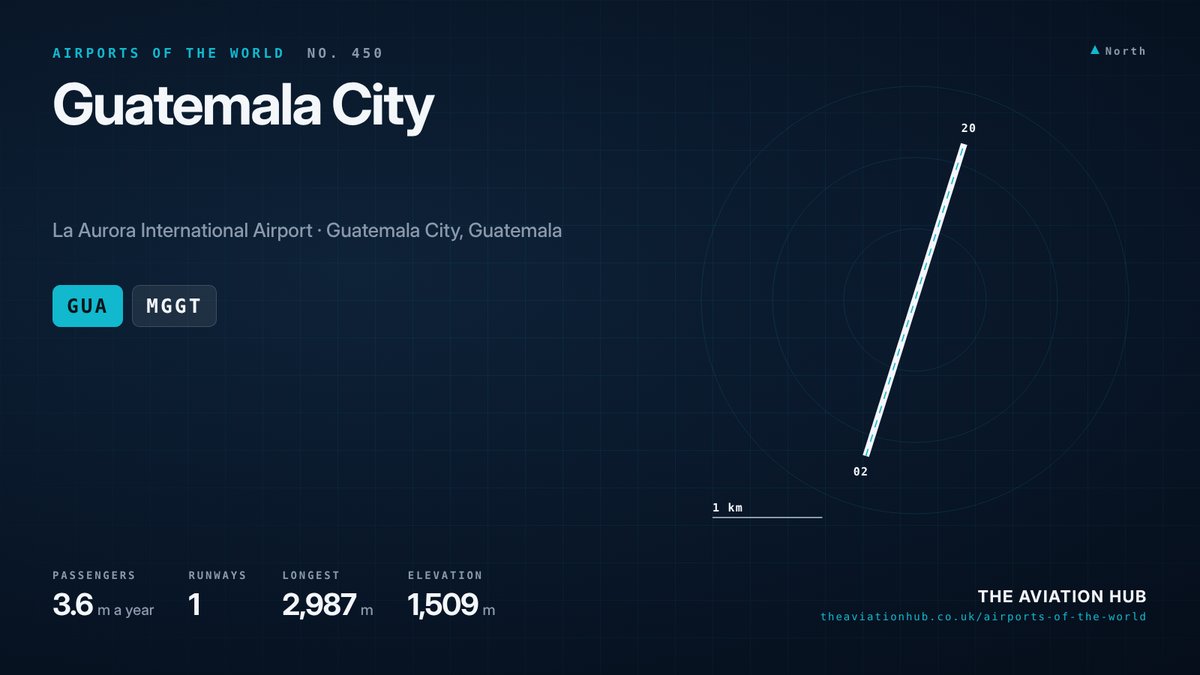
The IATA code is GUA and the ICAO code is MGGT. The airport lies about 4 miles (6.4 km) south of the city centre in Zone 13, at an elevation of 4,952 feet (1,509 m). It has one runway and one passenger terminal. Guatemala City Airport recorded 4,919,850 passengers in 2024.
The Ministry of Communications, Infrastructure and Housing owns the field, and the General Directorate of Civil Aeronautics runs it. Avianca Guatemala, the regional airline TAG and the cargo operator DHL de Guatemala use it as a hub. Flight information and passenger guidance are on the airport’s official website.
How Guatemala’s Capital Got Its Airport
Aviation at La Aurora goes back to the early twentieth century, when the field stood on open ground at the southern edge of the city. It shares its name with the neighbouring La Aurora park and zoo. Over the following decades the capital spread south and wrapped itself around the airport, leaving it surrounded by residential and business districts.
Aviateca, the national airline, built its network here, and the field later became part of the TACA and then Avianca systems as Central American airlines consolidated. In October 2004 Iberia began nonstop Madrid flights with Airbus A340s after closing its Miami hub. A major modernisation in the 2000s enlarged the terminal and added jet bridges.
Guatemala City Airport closed entirely for six months between March and September 2020 because of COVID 19. Traffic has since recovered strongly, helped by low cost airlines and demand from Guatemalans living in the United States.
Runways at Guatemala City Airport
There is one asphalt runway, 02/20, measuring 2,987 metres (9,800 feet) long and an unusually wide 60 metres. At this altitude, aircraft need more distance to take off and land, and heavy long haul jets face payload limits on hot afternoons. The runway was formerly designated 01/19 before a change in magnetic variation led to renumbering.
The runway’s tight urban setting has produced several overruns. On 6 April 1993 a TACA Boeing 767 ran off the end of runway 19 in heavy rain from a tropical storm and was written off, without fatalities. On 28 April 1995 a Faucett DC-8 overshot and hit houses, killing six people on the ground. On 21 December 1999 a Cubana DC-10 overran the same runway into a residential area, killing 16 people aboard and two on the ground.
Terminals and Airlines
A single terminal at Guatemala City Airport handles all scheduled flights, international and domestic. Lounges include the Los Anejos Business Lounge and a Copa Club for Copa and United passengers. TAG flies domestic and regional routes, including services to Flores for the Maya ruins at Tikal, using smaller aircraft.
United serves Chicago, Houston, Los Angeles and Newark, with seasonal Washington Dulles. American flies to Dallas Fort Worth and Miami, Delta to Atlanta, and JetBlue, Alaska, Frontier and Aeromexico add more North American links. Avianca and Copa connect Bogota and Panama City. Volaris serves Mexico City and Cancun, Arajet links Santo Domingo, Wingo serves Colombia, and Air Canada flies to Montreal. Iberia links Madrid.
Routes and Destinations
Los Angeles was the busiest route in 2024, with 501,486 passengers, reflecting the large Guatemalan community in Southern California. San Jose in Costa Rica followed with 441,644, then Panama City with 416,332, Mexico City with 413,213 and San Salvador with 368,894. Guatemala City Airport is therefore both a diaspora gateway and a regional connector.
Madrid is the longest route, at roughly 5,400 miles (8,700 km). New routes keep arriving: Air Canada is due to start Toronto on 1 December 2026, Volaris adds Guadalajara on 4 December 2026, and BermudAir begins seasonal flights to Belize City and Boston on 19 December 2026. Avianca also flies to Los Angeles and New York JFK, with seasonal Chicago and San Francisco. Cargo is significant, with DHL and others flying out fresh produce and textiles.
Getting to and from Guatemala City Airport
The central location keeps journeys short. Authorised taxis wait outside arrivals and reach Zone 10, the main hotel and restaurant district, in around 15 minutes outside rush hour. Ride hailing apps also operate and are usually the cheapest sensible option. Agree any taxi fare before setting off.
Many visitors head straight for Antigua Guatemala, about 16 miles (25 km) away. Shared and private shuttles run there frequently and take around an hour, depending on traffic on the mountain road. Public buses pass nearby but are not practical with luggage, and there is no rail service. Parking is available in front of the terminal, and car hire desks sit in arrivals.
Spotting and Photography
Few airports offer a backdrop like Guatemala City Airport. On clear mornings the volcanoes Agua, Fuego and Pacaya stand on the southern horizon, and Fuego often puffs ash. Avenida Hincapie, which runs along the eastern side lined with general aviation hangars, gives views of the runway and the apron. Hotels in Zone 13 and the higher ground around the city offer elevated views.
The dry season from November to April brings the clearest light, while afternoon clouds build quickly in the wet season. Traffic ranges from United 737s and Avianca A320s to TAG turboprops and DHL freighters. Stay on public land, keep away from fences and carry identification. Security and police may question photographers, so stay calm and cooperative.
What Comes Next
La Aurora’s city centre location is both its strength and its limit. There is little room to extend the runway or build a second one, and the overrun history keeps safety in focus. The government has announced plans to modernise the terminal and airfield, and the idea of a new airport outside the valley resurfaces regularly.
For now, airline growth is the story, with new links to Canada, Mexico and the United States. The verdict: Guatemala City Airport will keep growing on diaspora and regional demand, but its long term future may lie on a new site. Explore other Central American gateways on the Airports of the World map.
Continue to follow The Aviation Hub for more analysis and insight.
Advertise with us Your brand, in front of an aviation audience Home page and in-article placements, sold directly, one advertiser per slot. From £250 a year. See the rates