
Verona Airport Guide: Catullo, Lake Garda and the Opera
Verona Airport serves Verona and Lake Garda. Its history, runway, fog system, terminals, airlines, routes, the Aerobus link and the enlarged terminal.
 By The Aviation Hub
5 min read
Updated October 20, 2026
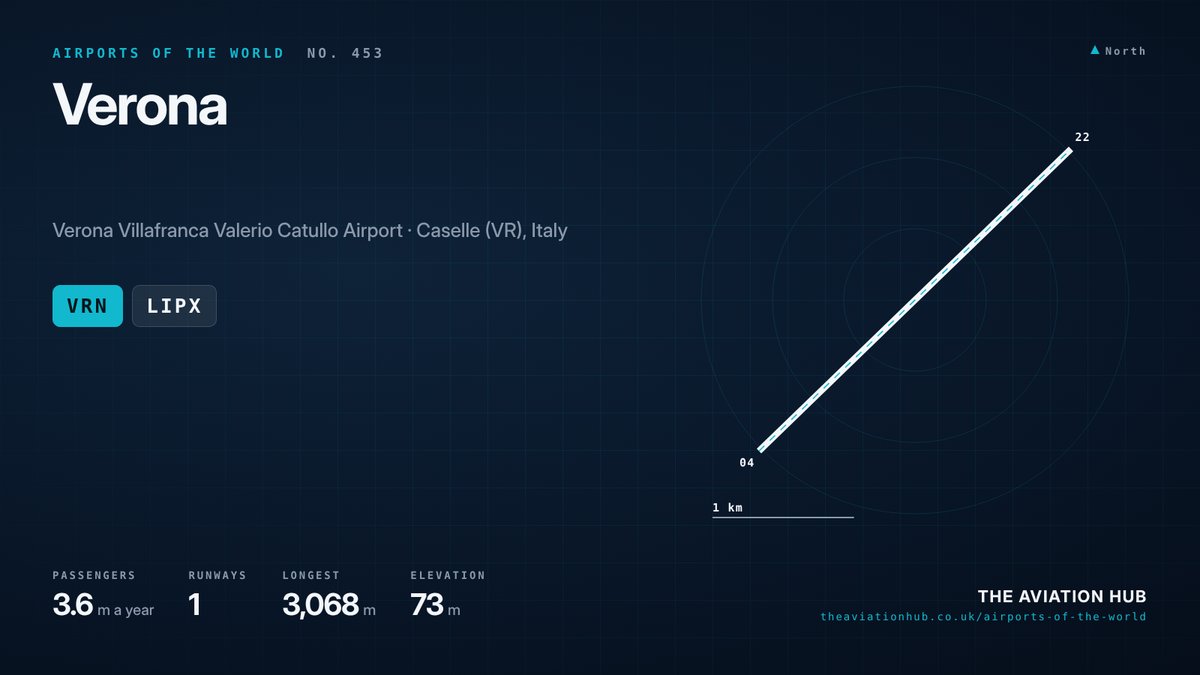
Verona Airport, officially Verona Villafranca Valerio Catullo Airport, sits in the flat countryside south west of Verona in Italy’s Veneto region. It serves the city of Romeo and Juliet, its summer opera season in the Roman Arena and the holiday resorts of Lake Garda. Traffic passed four million passengers for the first time in 2025. A busy mix of low cost, network and charter airlines keeps the field busy in every season.
Verona Airport at a Glance
The IATA code is VRN and the ICAO code is LIPX. The airport lies about 6 miles (10 km) south west of central Verona, beside the junction of the A4 and A22 motorways. It sits 239 feet (73 m) above sea level, with one runway and two linked terminal buildings. Verona Airport handled 4,027,863 passengers in 2025, up about 8.7 per cent, with 30,784 aircraft movements.
The operating company, Aeroporto Valerio Catullo di Verona Villafranca S.p.A., was set up in December 1978. Its shareholders include provincial governments in Veneto, Lombardy, Trentino and Alto Adige, and the Venice airport group SAVE has been a major investor since 2014. Timetables and transport details are on the airport’s official website.
A Short History of Villafranca
The site served as an airbase for Italian military aviation during both world wars. Civil flying at Verona Airport began in 1961 with charter and domestic services, and the military presence continued alongside. The airport is named after Valerio Catullo, the Italian form of Catullus, the Roman poet born in Verona. Locals often simply call it Villafranca, after the nearby town.
Growth came with package holidays and the rise of Lake Garda as a destination. A road link to Verona’s ring road opened in 1990. During the Bosnian War in the 1990s, NATO aircraft used the field as a staging area. Terminal 2 opened in May 2006 and doubled capacity.
Traffic reached 3,385,794 passengers in 2011 before dropping after Ryanair pulled out in 2012, following a European Union investigation into subsidies on its routes. Ryanair returned in 2015 with flights to Palermo, London Stansted and Brussels. Steady growth since then pushed traffic past the 2007 record of 3.5 million and on to four million.
Runways at Verona Airport
There is one runway, 04/22, with an asphalt surface measuring 3,068 metres (10,064 feet) long and 45 metres wide. The length handles everything from turboprops to wide body charters. The runway is certified for Category IIIb instrument landings, a vital capability in the Po valley, where thick winter fog can settle for days.
A fog dispersal system has operated since 2003, allowing landings in visibility as low as 75 metres. The airport’s darkest day came on 13 December 1995, when Banat Air Flight 166, an Antonov An-24, stalled after takeoff. It had not been deiced and was overloaded by at least two tonnes, and all 49 people aboard died. The Italian Air Force still shares the field.
Terminals and Airlines
The terminal complex is split by function. Terminal 1 handles departures and Terminal 2, opened in 2006, handles arrivals. The Romeo project, a new departures building costing more than 90 million euros, was completed in February 2026. It enlarged the departure area to over 36,000 square metres and raised the number of gates from 13 to 19.
Volotea has a base at Verona Airport and runs a large domestic and European network. Ryanair flies to Palermo, London Stansted, Brussels and many other cities. Air Dolomiti, the Lufthansa group airline with its headquarters close to the airport, links Munich and Frankfurt. Transavia serves Amsterdam, while Finnair and airBaltic fly seasonally to Helsinki and Riga. Neos, easyJet, Jet2 and TUI add holiday flights, especially from the UK and Northern Europe.
Routes and Destinations
Domestic routes to Sicily and Sardinia are a mainstay at Verona Airport, with Palermo, Catania, Cagliari and Olbia all well served. Naples and Bari add family traffic, and ITA Airways plans to restore Rome Fiumicino in March 2027. Internationally, London, Munich, Frankfurt, Paris and Brussels connect Verona with Europe’s hubs and with the many tourists heading for Lake Garda.
Seasonality shapes the network. Summer brings charter and low cost flights from the UK, Germany, Scandinavia and the Baltic states, carrying visitors to Lake Garda and the opera festival. Winter brings ski charters for resorts in Trentino and the Dolomites, plus holiday flights to Egypt and the Canary Islands. Cargo is modest, at about 856 tonnes in 2025.
Getting to and from Verona Airport
The Aerobus, ATV line 199, connects the terminal with Verona Porta Nuova railway station in around 15 to 20 minutes. It is the cheapest sensible option for reaching the city and the main rail network. From Porta Nuova, trains run to Venice, Milan, Bologna and the Brenner line towards Austria. There is no rail station at the airport itself.
In summer, ATV lines 164, 183 and 184 run hourly to towns on Lake Garda, from June to September. By road, the airport sits next to the A4 between Milan and Venice and the A22 north to the Brenner Pass. Taxis reach central Verona in about 20 minutes, and car hire desks are busy with Lake Garda visitors. Parking is available beside the terminals.
Spotting and Photography
Verona Airport sits in open farmland, and minor roads around the perimeter offer views of the runway and approaches. Arrivals on runway 04 pass over fields to the south west, while runway 22 arrivals come in from the north east. Winter fog can make photography impossible for days, but clear spring and autumn mornings offer crisp light with the Alps on the horizon.
The mix includes Air Dolomiti Embraers, Volotea Airbus jets, Ryanair 737s, Jet2 and easyJet jets and occasional military aircraft. Remember that the Italian Air Force uses the field, so never photograph military areas. Stay on public roads, keep clear of fences and follow instructions from the carabinieri or airport staff.
What Comes Next
The new departures building, finished in February 2026, gives the airport far more room for passengers. Growth beyond four million passengers will depend on adding routes in the winter months and capturing more of the Lake Garda market. The shareholding link with the Venice airport group allows joint planning across the region.
The verdict: Verona Airport has the runway and fog protection to grow steadily, and its enlarged terminal gives it the space to do so. Compare it with other northern Italian airports on the Airports of the World map.
Continue to follow The Aviation Hub for more analysis and insight.
Advertise with us Your brand, in front of an aviation audience Home page and in-article placements, sold directly, one advertiser per slot. From £250 a year. See the rates

