
Kumamoto Airport Guide: Volcano Views and a Rebuilt Terminal
Kumamoto Airport links central Kyushu with Tokyo, Osaka, Taiwan and Korea. Read about its history, new terminal, runway, routes and transport links.
 By The Aviation Hub
5 min read
Updated October 20, 2026
Kumamoto Airport sits on a plateau east of Kumamoto city in central Kyushu, with the huge caldera of Mount Aso on the horizon. It carries more than three million passengers a year, most of them on domestic flights to Tokyo and Osaka. The region’s semiconductor boom has added fresh international demand, especially from Taiwan. A new terminal, opened in 2023 after earthquakes wrecked the old one, gives the airport a modern face.
Kumamoto Airport at a Glance
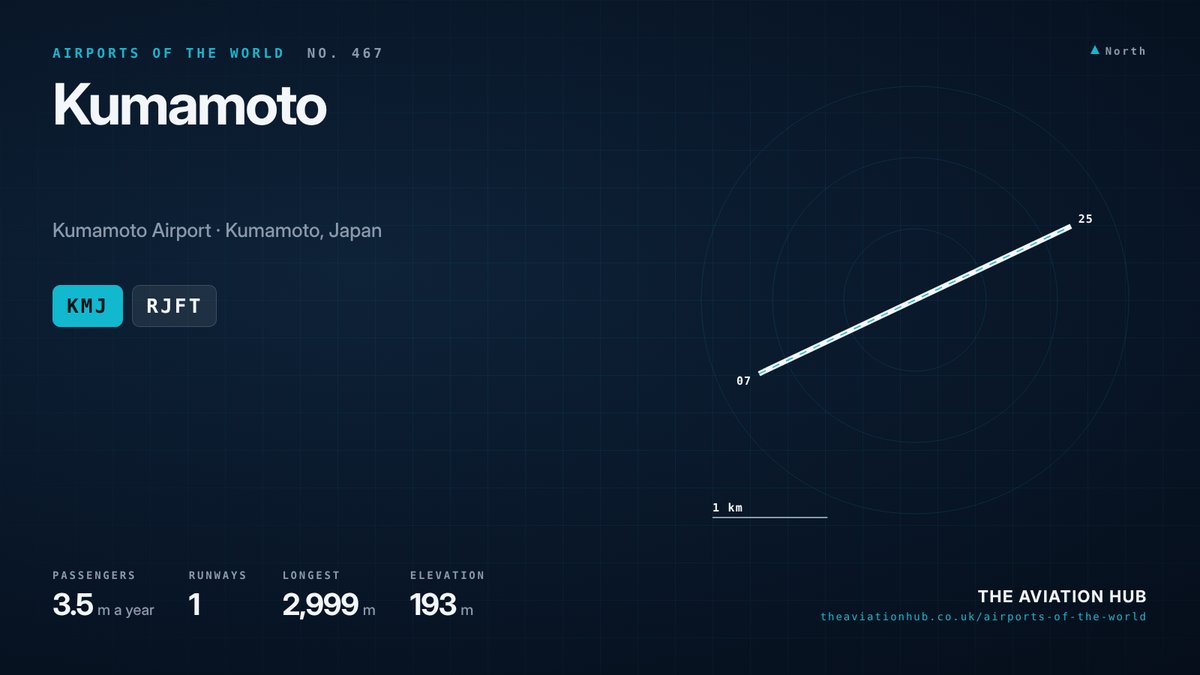
The codes are KMJ for IATA and RJFT for ICAO. The airport lies in the town of Mashiki, about 9 miles (15 km) north east of Kumamoto city centre. Elevation is 193 metres (632 feet). There is one runway and one combined domestic and international terminal. Its marketing name, Aso Kumamoto Airport, nods to the volcano that dominates the view.
Before the pandemic traffic ran above three million passengers a year, and demand has since recovered strongly. All Nippon Airways, Japan Airlines and Solaseed Air link the city with Tokyo, while international routes serve Taiwan and South Korea. Since April 2020 Kumamoto International Airport Co., Ltd., a consortium led by Mitsui Fudosan, has run Kumamoto Airport. Timetables are on the airport’s official website.
A Short History of Kumamoto’s Airport
The first civil airport opened in 1960 on a former Imperial Japanese Army air base closer to the city. Its runway was just 1,200 metres long, too short for jets. As air travel grew in the 1960s, the prefecture looked for a better site.
The current airport opened in 1971 on the plateau at Mashiki, with a 2,500 metre runway that allowed jet operations. The runway was extended to 3,000 metres in 1980. In the fiscal year 2011 Kumamoto Airport was one of only three nationally owned airports to make a profit, alongside New Chitose and Komatsu.
The turning point came in April 2016, when two powerful earthquakes struck the region. Mashiki was close to the epicentre, and the terminal was badly damaged. The rebuild became part of a privatisation plan, and the new terminal opened on 23 March 2023, designed to withstand strong earthquakes.
Runways at Kumamoto Airport
There is a single asphalt runway, 07/25, measuring 2,999 metres (9,840 feet) long and 46 metres wide. That is ample for the Boeing 737, Airbus A320 and Boeing 767 types that dominate the schedule, and it can take larger wide body aircraft when needed.
The runway runs roughly east to west across the plateau. Winds vary with the season, and both directions see regular use. Approaches from the east pass over farmland on the lower slopes leading towards Aso, while those from the west come in over the outskirts of Kumamoto and Kikuyo.
Volcanic ash is a rare but real hazard. Eruptions at Mount Aso have occasionally disrupted flights across central Kyushu, and fog on the plateau can also delay early departures.
Terminals and Airlines
The 2023 terminal brings domestic and international flights under one roof. It is brighter and far more spacious than its predecessor, with improved shops and dining. Kumamoto Airport has no single home airline, but the major Japanese carriers all maintain strong schedules.
ANA and JAL both fly to Tokyo Haneda, and Solaseed Air adds further Haneda flights in partnership with ANA. ANA, ANA Wings and J Air serve Osaka Itami, while Jetstar Japan flies to Kansai and Narita. Fuji Dream Airlines and Ibex Airlines link the city with Nagoya. Amakusa Airlines, the small carrier from the nearby islands, flies an ATR 42 to Amakusa and Itami. Korean Air, Trinity Airways and Eastar Jet serve Korea, and China Airlines, Starlux Airlines and Tigerair Taiwan fly to Taiwan.
Routes and Destinations
Tokyo Haneda is the backbone route from Kumamoto Airport, flown by three airlines and dominated by business and family travel. Osaka is the other major domestic market, split between Itami and Kansai. Nagoya, Naha and Amakusa complete the domestic map. The Shinkansen competes hard for travel to Fukuoka and western Honshu, so short domestic flights are few.
International links have grown quickly. China Airlines and Starlux fly to Taipei Taoyuan, and Taichung, Kaohsiung and Tainan also have direct services. Much of this growth follows the arrival of TSMC’s chip factory in neighbouring Kikuyo, which brought Taiwanese engineers, suppliers and visitors. Seoul Incheon and Busan provide the Korean side of the network.
Cargo is modest but steady, with around 16,500 tonnes recorded in 2015, much of it carried in the holds of domestic passenger jets. There are no long haul flights.
Getting to and from Kumamoto Airport
There is no rail link yet. Limousine buses run to central Kumamoto, Kumamoto Station and the Sakuramachi bus terminal, taking around 50 to 60 minutes for a fare of roughly ¥1,000 (about £5). The bus is the cheapest sensible option for the city.
A shuttle bus links the terminal with Higo Ozu Station on the JR Hohi Line in about 15 minutes. From there local trains run to Kumamoto and towards Aso. Taxis take around 40 minutes to the city centre, depending on traffic. Car hire is popular for trips to Aso, and parking sits beside the terminal. Prefectural plans for a rail branch from Higo Ozu to the airport are moving forward, with opening targeted for the 2030s.
Spotting and Photography
The plateau setting makes Kumamoto Airport an attractive place to watch aircraft. Japanese airports traditionally cater for the public, and the new terminal gives views of the apron and runway. On clear days the outer slopes of Aso rise behind the aircraft.
Expect ANA and JAL Boeing 737-800s and 767s, Solaseed 737s, Jetstar Airbus A320s and Fuji Dream Embraer E175s. The Amakusa Airlines ATR, painted with cheerful dolphins, is a favourite. Japan Ground Self Defense Force helicopters also operate nearby. Use public roads and parks, avoid stopping on narrow lanes, and follow the polite local rules.
What Comes Next
The rail link from Higo Ozu is the biggest project on the horizon. It would end the airport’s reliance on buses and tie it to a fast growing industrial corridor. A second TSMC factory nearby would deepen links with Taiwan and boost business travel further.
With a new terminal, a private operator and strong semiconductor demand, Kumamoto Airport looks set for steady growth. International routes, especially to Taiwan and Korea, should keep climbing. See how it compares with Fukuoka and other Kyushu airports on our Airports of the World map.
Continue to follow The Aviation Hub for more analysis and insight.
Advertise with us Your brand, in front of an aviation audience Home page and in-article placements, sold directly, one advertiser per slot. From £250 a year. See the rates

