
Des Moines Airport Guide: New Terminal, Old Midwest Roots
Des Moines Airport set a record of 3.25 million passengers in 2025 and is building a new terminal. See its runways, airlines, routes and how to get there.
 By The Aviation Hub
5 min read
Updated October 20, 2026
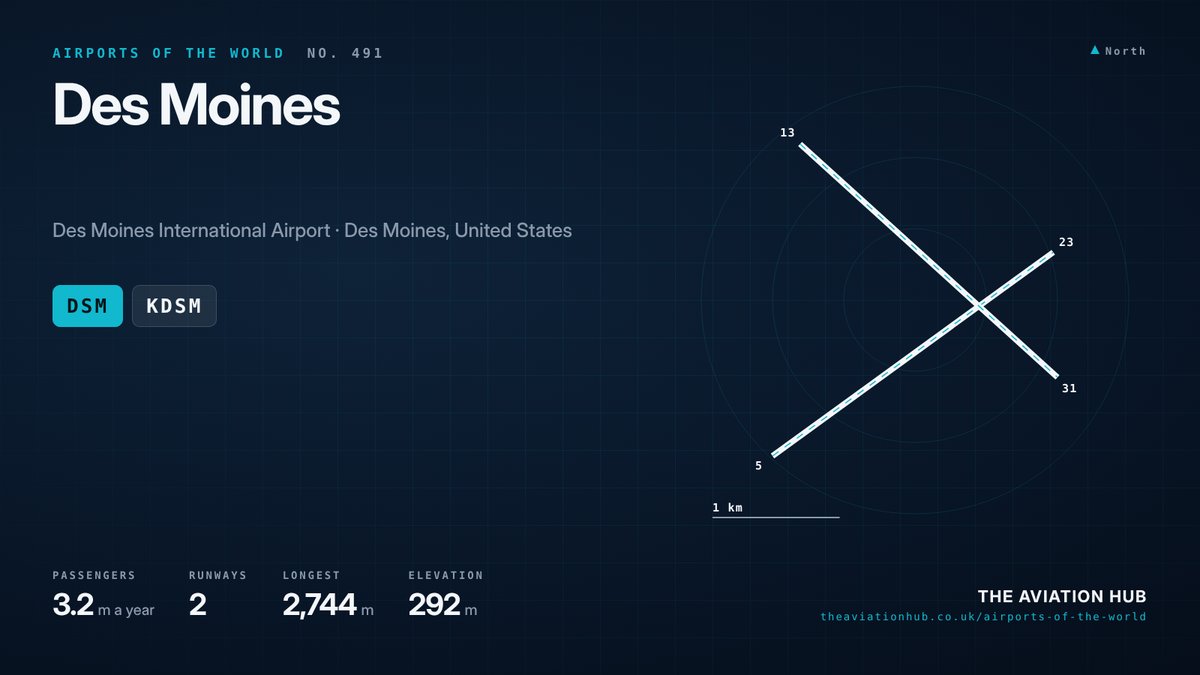
Iowa’s capital is served by a field that has outgrown its post war terminal and is building a replacement. Des Moines Airport handled a record 3.25 million passengers in 2025, and growth has been steady since the pandemic. It sits on the south western edge of the city, a short drive from downtown. American, Allegiant, United and Southwest carry most of the traffic, and a new $445 million terminal is rising beside the old one.
Des Moines Airport at a Glance
The codes are DSM and KDSM. The airport lies 5 miles (8 km) south west of downtown Des Moines, at an elevation of 958 ft (292 m). It has two runways and a single terminal with two concourses. The campus covers about 2,625 acres.
Passenger numbers reached 3,254,107 in 2025, up 2.4 per cent and a new record. Allegiant opened a base at Des Moines Airport in 2021, and Endeavor Air, which flies for Delta, runs a maintenance base here. The Des Moines Airport Authority has run the field since 2011 on a 99 year lease from the city. Flight times and parking are on the airport’s official website.
How Iowa’s Capital Got Its Airport
In 1929 the Iowa General Assembly allowed cities to sell bonds for municipal airports. Des Moines looked at more than 80 sites before choosing 160 acres of farmland south of the city. Construction ran from 1932 to 1933, and the airport opened in 1933.
The present terminal dates from around 1948, with concourses added in 1970. The airport took its international title in 1986, recognising the United States Customs office on site. In 2011 control passed from the City of Des Moines to an independent authority.
The Iowa Air National Guard has been part of the airport for decades. Its 132nd Wing, based at the end of runway 13/31, flew fighters for almost 70 years before switching in 2013 to intelligence, surveillance, reconnaissance and cyber missions. An Army National Guard helicopter unit has since moved in, turning the site into a joint base.
Runways at Des Moines Airport
Runway 05/23 measures 2,744 m (9,004 ft) and has a grooved concrete surface. Runway 13/31 measures 2,744 m (9,001 ft). Both are 46 m (150 ft) wide, and they cross, giving two nearly equal options for the wind of the day.
Runway 05/23 was fully rebuilt in 2022 and 2023, and runway 13/31 has also been closed for long periods of construction. Work on both has kept the field operating on a single runway at times. Four centralised deicing pads were funded under a $12.28 million contract.
Winter is the main operational challenge. Icing contributed to a fatal 1985 crash on approach that killed the pilot and six members of the Iowa State University women’s cross country team. In November 2025 an Endeavor Air CRJ-900 slid off the runway after a snowstorm. Nobody was hurt, but the airport closed for 14 hours.
Terminals and Airlines
The current terminal has Concourse A with gates A1 to A5 and Concourse C with gates C1 to C7. It is compact and easy to navigate, though cramped at peak times. Six airlines serve Des Moines Airport: American, Allegiant, Delta, Frontier, Southwest and United.
American leads with around a fifth of passengers, flying mainline jets and American Eagle regional aircraft to its hubs. Allegiant is second, flying Airbus A320 family jets to sun and leisure destinations. United and Southwest follow. Delta flies mainline jets to Atlanta, while regional partners such as Endeavor Air fly to Detroit, Minneapolis and New York LaGuardia.
Frontier adds low cost flights to Denver and selected leisure points. There are no airline lounges of note, which reflects the regional character of the traffic.
Routes and Destinations
Denver is the busiest route, with almost 225,000 passengers in 2025, closely followed by Chicago O’Hare at around 220,000. Dallas Fort Worth, Atlanta and Phoenix each carried more than 100,000. Charlotte, Las Vegas, Minneapolis, St Louis and Detroit complete the top ten.
The pattern is classic Midwest. Most travellers connect at a hub to reach the coasts or international destinations, while Allegiant and Southwest add point to point leisure flights. Florida, Arizona and Nevada are strong winter markets.
Cargo at Des Moines Airport is significant for a field of its size, at more than 32 million lb in 2025. Overnight parcel flights for the big integrators are a regular feature, serving the wider Iowa economy.
Getting to and from Des Moines Airport
There is no rail link. The airport sits on Fleur Drive, which runs straight into downtown in about 10 minutes, with Interstate 235 reached in a few minutes. Taxis and rideshare wait outside baggage claim.
DART, the regional bus operator, runs a route along Fleur Drive between the terminal and downtown. It is the cheapest option, though frequency is limited in the evenings and on weekends. Many hotels run free shuttles.
Parking is close and cheap by national standards, split between a garage and surface lots near the terminal. The LiftDSM programme includes new parking alongside the terminal project.
Spotting and Photography
Des Moines Airport offers relaxed spotting. The crossing runways mean aircraft approach from several directions, and the open Iowa landscape gives clear views. Regional jets, Allegiant A320s and the occasional freighter keep things varied.
Public roads around the perimeter give views of approaching aircraft, and Fleur Drive passes close to the field. The Guard base adds variety, though fighters no longer fly here. Low winter sun gives crisp light, and summer evenings stay bright until late.
The Guard base is a military installation, so do not photograph its facilities. Stay on public land, keep clear of fences and follow instructions from airport police.
What Comes Next
The new terminal is the centrepiece of the LiftDSM programme. Ground was broken in October 2023, and the building is scheduled to open in January 2027 with 18 gates, a capacity increase of around 50 per cent. It will replace the 1948 terminal entirely, with modern security, wider concourses and more space for airlines to grow.
Des Moines Airport is heading into a new chapter with more room, more gates and a stronger case for new routes. See how it compares with other Midwest fields on the Airports of the World map.
Continue to follow The Aviation Hub for more analysis and insight.
Advertise with us Your brand, in front of an aviation audience Home page and in-article placements, sold directly, one advertiser per slot. From £250 a year. See the rates

