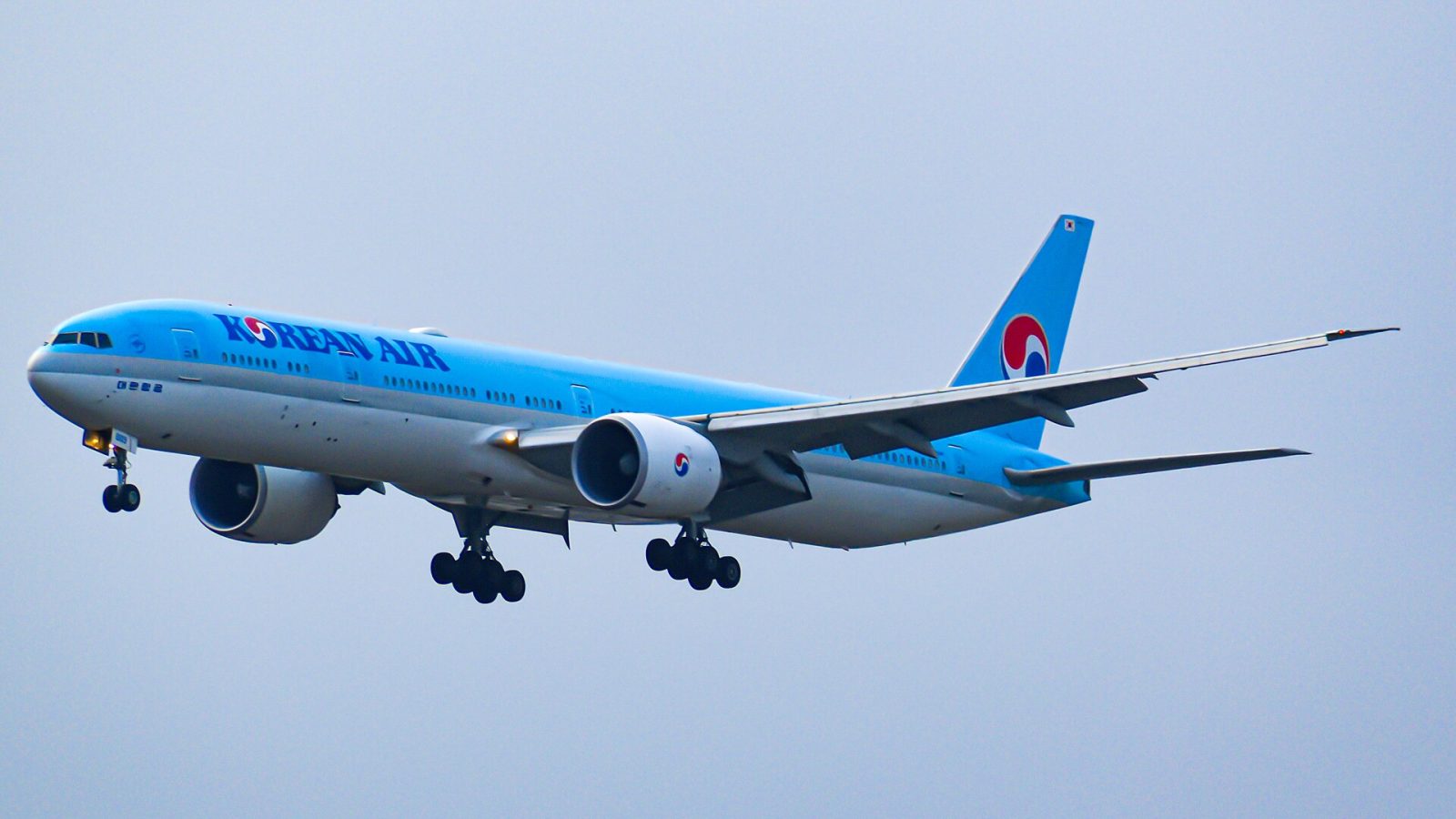
Korean Air aerospace division has set out its ambition to win greater workshare on the Boeing 777X, arguing that its long record across Boeing's commercial programmes gives it a clear case for a larger role. FlightGlobal broke this story through its own reporting.

The division, based at Busan's international airport, currently holds 24 work packages across Airbus and Boeing aircraft. Its ambition is to add to that total as Boeing's widebody production ramps up.
What Korean Air Already Makes for Boeing
The scope of Korean Air's aerostructures portfolio across Boeing platforms is considerable. For the 787, the division's work spans the raked wingtips, composite aft fuselage, and flap support fairings. The 737 MAX relationship runs equally deep: the division is the exclusive source of the type's split wingtips, and its involvement stretches back through the earlier 737NG programme.
On the widebody side, the division produced the raked wingtips for the 777-300ER, the aircraft the 777X is designed to replace in airline fleets. Its position on the 777X is, by comparison, significantly smaller.
For Airbus, Korean Air produces sharklets for the A320 family, swept sharklets for the A330neo, and composite cargo doors for the A350, showing capability across both narrowbody and widebody composite structures.
The Korean Air Aerospace Case for More 777X Work
The 777X presents a natural target. The aircraft features foldable wingtips and an extended wingspan compared with the 777-300ER, making composite wingtip expertise directly relevant. Korean Air built that expertise on the 777-300ER programme, and the division believes that history earns it consideration.
The Korean Air aerospace division's head of programme management, Younsoo Kim, framed the ambition in straightforward terms: "We have done all of the Boeing platforms, so why not the 777X?"
The obstacle is one of recent history rather than capability. In the 2010s, Boeing moved some 777X aerostructures work to Boeing Defense, Space and Security employees, reducing the share available to external suppliers. Recovering ground on a programme that has already been allocated is a different proposition from bidding on new work.
The division has also invested in future-facing technology. It has conducted research and development with the South Korean government on producing large composite parts without an autoclave, a manufacturing approach that could reduce cost and complexity for next-generation structures.
Where Boeing Production Stands
Any expansion of Korean Air's workshare depends, in part, on Boeing's own output recovering to planned levels. The picture there remains mixed.
Boeing CEO Kelly Ortberg has conceded that the target of 47 737 MAX deliveries per month at Renton, Washington, will not be achieved by 2026. Looking further ahead, a fourth 737 MAX production line is being established at Everett, a move that could push monthly narrowbody output to 52 aircraft.
On the 787, production is currently running at eight aircraft per month at North Charleston, South Carolina, against a target of ten. Korean Air supplies key composite structures to that programme, so any acceleration would affect its own workload directly.
The 777X position is the most constrained. Boeing is producing one 777-9 per month, a rate expected to continue through most of 2027, and the aircraft has not yet received certification. Until the regulatory path is complete, the programme's commercial timetable remains open. Use our Aircraft Search to explore the 777X and other types in detail.
Boeing Defense and the Sixth-Generation Context
Korean Air's push for a greater share of commercial work coincides with a notable expansion on the defence side of Boeing's business. Two sixth-generation fighter contracts have been awarded to Boeing Defense: the F-47, destined for the US Air Force, and the F/A-XX, intended for the US Navy. Both programmes will draw heavily on the engineering and manufacturing resources within Boeing's defence arm, one of the divisions that absorbed 777X aerostructures responsibilities during the 2010s. Whether that internal pressure might create opportunities for outside suppliers on the commercial side remains beyond what the available facts allow us to conclude with confidence.
The Bottom Line
Korean Air aerospace has built a genuinely broad portfolio across two of the world's largest airframers. Its record on the 737NG, 737 MAX, 787 and 777-300ER gives it a credible platform from which to argue for more 777X work. The challenge is that the programme's workshare was already reallocated internally a decade ago, and the 777-9 is only now moving through the certification process.
Boeing's production ramp across all three commercial types remains work in progress, as Ortberg's own acknowledgement about the 737 MAX rate shows. For Korean Air's aerospace division, growth in workshare on existing programmes may come sooner than any new 777X packages. The non-autoclave composite research is the longer play: a technology bet on where aerostructures manufacturing is heading, regardless of which specific contract it wins next.
Continue to follow The Aviation Hub for more analysis and insight.
Advertise with us Your brand, in front of an aviation audience Home page and in-article placements, sold directly, one advertiser per slot. From £250 a year. See the rates