
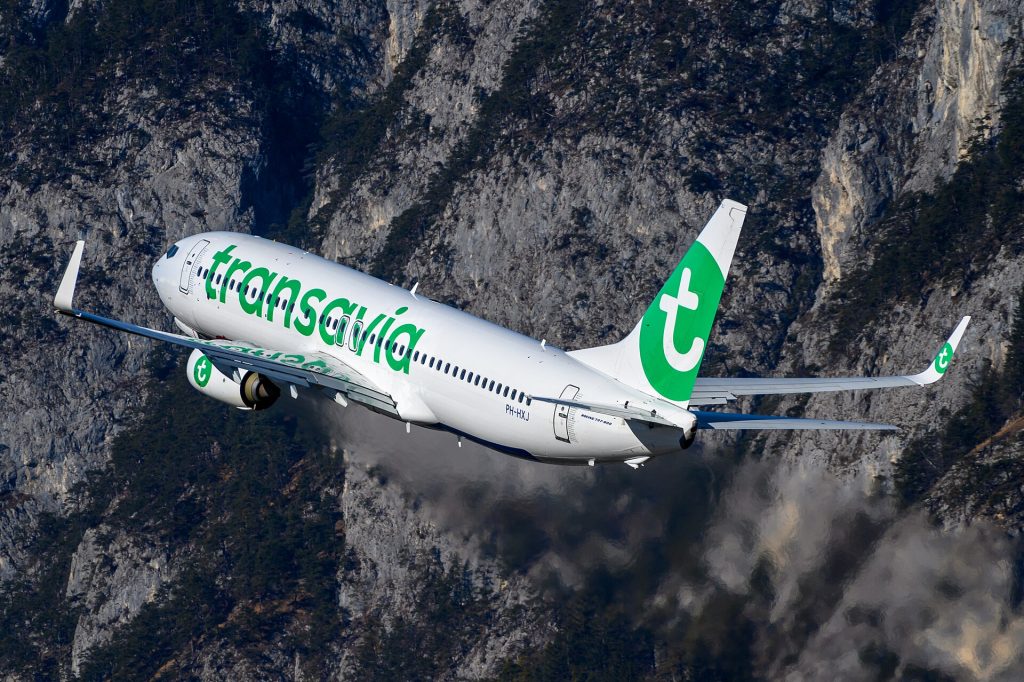
A Transavia France flight from Madrid to Paris declared an emergency over northern Spain this afternoon. Flight TO4635 began squawking 7700 at around 14:42 UK time, roughly half an hour after leaving Madrid. However, the reason for the emergency is still unclear.
What the Flight Data Shows
Data from Flightradar24 shows the Boeing 737-800 flying under the callsign TVF25BV. When the alert appeared, the jet was at 9,800 feet with a ground speed of 341 knots.
That altitude sits well below a normal cruising level for this stage of the journey. In fact, the track suggests the jet had already descended from a higher level.
Before the alert, the flight was heading north from Madrid towards Paris Orly. At that point, the aircraft was near the Bay of Biscay coast, not far from France. Its icon also turned red on the tracking map as the emergency code appeared.
The Aircraft Behind the Paris Service
The aircraft involved is F-GZHM, a Boeing 737-8K2. According to Airport-Data, Boeing built the jet in 2014, and Transavia France took delivery that same year. It flies with two CFM International CFM56-7BE engines.
This is also not the first notable event for this airframe. In February 2019, F-GZHM hit turbulence on a Lyon to Tel Aviv flight, and AeroInside reported ten injuries.
Transavia France operates as the low cost arm of Air France KLM, with its main base at Paris Orly.
What Squawk 7700 Means
Squawk 7700 is the code crews use to signal a general emergency, as Flightradar24 explains. Once a crew selects it, every air traffic control unit in the area receives an immediate alert.
However, the code covers a wide range of problems. RAF Lossiemouth has explained that these can range from a minor electrical fault to engine trouble. Crews also use it for medical emergencies and pressurisation issues.
For passengers bound for Paris, the alert does not automatically mean grave danger. Instead, it gives the crew priority handling and a clear path to a suitable airport.
What Happens Next for the Paris Flight
Right now, it is still unclear whether the crew will continue to Paris or divert. Several airports sit close to the aircraft’s position, including Bilbao, San Sebastián and Biarritz.
Biarritz also handled a similar Transavia France case last year. In November 2025, a 737 flying from Paris Orly to Lanzarote diverted there after declaring an emergency. That flight landed safely.
Normally, TO4635 covers the 1,028 kilometre trip in about one hour and 50 minutes before arriving at Orly Terminal 3. If the crew continues, emergency services at Paris Orly would typically stand by for the arrival.
Details on the number of passengers on board have not emerged yet. So far, Transavia has not released a statement on the incident either.
The Aviation Hub will update this story as soon as more information emerges. Meanwhile, you can track every live emergency on our Squawk 7700 board.
Continue to follow The Aviation Hub for more analysis and insight.
Continue to follow The Aviation Hub for more analysis and insight.
Advertise with us Your brand, in front of an aviation audience Home page and in-article placements, sold directly, one advertiser per slot. From £250 a year. See the rates