Christmas is one of the busiest times of year for families travelling to see relatives, and for many it will be a baby’s first flight. Here is what you need to know about flying with a baby, from passports and milk at security to seating and sore ears.
Flying with a baby takes more planning than travelling alone, but most of the potential problems are easy to avoid. The most common mistakes happen before you even reach the airport.
Your Baby Needs a Passport
Every baby needs their own passport, even a newborn, Which? says. A standard child passport costs £66.50 if you apply online, according to GOV.UK.
The photo must be taken against a plain, light coloured background, without dummies, toys or clothing that makes your baby hard to recognise. If your surname is different from your child’s, Which? recommends carrying proof of your relationship, such as a birth certificate.
Milk and Baby Food at Security
The usual liquids limits do not apply to baby essentials. You can take enough baby food, milk and sterilised water for the journey in your hand luggage, according to GOV.UK, and there is no legal limit on the amount.
Formula, cow’s milk, soya milk for babies, sterilised water and baby food are only allowed in hand luggage when your baby is travelling with you. Breast milk is allowed even if you are not travelling with your baby, in containers of up to 2,000ml, but frozen breast milk must go in the hold.
Expect staff to screen each item and possibly open containers. Check with your airport before you travel, as GOV.UK advises.
Sitting Together
There is no UK law requiring children to sit with their parents, but separating them goes against Civil Aviation Authority guidance, Which? reports. The CAA says young children and infants should ideally sit in the same row as the adult they are travelling with.
Airline policies vary. Which? says British Airways guarantees children will sit with at least one adult family member, while Ryanair requires under 12s to sit with an adult but makes at least one adult pay to reserve a seat. Jet2, easyJet and TUI try to seat families together without a firm guarantee.
Pushchairs and Car Seats
Airlines generally let you check in a fully collapsible pushchair for free, although size and weight rules decide whether it goes in the cabin or the hold, Which? says.
Using a car seat on board usually means buying an extra seat. A car seat that is legal in the UK may also not be legal at your destination, so check before you rely on it for taxis abroad.
Helping With Sore Ears
Babies cannot pop their ears on purpose, because their Eustachian tubes are narrower. Feeding or giving a dummy during take off and landing can help, Which? says.
Which? advises against flying when your baby has an ear infection, because of the risk of a burst eardrum. Speak to your GP if you are unsure.
What to Pack
Pack extra nappies, wipes, spare clothes and feeding supplies in your hand luggage in case of delays. Bring a change of top for yourself too.
Which? notes that children may be entitled to delay compensation even if they did not have their own seat, so keep your booking details if your flight is late.
The Bottom Line
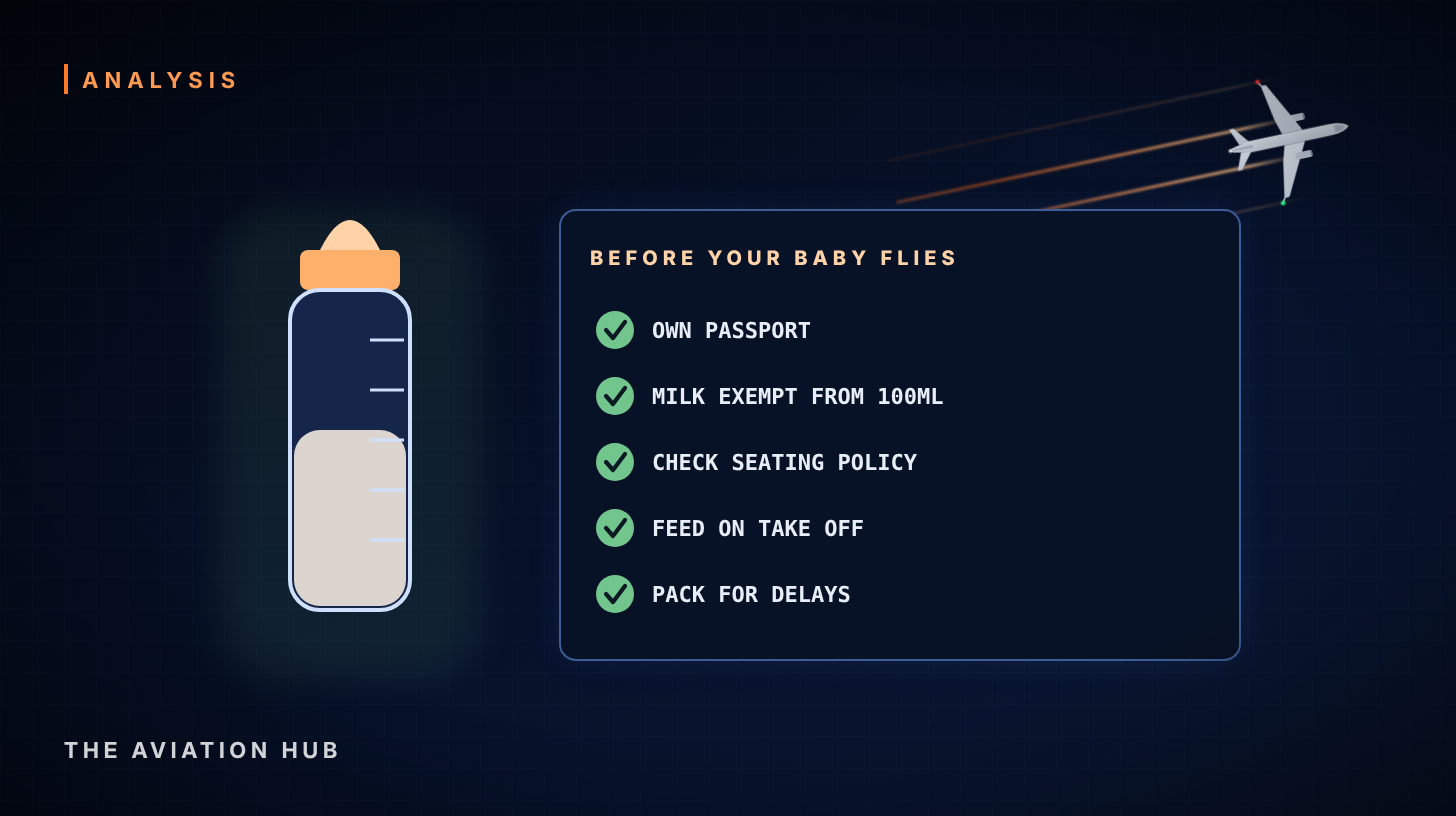
Flying with a baby is easier with the right preparation. Get your baby’s passport early, know that milk and baby food are exempt from the liquids limit and check your airline’s seating policy before you book.
Above all, pack for delays. A little extra in your hand luggage can make a long day far easier for everyone.
Continue to follow The Aviation Hub for more analysis and insight.
Advertise with us Your brand, in front of an aviation audience Home page and in-article placements, sold directly, one advertiser per slot. From £250 a year. See the rates