
Abha Airport Guide: Saudi Arabia’s Mountain Gateway
Abha Airport serves the cool Asir highlands of Saudi Arabia. Read about its history, high altitude runway, airlines, routes, access and expansion plans.
 By The Aviation Hub
5 min read
Updated October 20, 2026
High in the Asir mountains of southwest Saudi Arabia, where summer temperatures stay mild while the rest of the kingdom bakes, sits one of the region’s most unusual airports. Abha Airport serves the city of Abha and neighbouring Khamis Mushait from a plateau more than 2,000 m above sea level. It is the gateway for Saudi families escaping the summer heat and for a tourism push centred on the Asir highlands. Traffic has grown strongly, and a much larger terminal is planned.
Abha Airport at a Glance
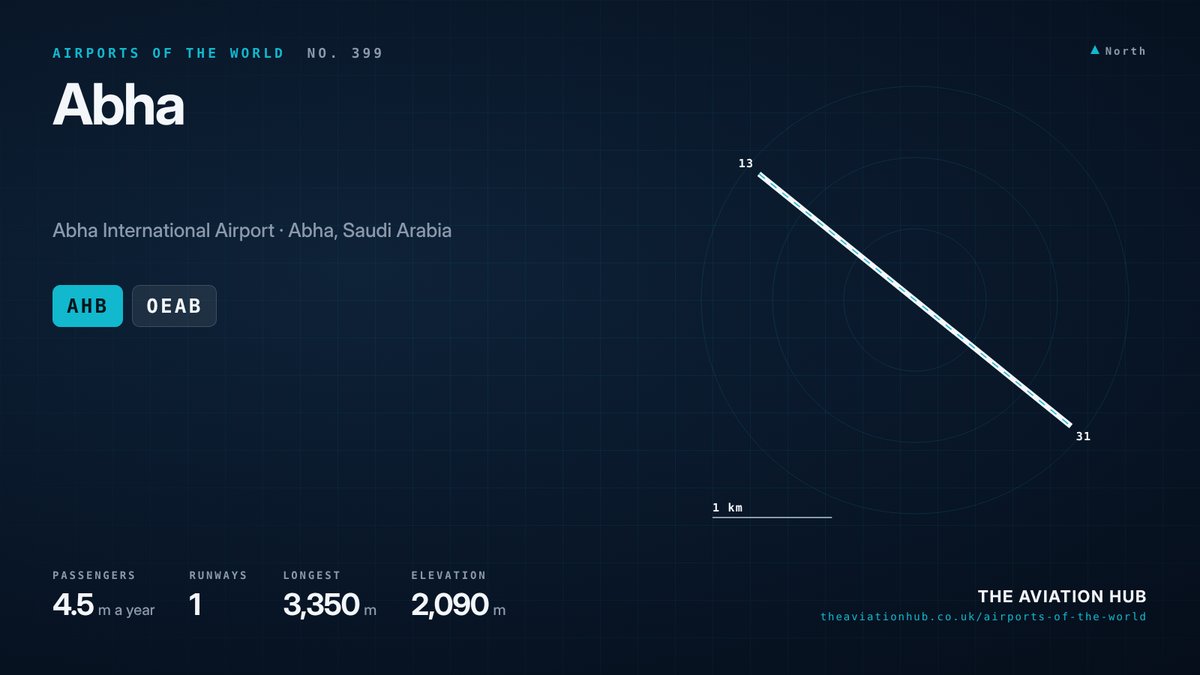
The IATA code is AHB and the ICAO code is OEAB. The airport lies between Abha and Khamis Mushait, about 10 miles (16 km) east of central Abha, at an elevation of 2,090 m (6,858 ft). It has one runway and a single passenger terminal. Industry estimates put traffic at Abha Airport at roughly 4.5 million passengers a year. Flynas runs an operating base here, and Saudia and flyadeal also fly heavily. The airport is state owned and is run as part of the Cluster2 group of Saudi regional airports. Up to date information is on the airport’s official website.
How Abha’s Airport Came to Be
Before the current airport existed, domestic flights used a military airfield near Khamis Mushait. Civil and military traffic shared the same facilities, with little room for passenger growth.
Construction of a new civil airport began in mid 1975 on a fresh site between the two cities, chosen so that it could serve both. The airport became operational in 1977 and quickly took over the region’s scheduled flights. Abha, the capital of the Asir region, sits on an escarpment above the Red Sea coastal plain, and the new airport put it within two hours’ flying time of Riyadh and Jeddah. International services followed over time, mainly to Egypt and the Gulf.
The Yemeni civil war brought danger close. Abha Airport lies within about 100 miles (160 km) of the Yemeni border, and it was frequently targeted by Houthi forces. In June 2019 one attack injured 26 people, and a second that month killed one person and injured 21. In February 2021 drones struck the airport and set a flyadeal Airbus A320 on fire. Attacks have since eased.
Runways at Abha Airport
A single asphalt runway, 13/31, handles all traffic. It measures 3,350 m (10,991 ft) long and 45 m wide. The length is essential, because at nearly 6,900 ft the thin air reduces both engine thrust and wing lift.
That elevation makes Abha a high altitude operation by any standard. Aircraft need longer take off runs, and on warm afternoons airlines may have to restrict payload on longer routes. Approaches pass over rugged terrain, and summer brings afternoon thunderstorms and low cloud that can roll in over the escarpment. Fog is also common in some seasons. Crews flying into Abha Airport plan carefully for these conditions, and the long runway provides a useful margin.
Terminals and Airlines
All passengers use a single terminal handling domestic and international flights. It is modest in size, and summer crowds stretch its facilities. The building is due to be replaced as part of the airport’s redevelopment.
Flynas has the largest network, with flights to Riyadh, Jeddah, Cairo, Dubai and Istanbul among others. Saudia serves Jeddah, Riyadh, Medina, Tabuk, Ta’if and Cairo. Flyadeal flies to Dammam, Jeddah and Riyadh, with seasonal Cairo services. Competition between the three Saudi airlines on the Riyadh and Jeddah routes is intense, which helps keep fares in check. Foreign carriers include Air Arabia, Air Cairo, EgyptAir, flydubai, Jazeera Airways, Nesma Airlines, Nile Air, Qatar Airways and SalamAir.
Routes and Destinations
Riyadh and Jeddah are the trunk domestic routes, served many times a day by all three Saudi airlines. Dammam, Medina, Tabuk and Ta’if fill out the domestic network. The Hajj and Umrah seasons add extra demand for flights to Jeddah and Medina. Most aircraft are Airbus A320 family jets.
Cairo is the most widely served international destination, reflecting the large Egyptian community working in the region. Dubai, Sharjah, Doha, Kuwait and Muscat link Abha with the Gulf, and Istanbul offers a gateway to Europe. Flynas planned new routes to Kuwait City and Trabzon from June 2026. Summer is the peak season at Abha Airport, when Saudis head for the cool mountains, the Soudah highlands and the heritage village of Rijal Almaa.
Getting to and from Abha Airport
There is no rail link. Taxis and ride hailing apps are the main options, reaching central Abha in around 20 to 25 minutes and Khamis Mushait in about 15. Khamis Mushait, the larger commercial city, is actually closer to the terminal than Abha itself.
Car hire is popular and makes sense for exploring the region. Desks sit in the arrivals hall at Abha Airport, and the drive to the Soudah area and the mountain escarpment takes under an hour. Roads in the highlands can be steep and winding, so allow extra time, particularly in fog. Parking is available beside the terminal.
Spotting and Photography
Saudi Arabia is not a country for casual airport photography. The Abha area also hosts King Khalid Air Base near Khamis Mushait, and the security situation near the Yemeni border remains sensitive. Photographing aircraft, the perimeter or military installations can lead to questioning or detention.
The safest approach is to watch from inside the terminal and avoid filming. The mountain backdrop and green summer landscapes make the setting attractive, but enthusiasts should keep cameras packed. Respect all signs, follow every instruction from police and security staff, and seek permission before photographing anywhere near Abha Airport.
What Comes Next
A major redevelopment is planned. In 2023 Saudi Arabia announced a masterplan for a new terminal at Abha, designed to raise capacity to around 13 million passengers a year by the end of the decade. The project supports the kingdom’s Vision 2030 tourism goals for the Asir region.
Flynas continues to add routes, and the Soudah development aims to bring luxury resorts to the highlands. A larger terminal could also attract more foreign airlines, particularly from Egypt, the Gulf and Turkey. With domestic tourism booming and more international links planned, the airport looks set for rapid growth. Explore more airports on the Airports of the World map.
Continue to follow The Aviation Hub for more analysis and insight.
Advertise with us Your brand, in front of an aviation audience Home page and in-article placements, sold directly, one advertiser per slot. From £250 a year. See the rates

