
Abu Dhabi Airport Guide: Etihad’s New Terminal A Hub
Abu Dhabi Airport, now Zayed International, moved into a vast new Terminal A in 2023. Read how the Etihad hub, its runways and its access work.
 By The Aviation Hub
6 min read
Updated October 20, 2026
Abu Dhabi Airport lies on the mainland about 19 miles (30 km) east of the island city that is the capital of the United Arab Emirates. Renamed Zayed International Airport in February 2024 after the country’s founding president, it is the hub of Etihad Airways and the second busiest airport in the UAE after Dubai. The opening of the enormous Terminal A in late 2023 turned a cramped, patched together field into one of the largest single terminal operations in the world. More than 32 million passengers used it in 2025.
Abu Dhabi Airport at a Glance
The codes are AUH and OMAA. The field sits on flat desert 27 m (88 ft) above sea level, covering about 6,000 hectares beside the E10 highway towards Dubai. It has two parallel asphalt runways and now a single passenger terminal, Terminal A, with the older Terminals 1, 2 and 3 closed. Abu Dhabi Airports, a state owned company, operates it along with Al Bateen, Al Ain and the emirate’s smaller fields.
Abu Dhabi Airport handled roughly 32 million passengers in 2025, after a record of more than 29 million in 2024. Etihad is the dominant carrier by far, with Wizz Air Abu Dhabi and Air Arabia Abu Dhabi as low cost partners until Wizz withdrew in 2025. About 24 scheduled airlines serve roughly 130 destinations, and the US Customs preclearance facility is the only one in the Middle East. Flight information is on the airport’s official website.
How Abu Dhabi’s Airport Came to Be
Abu Dhabi’s first airport was on the island itself, at the site now called Al Bateen Executive Airport. By the early 1970s it was hemmed in by the growing city and reachable from the mainland by a single bridge. Planning for a replacement began in 1974 as part of Sheikh Zayed’s modernisation programme, and construction started in 1979 on open desert to the east.
The new airport opened on 2 January 1982 with a striking design, a circular satellite with gates on its rim linked to a half circle main building. Gulf Air, then jointly owned by Abu Dhabi, Bahrain, Oman and Qatar, made it one of its hubs. A low cost Terminal 2 followed in 2005 and Terminal 3 opened in January 2009 as an interim building for Etihad, which had been founded in 2003 and was growing fast.
The Midfield Terminal was conceived in the 2000s and due in 2017, but the date slipped repeatedly, and a major construction contract was cancelled in 2021. Etihad flew the first departure from the renamed Terminal A on 31 October 2023 and every airline had moved in by 14 November. The airport took the Zayed name on 9 February 2024.
Runways at Abu Dhabi Airport
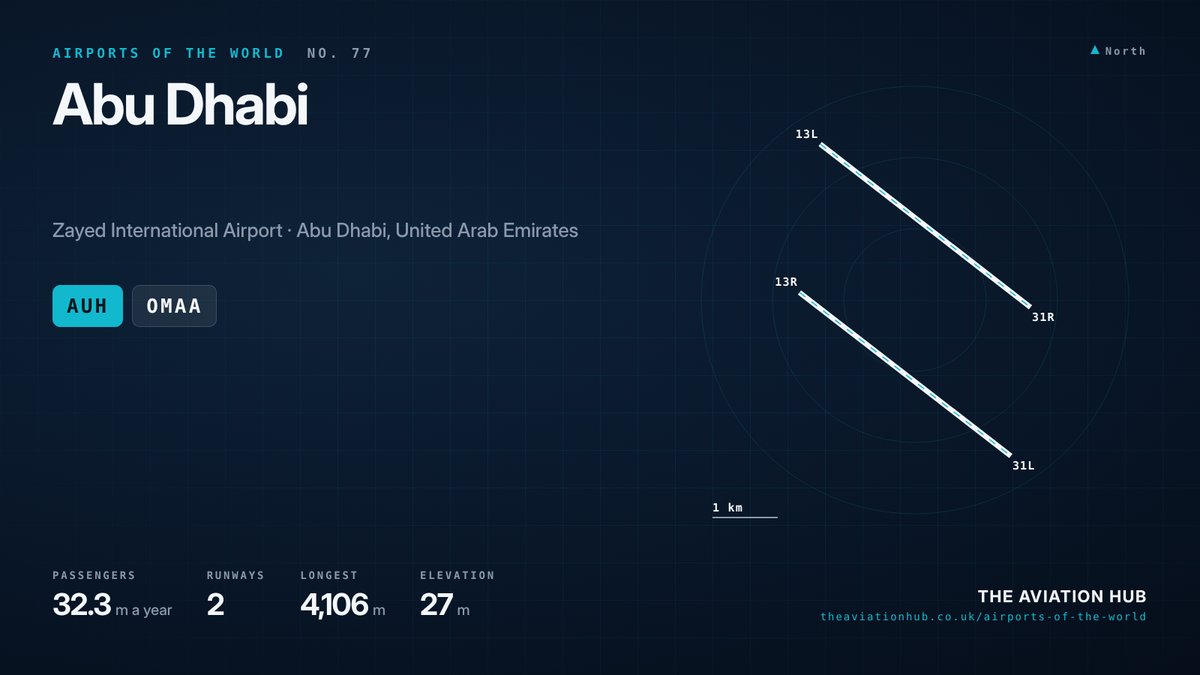
Abu Dhabi Airport has two parallel asphalt runways, both 60 m wide. Runway 13R/31L is 4,106 m (13,471 ft) long and Runway 13L/31R is 4,100 m (13,451 ft). Both are long enough for a fully loaded Airbus A380 or Boeing 777-300ER in the heat of a Gulf summer, when thin air stretches take off runs. Both carry instrument landing systems for the dust and fog that sometimes settle over the coast.
The runways are far enough apart for independent parallel operations, and Terminal A sits between them, which is why the project was called the Midfield Terminal. Cross field taxiways link both strips to the terminal aprons. The prevailing northwesterly shamal wind favours the 31 direction, with approaches over the desert from the southeast, while the 13 direction brings arrivals in over the Gulf shore.
Capacity on the pair is well above current demand, and the master plan reserves land for a third parallel runway. A 109 m control tower already stands between the existing pair, built in the late 2010s.
Terminals and Airlines
Terminal A is the whole airport for passengers. Its floor area exceeds 780,000 square metres, it has capacity for 45 million passengers a year and it can park 79 wide body aircraft at once. The X shaped building was designed by Kohn Pedersen Fox, with a central hall under a sweeping roof and four piers. Biometric gates handle check in, security and boarding for many Etihad flights under the Smart Travel programme launched in 2024.
Etihad occupies the lion’s share with its Boeing 787s, Airbus A350-1000s, A380s and A321neos. Its partners and visiting carriers include British Airways, Turkish Airlines, Qatar Airways, Saudia, IndiGo, Air India Express, Pakistan International, Air China and China Eastern. Air Arabia Abu Dhabi runs a low cost network to the subcontinent and the Middle East. The Etihad First and Business lounges and a large US preclearance hall sit in the same building.
Routes and Destinations
The Indian subcontinent supplies the bulk of the traffic from Abu Dhabi Airport. Mumbai, Delhi, Kochi, Thiruvananthapuram, Karachi, Lahore, Dhaka and Kathmandu are flown many times a day by Etihad, Air Arabia Abu Dhabi, IndiGo and the national carriers, carrying workers and families between the Gulf and South Asia. London Heathrow, Manchester, Paris, Frankfurt and Istanbul lead the European list.
Etihad’s long haul network reaches New York JFK, Washington, Chicago, Boston, Toronto, Sydney, Melbourne, Tokyo, Shanghai, Bangkok and Johannesburg, with Boeing 787-9s and Airbus A350-1000s doing most of the work and the A380 on London. Sydney at about 7,500 miles (12,000 km) is among the longest services. The airline has been adding destinations rapidly since 2023 as it rebuilds after years of retrenchment.
Cargo is a major business, with around 680,000 tonnes handled a year. Etihad Cargo operates 777 freighters and the operator plans further growth in cargo and logistics.
Getting to and from Abu Dhabi Airport
There is no rail link yet, so the airport depends on roads. The E10 and E11 highways reach the city in 25 to 40 minutes and Dubai in about an hour and a quarter. Taxis wait outside Terminal A and a ride to downtown Abu Dhabi costs around AED 80 to 100 (£17 to 22), with a surcharge for airport pick up. Ride hailing apps work from a marked zone.
Abu Dhabi’s Department of Transport runs bus routes A1 and A2 to the city centre around the clock for a flat fare of about AED 4, which makes them the cheapest sensible option, and route E102 continues to Dubai. Etihad runs coaches to Dubai and Al Ain for its passengers. Short and long stay car parks surround Terminal A, but Abu Dhabi Airport still waits for a rail connection.
Spotting and Photography
Terminal A has large glass walls on the airside, and the piers give views of the Etihad fleet parked along the stands, so the terminal itself is the easiest vantage point once past security. Outside the fence, the desert roads near the 31 thresholds southeast of the field give views of arrivals, but there is no official viewing area and the heat makes long sessions difficult for much of the year.
Winter mornings are the best time, with clear air and soft light from the east. The Etihad A380s and A350-1000s, Air Arabia A320s, Etihad Cargo 777Fs and the stream of Indian and Pakistani 737s and A320s provide the interest. Security is strict in the UAE, so photograph only from public areas, never near military or government buildings, and move on if police ask.
What Comes Next
Terminal A was built with growth in mind. Its capacity can be raised from 45 million to 60 million passengers through additional piers, and the master plan allows for a further facility to take the field to 80 million. Etihad plans to double its fleet by 2030, and a third runway and expanded cargo zone wait in the plan for when demand justifies them.
A rail connection would complete the picture, and Etihad Rail’s passenger service is the project to watch. Abu Dhabi Airport is finally the hub its airline needed and has room to grow for decades. Compare it with Dubai and Doha on the Airports of the World map.
Continue to follow The Aviation Hub for more analysis and insight.
Advertise with us Your brand, in front of an aviation audience Home page and in-article placements, sold directly, one advertiser per slot. From £250 a year. See the rates

