
Ahmedabad Airport Guide: Gujarat’s Busy Single Runway Hub
Ahmedabad Airport handles over 13 million passengers on one runway. Read about its history, terminals, routes, transport links, spotting and future plans.
 By The Aviation Hub
6 min read
Updated October 20, 2026
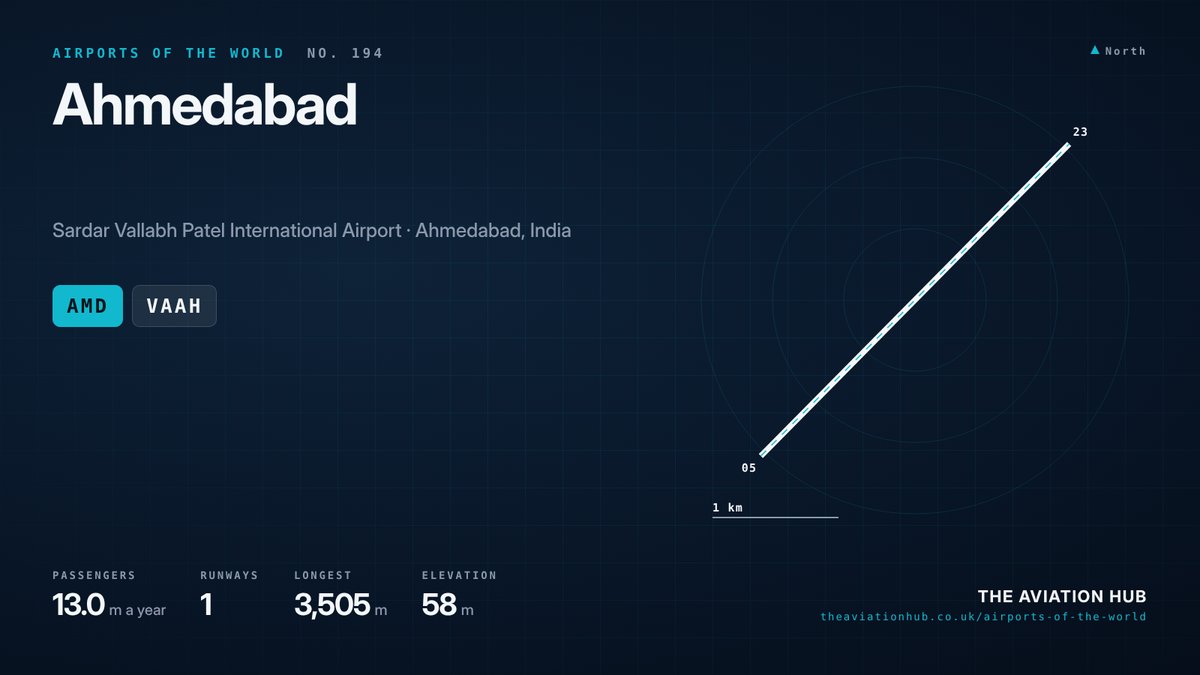
Ahmedabad Airport, officially Sardar Vallabhbhai Patel International Airport, is the main air gateway to Gujarat and one of the busiest airports in India. It sits on the northern side of Ahmedabad, the state’s largest city and commercial centre. More than 13 million passengers used it in the 2024 to 2025 financial year, making it the seventh busiest airport in the country. All of that traffic runs on a single runway, which shapes nearly every plan for its future.
Ahmedabad Airport at a Glance
The IATA code is AMD and the ICAO code is VAAH. The airport lies at Hansol, roughly 6 miles (9 km) north of the old city. Elevation is 58 metres (189 feet). There is one runway and two main passenger terminals, plus a separate cargo terminal.
Ahmedabad Airport handled about 13.4 million passengers in the 2024 to 2025 financial year. IndiGo has an operating base here, and Air India treats it as a focus city alongside its low cost arm, Air India Express. Akasa Air and SpiceJet also run sizeable operations. The Adani Group operates the site through Ahmedabad International Airport Limited, under a concession signed with the Airports Authority of India in February 2020. Flight details are on the airport’s official website.
How Ahmedabad’s Airport Came to Be
The airfield opened in 1937, in the late colonial era, as a modest aerodrome for the textile city. For decades it handled a few domestic flights to Bombay and Delhi. International operations began on 26 January 1991, Republic Day, and the airport gained full international status on 23 May 2000.
The name honours Sardar Vallabhbhai Patel, the independence leader from Gujarat who became India’s first Deputy Prime Minister. On 19 October 1988, Indian Airlines Flight 113 from Mumbai crashed in fog on final approach. The crash killed 133 people and remains a sombre part of the airport’s story.
A new international terminal, Terminal 2, opened on 15 September 2010 with four air bridges. Its design drew on Singapore Changi, and it marked the start of real growth. Adani took over operations in late 2020. On 12 June 2025, Air India Flight 171, a Boeing 787-8 bound for London Gatwick, crashed in Meghaninagar shortly after take off. Of the 242 people on board, 241 died, along with 19 people on the ground.
Runways at Ahmedabad Airport
Ahmedabad Airport has a single asphalt runway, 05/23, which is 3,505 metres (11,499 feet) long and 46 metres wide. That length handles any wide body type in service, from the Boeing 777 and 787 to the Airbus A350. The runway runs northeast to southwest through dense urban districts.
Runway 23 is used for more than 70 per cent of operations, so most arrivals come in from the northeast and most departures climb out to the southwest. Summer heat, often above 40 degrees Celsius before the monsoon, eats into aircraft performance on long haul take offs. Winter fog can disrupt early morning flights.
The weak point has been the taxiway. The parallel taxiway was only 1,895 metres long, so many aircraft had to backtrack along the runway, which cuts capacity. The first 395 metre extension was finished in March 2024, and work continues to run it the full length of the runway.
Terminals and Airlines
Terminal 1 has traditionally handled domestic flights and covers about 45,000 square metres with 32 check in counters. Terminal 2 was built for international traffic, with four air bridges and 32 counters of its own, though airlines have been shuffled between the buildings as demand has grown. A 500 metre moving walkway links the two. The airport won Airport Service Quality awards in 2019.
IndiGo is the largest operator at Ahmedabad Airport, flying Airbus A320neo and A321neo jets plus ATR 72 turboprops. Air India and Air India Express fly A320 family and Boeing 737 aircraft, while Akasa Air uses the 737 MAX. Gulf carriers dominate the foreign list, led by Emirates, Qatar Airways, Etihad, flydubai and Air Arabia.
Routes and Destinations
Mumbai and Delhi are the busiest routes, each served many times a day. Bengaluru, Hyderabad, Chennai, Kolkata, Pune and Goa follow, along with a growing list of tier two cities. Short regional flights link Ahmedabad with smaller airports around Gujarat and neighbouring states.
Internationally, the Gulf is the core market. Dubai, Abu Dhabi, Doha, Sharjah and Kuwait carry heavy flows of migrant workers, traders and families. Gujarat’s large diaspora in Britain and North America drives long haul demand. Air India flew to London Heathrow from 2004 to 2008 and resumed in 2016, and later served London Gatwick. London is the longest nonstop sector, at roughly 4,300 miles (6,900 km). Wedding season and the Navratri festival bring strong autumn and winter peaks.
Getting to and from Ahmedabad Airport
Ahmedabad Airport is not yet on the city’s metro network, so road transport carries almost everyone. The drive to the old city and the Sabarmati riverfront takes 20 to 40 minutes, depending on traffic. Gandhinagar, the state capital, is around 30 to 45 minutes away.
Prepaid taxis wait outside arrivals, and app based services such as Uber and Ola work well. Agree fares or use the app price to avoid surprises. Municipal AMTS buses run to the airport from the city and are the cheapest sensible option for light travellers. Short and long stay parking sits in front of both terminals.
Spotting and Photography
Spotting at Ahmedabad Airport needs care. Indian airports are sensitive sites, and photography near fences can draw police attention quickly. The safest views come from inside the terminals, where the departure gates look over the apron and the parallel taxiway.
With runway 23 dominant, arrivals pass low over residential areas to the northeast, and some rooftops give clear views of aircraft on short final. Morning sun lights the southeast side of the runway, while late afternoon favours the northwest. The traffic is mostly A320neo and 737 types, with Emirates wide bodies a daily highlight. Stay on public land, never photograph security installations and follow every instruction from officials. Respect local rules at all times.
What Comes Next
Adani plans a third passenger terminal and a new air traffic control building with a 65 metre tower. Completing the full length parallel taxiway will lift runway capacity, which is the airport’s biggest constraint. A second runway would be hard to fit on the crowded urban site.
Longer term, a new airport at Dholera, about 66 miles (107 km) southwest, is under construction and could take some cargo and overflow traffic. The loss of Flight 171 also brought renewed scrutiny of safety and emergency planning around the airfield. Ahmedabad Airport is heading for steady growth, held in check by one runway until new capacity arrives. Compare it with other Indian airports on the Airports of the World map.
Continue to follow The Aviation Hub for more analysis and insight.
Advertise with us Your brand, in front of an aviation audience Home page and in-article placements, sold directly, one advertiser per slot. From £250 a year. See the rates

