
Algiers Airport Guide: Air Algérie’s Home and the New Terminal
Algiers Airport is Air Algérie's hub, with two long runways and a terminal opened in 2019. Explore its history, routes to France and beyond, and transport.
 By The Aviation Hub
6 min read
Updated October 20, 2026
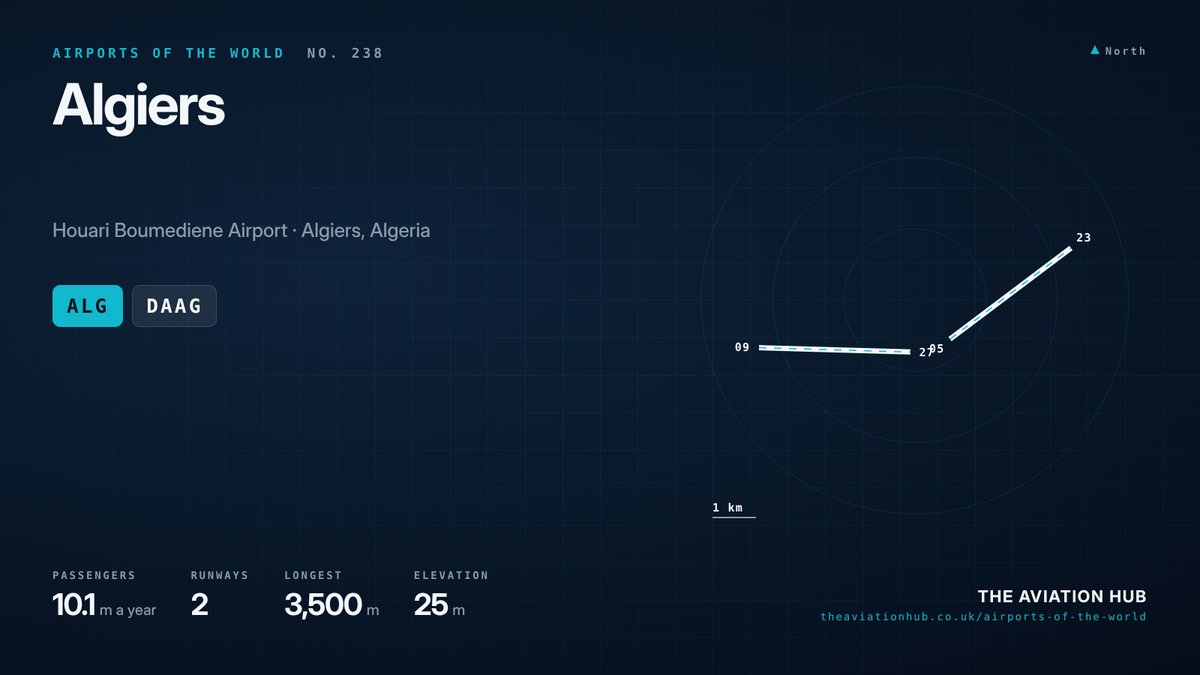
Houari Boumediene Airport lies at Dar El Beida, about 10 miles (16 km) east of central Algiers on the coastal plain. It is the main international gateway to Africa’s largest country and the home base of Air Algérie. Algiers Airport handled around 10 million passengers in 2025, up from about 9.15 million in 2024. Its flights to France carry one of the busiest diaspora flows in the Mediterranean, and a large new terminal opened in 2019 has transformed the passenger experience.
Algiers Airport at a Glance
The IATA code is ALG and the ICAO code is DAAG. The field sits 82 feet (25 m) above sea level, between the city’s eastern suburbs and the Mitidja plain. It has two runways and four terminal buildings, of which Terminal 4 handles most international flights. Traffic reached 9,151,517 passengers in 2024, and roughly 10 million in 2025.
Air Algérie is the hub carrier at Algiers Airport, and the new domestic carrier Domestic Airlines is also based here. The state owned company SGSIA runs the airport, after many years in which Aéroports de Paris managed operations under contract. Flight information and terminal guidance are on the airport’s official website.
From Maison Blanche to Boumediene
The airport opened in 1924 as Maison Blanche, named after the district now called Dar El Beida, which means the white house in Arabic. It grew into the main air link between Algiers and metropolitan France. During the Second World War it became a key Allied base after the Operation Torch landings of November 1942. RAF Hurricanes flew from the field, and the United States Army Air Forces used it as a major transhipment hub.
The name Maison Blanche runs through accounts of the Algerian War, when the airport handled French military traffic and later the mass departures of 1962. It was later renamed after Houari Boumediene, the president who led Algeria from 1965 until his death in 1978.
The modern era began on 29 April 2019, when Terminal 4 opened. Air Algérie moved across in stages and foreign airlines followed from mid May. A 320 room Hyatt Regency hotel, connected directly to the terminal, opened the same month.
Runways at Algiers Airport
There are two runways, both asphalt and both 3,500 metres (11,483 feet) long. Runway 05/23 is 60 metres wide and runway 09/27 is 45 metres wide. That length comfortably handles the Airbus A330 and Boeing 737 aircraft that make up Air Algérie’s mainline fleet, as well as visiting wide bodies such as the Boeing 777.
The two runways run on different headings, giving controllers options when the wind shifts along the coast. A helipad sits alongside for government and emergency flights. In 2023 an Air Algérie Cargo Boeing 737-800 struck its tail on runway 05 during take off and punctured its fuselage. The crew abandoned the departure unhurt, and investigators found a pallet had been loaded in the wrong compartment.
Terminals and Airlines
Terminal 4 is the centrepiece of Algiers Airport. It covers a vast site, can handle the Airbus A380 and added capacity for about 10 million passengers a year. Air Algérie and most foreign airlines operate from it. Terminal 1, the original international building, has two halls, one for domestic passengers and one for Middle East and Gulf carriers.
Terminal 2, renovated in 2007, now handles charter and Hajj pilgrimage flights. Terminal 3, the former domestic building, is due to be demolished to make way for a new terminal.
Air Algérie dominates the schedule at Algiers Airport with Boeing 737-800 and Airbus A330 jets. Foreign carriers include Air France, Transavia, Turkish Airlines, Pegasus, AJet, Qatar Airways, Saudia, Vueling, British Airways and Emirates, which has scheduled the end of its Dubai service for February 2027.
Routes and Destinations
France is by far the largest market for Algiers Airport, reflecting the millions of people of Algerian origin living there. Paris Charles de Gaulle and Orly lead, followed by Marseille, Lyon and other French cities. Istanbul, Barcelona, Madrid and London add further European links, and Tunis, Cairo and Jeddah anchor the Arab world network.
Air Algérie flies long haul to Montreal, about 3,900 miles (6,300 km) away, and to Beijing, Guangzhou and Kuala Lumpur. At roughly 6,600 miles (10,600 km), Kuala Lumpur is among the longest routes. Delhi and Shanghai join the network from 26 October 2026. African routes include Luanda and Libreville. Political tensions have left neighbouring Morocco without direct flights since 2021.
Traffic peaks in summer, when families in France return home, and around the Hajj season.
Getting to and from Algiers Airport
A railway line links the airport with Agha station in central Algiers, and trains take roughly half an hour. It is the cheapest sensible option for travellers heading to the city centre. An extension of the Algiers Metro towards the airport has also been under construction.
ETUSA buses run between the airport and central Algiers, including the stop near the Grande Poste, though journey times depend heavily on traffic. Taxis wait outside arrivals and take 30 to 60 minutes to the centre, so agree a fare before setting off. The East West motorway and national roads pass close to Algiers Airport, and car parks sit in front of each terminal.
Spotting and Photography
Spotting at Algiers Airport is not recommended outside the terminal. Algeria treats airports as sensitive sites, and photographing aircraft, runways or security installations from the perimeter can lead to detention. Military and government aircraft also use the field.
The best views are from inside Terminal 4, where large windows overlook the apron. Air Algérie’s 737s and A330s mix with Turkish, Gulf and European visitors, and the occasional Air Algérie Cargo freighter adds interest. The Mediterranean light is bright year round, and winter rain clears the air.
Respect local rules strictly. Ask before taking any photograph, never point a camera at military aircraft and stop immediately if officials object.
What Comes Next
Terminal 3 will give way to a new terminal, and the metro extension will improve access. Air Algérie is renewing its fleet and expanding into Asia, with Delhi and Shanghai the latest additions.
Capacity is no longer the immediate problem. With Terminal 4 open, the airport can handle well above its current traffic, and the two long runways have room for many more movements. The bigger limits are commercial, as strict visa rules, currency controls and a small inbound tourism market hold back demand. Algiers Airport is heading for steady expansion, anchored by the French diaspora market and Air Algérie’s long haul ambitions. See how it compares with Tunis and Casablanca on the Airports of the World map.
Continue to follow The Aviation Hub for more analysis and insight.
Advertise with us Your brand, in front of an aviation audience Home page and in-article placements, sold directly, one advertiser per slot. From £250 a year. See the rates

