
Alicante Airport Guide: The Costa Blanca’s Busy Gateway
Alicante Airport is the Costa Blanca gateway loved by British travellers, with one runway and a Ryanair base. Runways, routes and access explained.
 By The Aviation Hub
7 min read
Updated October 20, 2026
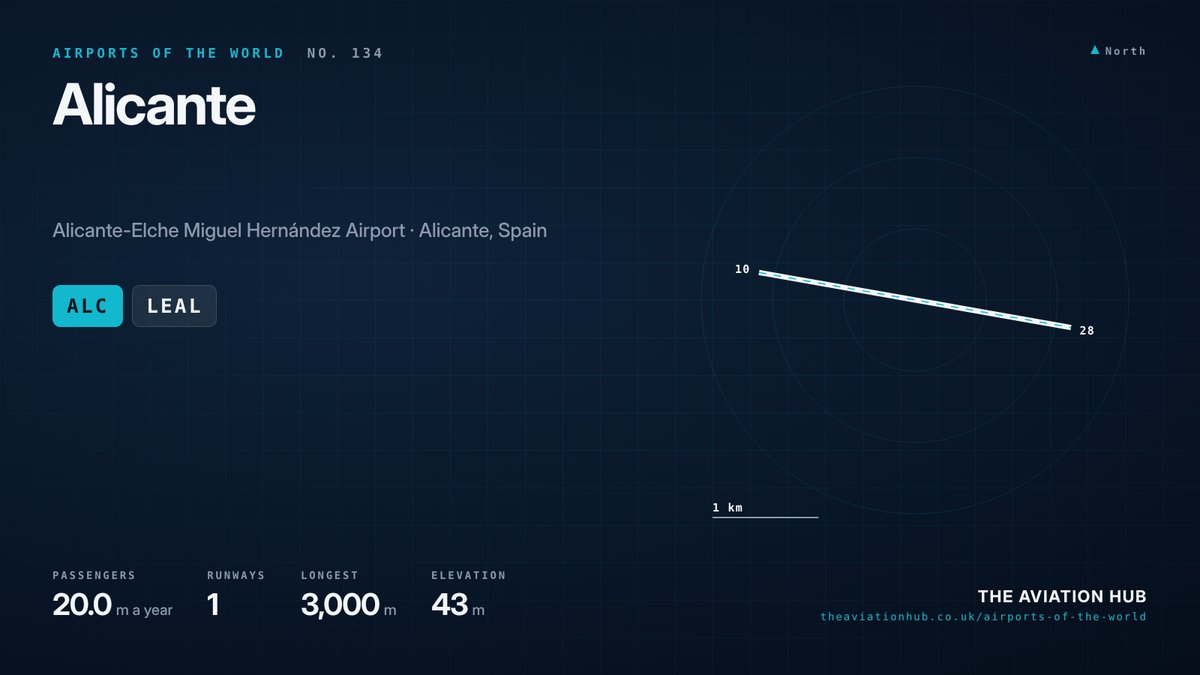
Alicante Elche Miguel Hernandez Airport lies at El Altet, about 6 miles (9 km) south west of Alicante and the same distance east of Elche, on the Costa Blanca in south eastern Spain. It is the busiest airport in the Valencian Community and the fifth busiest in Spain. Alicante Airport handled just under 20 million passengers in 2025, a large share of them from the United Kingdom, which makes it one of the most familiar foreign airports to British travellers. A single runway and a single terminal cope with a market that is heavily seasonal and almost entirely low cost.
Alicante Airport at a Glance
The codes are ALC and LEAL. The field sits at 43 m (142 ft) above sea level on a dry plateau a couple of miles inland from the beaches of Arenales del Sol. It has one runway, 10/28, and one terminal in public use, the New Terminal Area known as the NAT, which opened in 2011 and has a stated capacity of 20 million passengers a year.
Aena, the Spanish state controlled airport company, owns and operates Alicante Airport. Ryanair is the largest airline with 18 based aircraft in summer 2025, and easyJet, Vueling and Norwegian also base aircraft here. Jet2 is a major presence without a formal base. Traffic in 2025 reached 19.95 million passengers on about 126,000 aircraft movements, up 8.5 per cent on 2024. Live flight information and parking rates are on the airport’s official website.
How Alicante’s Airport Came to Be
Alicante was served from 1936 by the La Rabassa aerodrome north of the city, a grass field that could not handle jets. The replacement at El Altet opened on 4 May 1967, taking its name from the surrounding countryside of the Elche municipality. The runway was extended to 3,000 m in 1980 as the package holiday boom took hold.
Iberia led the traffic until 2003, and easyJet took the lead in 2004, a sign of how completely the low cost model had captured the Costa Blanca. The old terminal was enlarged repeatedly and an auxiliary T2 opened in 2007, but neither could keep pace. The New Terminal Area opened on 23 March 2011, a vast building of around 333,500 square metres that replaced both at a stroke. Terminals 1 and 2 have stood closed ever since.
The name gained Elche in 2013 and in 2021 the airport was renamed after Miguel Hernandez, the poet from nearby Orihuela who died in a Francoist prison in 1942. A roof fire in January 2020 closed the airport for 24 hours and diverted around 160 flights, one of the worst disruptions in its recent history.
Runways at Alicante Airport
The single runway, 10/28, is 3,000 m (9,842 ft) long and 45 m wide, surfaced in asphalt. It runs roughly east to west, with the 28 end nearest the sea. The length is ample for the Boeing 737 and Airbus A320 families that make up almost all the traffic, and wide body visitors such as Boeing 787s and Airbus A330s on occasional long haul charters use it without difficulty.
Wind patterns on this coast are gentle but shift through the day. Sea breezes from the east in the afternoon put arrivals on 10, approaching over the plateau from the Elche side, while mornings and winter days often favour 28 with approaches from over the coast. Fog is rare, but the gota fria storms of autumn can bring torrential rain and flooding to the roads around the field.
One runway is enough for most of the year. In the July and August peak the runway runs close to capacity and Alicante Airport has its busiest days of the year on Saturdays, when the weekly package holiday rotations change over.
Terminals and Airlines
The New Terminal Area is a long rectangular building with check in and arrivals at ground level, security and shopping above, and gates arranged along two piers with around 40 stands, many of them walk out rather than jet bridge. Schengen and non Schengen flights are separated airside, and the non Schengen area, where British flights depart, becomes crowded at summer peaks. Lounge space is limited.
Ryanair is the largest carrier at Alicante Airport by a wide margin, flying Boeing 737-800s and 737 MAX 8-200s to dozens of British, Irish, Scandinavian and central European cities. easyJet flies Airbus A320s and A321neos from most of its British bases and from Switzerland. Jet2 fields 737-800s and A321neos from all its northern English and Scottish bases, and Vueling and Iberia cover Spain.
Norwegian, SAS, Finnair, KLM, Transavia, Lufthansa, Eurowings, Brussels Airlines, Air Europa, Wizz Air and TUI complete a roster that is almost entirely European. Volotea adds Bilbao and Asturias, while Royal Air Maroc and Air Algérie cross to North Africa.
Routes and Destinations
The British routes dominate. Manchester was the busiest single route in 2023 with around 850,000 passengers, followed by London Gatwick at about 737,000, Bristol at roughly 464,000, London Stansted at around 450,000, East Midlands at about 360,000 and Birmingham at around 346,000. Leeds Bradford, Liverpool, Newcastle, Glasgow, Edinburgh and Belfast all see several flights a day in summer.
Amsterdam, Brussels, Oslo and Stockholm lead the continental routes, and Palma de Mallorca, Barcelona and Madrid are the busiest domestic flights. The longest scheduled service is FlyOne’s link to Yerevan at about 2,380 miles (3,840 km), ahead of Reykjavik at around 2,000 miles, and there is no regular long haul. Traffic is strongly seasonal, peaking from June to September and dipping in January, although the winter is cushioned by retired British and Scandinavian residents flying home for Christmas. Cargo is minimal.
Getting to and from Alicante Airport
There is no rail link yet. Bus C6 runs between the terminal and central Alicante every 15 minutes from 6am to 11pm and hourly overnight, taking around 30 minutes for a fare of under €5, the cheapest sensible option. Buses R10 and R11 serve Elche, and hourly coaches run to Benidorm, Torrevieja, Santa Pola, Guardamar del Segura and Murcia.
By road the airport sits beside the N 338 link to the A 7 and AP 7 motorways, with Alicante 15 to 20 minutes away and Benidorm about 45 minutes. Official white taxis with a green stripe charge around €25 to €30 (roughly £21 to £26) to Alicante, and Uber and Cabify have had pick up areas since 2024. Car hire is huge here, with a dedicated rental centre, and the long stay car parks fill in August. Aena has reserved space in the terminal for a future railway station and tram stop on the planned Alicante to Murcia commuter line.
Spotting and Photography
Alicante Airport is a pleasant place to watch aircraft, helped by the climate. The best known spots line the fence on the far side of the runway from the terminal, reached through the village of El Altet. A broken wall by the 28 touchdown zone suits winter, when 28 is usually in use, and a small mound halfway along lets photographers shoot over the fence in both directions. Further west, rocks beside the fence make the best spot when runway 10 is active, as it is for most of the year.
Inside the terminal the upper level windows look onto the main apron and the runway. The traffic is overwhelmingly 737s and A320s in a dozen liveries, but North African carriers, business jets and the occasional visiting A330 or 787 add interest. Winter brings the odd diversion.
The Guardia Civil patrol the perimeter and are generally relaxed about spotters on public land. Stay off the fence, park sensibly on the narrow roads and avoid pointing lenses at the police or airport staff.
What Comes Next
Aena approved a major expansion in September 2026 worth around €868 million, due to finish in 2031. It adds a new non Schengen boarding area that enlarges the terminal by nearly 30 per cent, more stands and a new apron, and finally demolishes the derelict Terminals 1 and 2. The project reflects the reality that British and other non Schengen passengers have outgrown the space set aside for them.
The rail link remains the missing piece. The Cercanias commuter line between Alicante and Murcia via the airport has been planned for decades, and the terminal is built to receive it when funding and politics align. Noise and water constraints are modest for a Spanish airport, and the main limit on growth is the single runway at summer peaks.
Alicante Airport is heading well past 20 million passengers and a terminal fit for them, with the Costa Blanca’s appeal showing no sign of fading. Compare it with other Spanish gateways on the Airports of the World map.
Continue to follow The Aviation Hub for more analysis and insight.
Advertise with us Your brand, in front of an aviation audience Home page and in-article placements, sold directly, one advertiser per slot. From £250 a year. See the rates

