
Amman Airport Guide: Jordan’s Gateway Under the Domes
Amman Airport is home to Royal Jordanian and a domed Foster terminal. Read our guide to its runways, airlines, routes, transport links and spotting.
 By The Aviation Hub
7 min read
Updated October 20, 2026
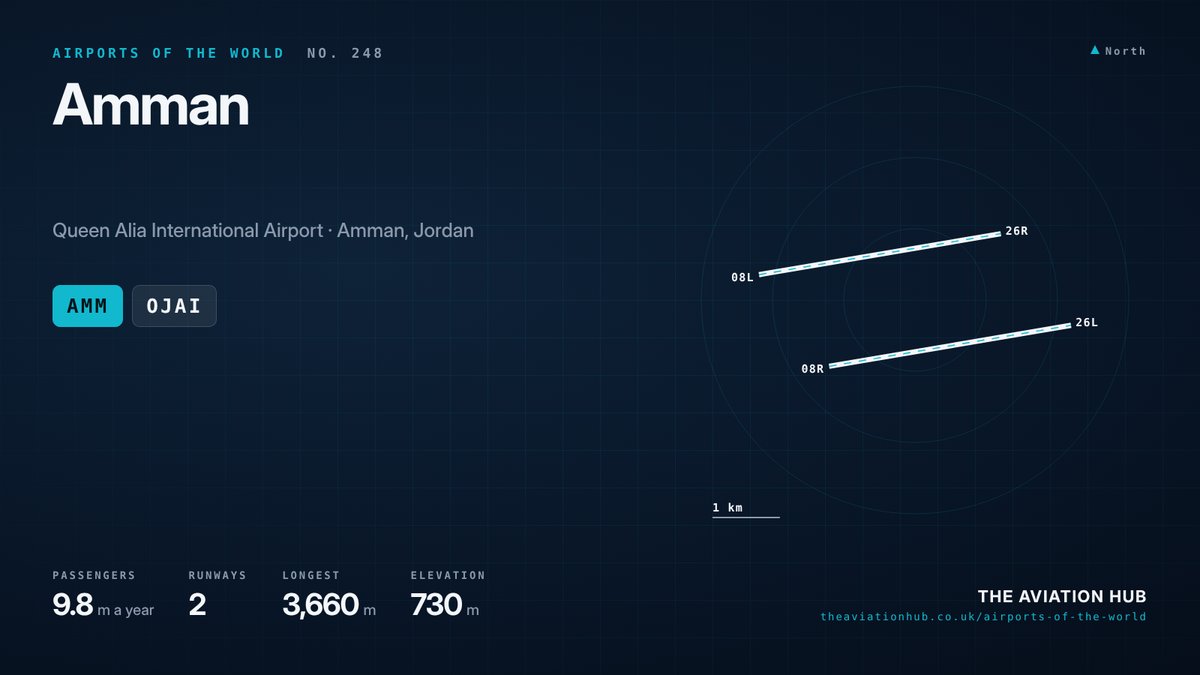
Queen Alia International Airport sits on the desert plateau about 18 miles (30 km) south of central Amman, beside the highway that runs down to Aqaba. Amman Airport is the main international gateway to Jordan and handles close to 9 million passengers a year. It is the home of Royal Jordanian, a oneworld member that links the Levant with Europe, the Gulf and North America. Its domed terminal, designed by Foster + Partners, is one of the more distinctive buildings in Middle Eastern aviation.
Amman Airport at a Glance
The IATA code is AMM and the ICAO code is OJAI. Amman Airport lies around 18 miles (30 km) south of the city centre at an elevation of 730 metres (2,395 feet). It has two parallel runways and a single passenger terminal that opened in 2013 and was enlarged in 2016. Design capacity is about 12 million passengers a year.
Traffic reached a record of roughly 9.2 million passengers in 2023 before slipping to about 8.8 million in 2024, as conflict in the region hit demand. Royal Jordanian dominates the schedule, and Jordan Aviation also bases aircraft here. Airport International Group runs the field under a 25 year concession, while the government keeps ownership. Groupe ADP of Paris holds the majority stake in that consortium. Terminal maps and live flight information are on the airport’s official website.
How Amman’s Airport Came to Be
Amman’s first airport was at Marka, on the eastern edge of the city. By the 1970s it was hemmed in by housing and could not keep pace with traffic. The government chose open land on the plateau south of the capital, and Queen Alia International opened in 1983. The name honours Queen Alia, wife of King Hussein, who died in a helicopter crash in 1977.
Marka survives as Amman Civil Airport and handles light aircraft, training, charters and a few regional services. The 1983 terminals at the new site were functional concrete buildings that grew tired as traffic climbed through the 2000s. In 2007 the government awarded a 25 year build, operate and transfer concession to Airport International Group, which brought in Foster + Partners to design a replacement.
The new terminal opened in March 2013. A second phase completed in 2016 added gates and lifted capacity to 12 million, taking total investment to about US$1 billion. That year Emirates brought the Airbus A380 to Amman on a one off flight, and the type is now a daily visitor. The pandemic closed the airport to passenger flights from March to September 2020.
Runways at Amman Airport
Amman Airport has two parallel runways of identical length, each 3,660 metres (12,008 feet) long and 61 metres wide. Runway 08L/26R has an asphalt surface, while 08R/26L is concrete. Both are generous by regional standards, a reflection of the original brief to handle wide body jets in summer heat.
Hot and high conditions matter here. At 730 metres above sea level, with summer afternoons regularly above 30C, aircraft need extra distance to get airborne. The long strips let Royal Jordanian’s Boeing 787-8 leave for North America with full tanks and a healthy payload.
Prevailing winds blow from the west, so runways 26L and 26R are in use most of the time, with arrivals crossing open desert east of the field. The parallel pair gives controllers flexibility to split arrivals and departures at peak times. Runway capacity comfortably exceeds current demand, and there are no slot restrictions of note.
Terminals and Airlines
All passenger flights at Amman Airport use the single terminal. Its roof is made up of 127 shallow concrete domes inspired by Bedouin tents, with daylight filtering through gaps between them. The heavy concrete helps keep the halls cool in summer. Departures and arrivals are separated by level, and gates line the airside concourses beyond security.
Royal Jordanian is the anchor tenant and a member of oneworld, so connections with British Airways, Qatar Airways and other alliance partners are straightforward. Its fleet pairs the 787 on long haul with Airbus A320 family and Embraer jets on regional routes. The carrier’s Crown Lounge serves premium passengers, and separate lounges cater for other airlines and VIP travellers.
Gulf carriers are prominent, with Emirates, Qatar Airways, Etihad, flydubai, Saudia and Gulf Air all on the board. Turkish Airlines, Lufthansa and British Airways connect Amman with European hubs. Low cost airlines including Ryanair, Wizz Air, Pegasus and Air Arabia have grown leisure traffic since the late 2010s, helped by Jordanian tourism incentives.
Routes and Destinations
Many of the busiest flows run to the Gulf. Dubai, Jeddah, Riyadh, Doha and Kuwait carry large numbers of expatriate workers, pilgrims and business travellers, and Cairo and Istanbul are also heavy routes. Demand peaks around Eid and the summer holidays, when Jordanians working abroad return home and Gulf families escape the heat.
Royal Jordanian’s long haul network reaches North America, with 787 flights to New York JFK, Chicago O’Hare, Dallas Fort Worth, Detroit, Washington Dulles, Toronto and Montreal. Dallas Fort Worth is the longest route from Amman Airport at roughly 7,000 miles (11,300 km). Europe accounts for a growing share of traffic, from London Heathrow and Paris to a long list of low cost points that fill up in spring and autumn, when Petra and Wadi Rum are at their most comfortable. A dedicated cargo terminal handles freight, much of it carried in passenger aircraft holds.
Getting to and from Amman Airport
There is no rail link. The main public option is the Airport Express bus, which runs roughly every 30 minutes between the terminal and the city, with stops including the 7th Circle and the North Bus Station at Tabarbour. The ride takes around 45 minutes to an hour and costs a few Jordanian dinars, which makes it the cheapest sensible option.
Taxis wait outside arrivals and charge set fares to central Amman, usually around JOD 20 to JOD 25 (roughly £21 to £27). Ride hailing apps such as Careem and Uber also operate. The journey takes 30 to 45 minutes outside rush hour.
By road, Amman Airport sits beside the Airport Road, part of the Desert Highway that runs straight into southern Amman. Short and long stay car parks face the terminal, with a shuttle serving the outer lots, and the main car hire firms have desks in arrivals. A hire car makes sense for anyone heading to the Dead Sea, about an hour to the west, or to Petra, around three hours south.
Spotting and Photography
Jordan has no formal spotting culture and there is no public viewing terrace. Security around the perimeter is tight, and photographing military or security sites is restricted, so a long lens near the fence will attract attention. Keep to public places, carry identification and stop at once if police or airport staff ask.
The safest views are from inside the terminal. The departure lounges have large windows onto the apron, and the domed roof is a fine subject in its own right. Westerly winds mean most arrivals use runways 26L and 26R, approaching low over the flat desert. With the sun to the south for most of the day, the best light falls on aircraft seen from their southern side.
Variety is good for a medium sized airport. Royal Jordanian’s 787s and A320 family jets share the apron with the Emirates A380, Qatar Airways and Saudia wide bodies and a steady flow of European low cost aircraft. Passengers connecting through Amman Airport during the morning bank see the widest mix.
What Comes Next
The concession runs until 2032, and Airport International Group aims to reach around 16 million passengers a year before handing the airport back. Hitting that target will need further terminal work, since the 2016 expansion set capacity at 12 million. The pace of Royal Jordanian’s fleet renewal will shape how much growth comes from transfer traffic rather than tourism.
Regional politics remain the biggest variable. Traffic dipped in 2024 as conflict nearby deterred visitors, and Amman Airport rises and falls with the tourism economy built on Petra, Wadi Rum and the Dead Sea. The verdict is a modern, well run gateway with spare capacity, waiting for calmer times. See how it compares with its neighbours on the Airports of the World map.
Continue to follow The Aviation Hub for more analysis and insight.
Advertise with us Your brand, in front of an aviation audience Home page and in-article placements, sold directly, one advertiser per slot. From £250 a year. See the rates

