
Amsterdam Schiphol Airport Guide: Six Runways Below the Sea
Amsterdam Schiphol Airport is the KLM hub with six runways on a reclaimed polder below sea level. Runways, piers, routes, rail access and the Panorama Terrace.
 By The Aviation Hub
7 min read
Updated October 20, 2026
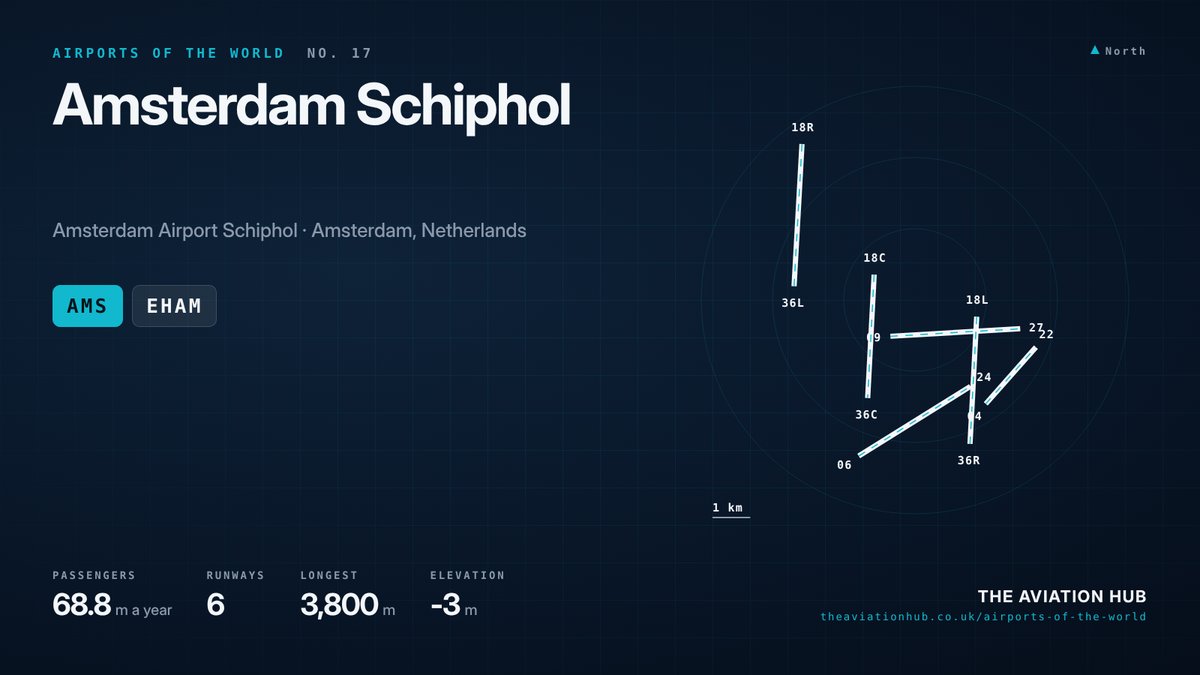
Amsterdam Schiphol Airport sits in the Haarlemmermeer polder about 7 miles (12 km) southwest of the Dutch capital, on the bed of a lake that was drained in the 1850s. It is the hub of KLM and the fourth busiest airport in Europe, with around 68.8 million passengers in 2025. Six runways spread across a site so wide that a taxi to the furthest one takes 20 minutes. A single terminal, a railway station beneath it and a rooftop viewing terrace make it one of the most spotter friendly major hubs anywhere.
Amsterdam Schiphol Airport at a Glance
The IATA code is AMS and the ICAO code is EHAM. The terminal lies roughly 7 miles (12 km) from Amsterdam Centraal in the municipality of Haarlemmermeer. Elevation is 11 feet (3 m) below sea level, which makes the field one of the lowest commercial airports in the world.
Six runways serve one terminal split into three departure halls and seven piers. Traffic in 2025 reached about 68.8 million passengers, of whom more than a third were transferring, and roughly 1.43 million tonnes of cargo. KLM, KLM Cityhopper and Martinair are based here, and Transavia, easyJet, TUI fly Netherlands, Corendon and Vueling keep bases. Royal Schiphol Group, owned mainly by the Dutch state and the city of Amsterdam, runs the airport. Pier maps and live departures sit on the airport’s official website.
How Schiphol Rose from the Polder
The airfield opened on 19 September 1916 as a military base on soft polder land south of the capital. KLM’s first scheduled service landed from London in 1920, and the airline has never left. The name predates the airport and probably refers to marshy ground, though the popular tale of ships lost on the old lake refuses to die. German forces renamed the field during the occupation and Allied bombing flattened it, but it was rebuilt within months of the liberation.
The decisive change came in 1967, when the present terminal opened on a new site in the middle of the polder with a tangential runway layout that let aircraft land and take off into almost any wind. The Aalsmeerbaan dates from 1950, the Kaagbaan from 1960 and the Buitenveldertbaan from 1967. A 101 metre control tower, the tallest in the world at the time, arrived in 1991. The Polderbaan opened in 2003 far to the northwest with its own tower to push noise away from the suburbs.
The darkest day was 4 October 1992, when El Al Flight 1862, a Boeing 747 freighter, lost two engines after departure and crashed into flats in the Bijlmermeer district, killing 43 people. A diamond robbery worth around €75 million hit the cargo area in 2005, and staff shortages in 2022 caused queues that cost the chief executive his job.
Runways at Amsterdam Schiphol Airport
Amsterdam Schiphol Airport has six asphalt runways, each with a Dutch name. The Polderbaan, 18R/36L, is the longest at 3,800 metres (12,467 feet) and sits 5 km from the terminal. The Buitenveldertbaan, 09/27, is 3,453 metres (11,329 feet) and points towards the city. The Kaagbaan, 06/24, measures 3,500 metres (11,483 feet). The Aalsmeerbaan, 18L/36R, is 3,400 metres (11,155 feet), the Zwanenburgbaan, 18C/36C, is 3,300 metres (10,826 feet), and the little Oostbaan, 04/22, is 2,020 metres (6,627 feet) and serves mostly business aviation.
Runway use follows a strict preference system driven by noise. In the common southwesterly wind the Polderbaan takes arrivals from the north on 18R and the Kaagbaan handles departures on 24. When the wind swings northerly the Polderbaan switches to departures on 36L and arrivals come down the Zwanenburgbaan or Aalsmeerbaan. The Buitenveldertbaan is used more sparingly, because its approach runs over the Buitenveldert suburb. Peak periods see two runways landing and one departing, and the pattern can change several times a day.
Terminals and Airlines
The single terminal concept at Amsterdam Schiphol Airport means every airline shares one building. Departure Halls 1, 2 and 3 line the landside, and the piers fan out airside. Piers B, C and M take Schengen flights, with M the budget pier used by easyJet and others that has no access to the rest of the airport once through security. Piers E, F and G handle long haul and other non Schengen traffic, Pier H is for low cost flights outside Schengen, and Pier D can switch between both with a clever split level design.
KLM and its SkyTeam partners Delta, Air France and Kenya Airways concentrate on Piers D, E, F and G, with the KLM Crown Lounge 52 above Pier F among the best in Europe. The oneworld and Star Alliance carriers, from British Airways to Lufthansa and United, scatter across the other piers. Pier A, a long delayed building southwest of the terminal, is due to open in April 2027 with eight gates including three for the largest aircraft.
Routes and Destinations
Barcelona was the busiest route in 2025 with around 1.6 million passengers, followed by London Heathrow, Dublin, Madrid and Copenhagen. KLM and easyJet fight over the main European trunks, while KLM Cityhopper’s Embraer E195-E2 fleet feeds the hub from dozens of regional cities, including Manchester, Birmingham, Bristol, Newcastle and Leeds Bradford. The Netherlands has no meaningful domestic air market.
Intercontinental traffic is led by Dubai, New York JFK and Atlanta, with the Delta partnership making the Atlanta flight almost a shuttle. Willemstad in Curaçao ranks fourth, reflecting the Dutch Caribbean ties. KLM Boeing 777-300ERs and 787-10s reach Johannesburg, Singapore, Tokyo and Buenos Aires. Cargo volumes rank fifth in Europe, with Shanghai Pudong and Doha the biggest freight routes.
Getting to and from Amsterdam Schiphol Airport
The railway station under Schiphol Plaza is the obvious choice. Intercity and Sprinter trains reach Amsterdam Centraal in 15 to 20 minutes for about €6 (£5) and run through the night, and direct services continue to Utrecht, Rotterdam, The Hague and Eindhoven. Eurostar trains stop here on the route to Brussels and Paris, and the Eurocity Direct runs to Brussels. For most visitors nothing else makes sense.
Buses fill the gaps, with route 397 to Leidseplein and Museumplein in about 30 minutes for around €7, and regional lines to Haarlem and Amstelveen. Taxis cost €45 to €60 (£38 to £51) to the centre and take 20 to 40 minutes on the A4 motorway. The A4 and A9 link the airport to the national motorway network, long term parking P3 is served by a shuttle, and cycle paths run to the terminal even though the roads themselves ban bicycles.
Spotting and Photography
The Panorama Terrace on the roof of the terminal is free, landside and open most of the day, with views across Piers C, D and E and the preserved Fokker 100 parked as an exhibit. Beyond the fence, the Polderbaan has an official spotter zone at the end of IJweg, with a food truck and a view along the runway. A second official zone at the McDonald’s car park in Schiphol Oost overlooks the Buitenveldertbaan, the Oostbaan and the Aalsmeerbaan. The old Kaagbaan viewing site closed in 2008.
Both official zones are free, and activity rarely pauses for long. Amsterdam Schiphol Airport offers KLM 777s, 787s and A330s, the Cityhopper E2 fleet, Delta A350s and widebodies from Asia and the Gulf. The police and the Marechaussee tolerate spotters who stay on public ground, so keep off service roads, avoid the fence and leave the Polderbaan tower area alone.
What Comes Next
Growth at Amsterdam Schiphol Airport is a political fight. The Dutch government has sought to cut the annual movement cap below the 500,000 flights of 2019, citing noise and nitrogen rules, and a figure around 478,000 has been debated in court and in Brussels. KLM argues that the hub cannot function with fewer slots. Traffic has still not returned to the 2019 record of 71.7 million passengers.
Investment continues regardless, with a €6 billion plan announced in 2024 and up to €10 billion of works through 2035, covering Pier A, renewed piers, a new bus station in 2027 and eventually a Terminal South. Amsterdam Schiphol Airport is heading for quality over quantity, a smaller but more valuable hub. Compare its unusual six runway layout with other hubs on the Airports of the World map.
Continue to follow The Aviation Hub for more analysis and insight.
Advertise with us Your brand, in front of an aviation audience Home page and in-article placements, sold directly, one advertiser per slot. From £250 a year. See the rates

