
Anchorage Airport Guide: Cargo Crossroads of the World
Anchorage Airport is a giant cargo hub between Asia and America. Runways, terminals, Alaska Airlines routes, Lake Hood floatplanes and spotting.
 By The Aviation Hub
6 min read
Updated October 20, 2026
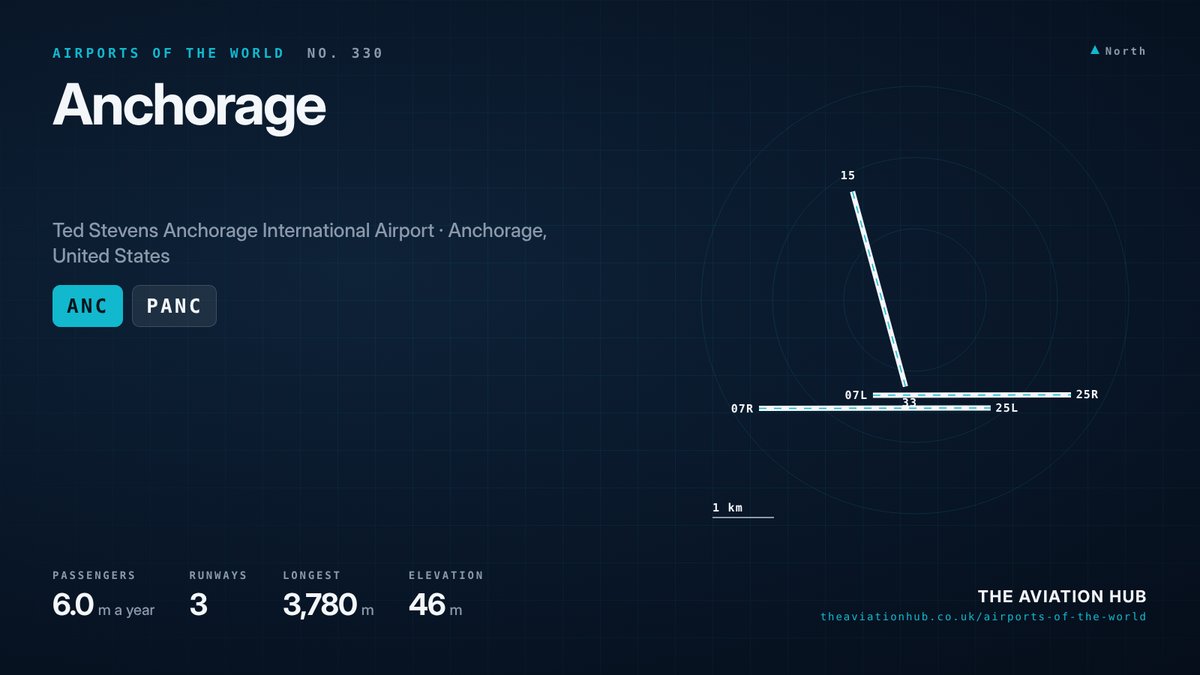
Anchorage Airport, formally Ted Stevens Anchorage International Airport, is the passenger gateway to Alaska and one of the great freight hubs of the world. It sits on the shore of Cook Inlet about 5 miles (8 km) southwest of downtown Anchorage. Wide body freighters from Asia stop here to refuel and swap cargo before heading on to the lower 48 states. The field was the busiest cargo airport in the United States in 2023. Next door, Lake Hood bustles with floatplanes.
Anchorage Airport at a Glance
The airport uses the IATA code ANC and the ICAO code PANC. It stands 46 m (152 ft) above sea level on a bluff above the inlet. Three runways and two passenger terminals, the domestic South Terminal and the international North Terminal, serve the field. The State of Alaska owns and runs it as part of the Alaska International Airport System.
Anchorage Airport handled about 5.4 million passengers in the 2025 fiscal year, with more than 100,000 landings. Cargo is the bigger story, at around 3.75 billion pounds (1.7 million tonnes) in the same year, ranking it third in the world in 2025. Alaska Airlines carries roughly 69 per cent of passengers. FedEx Express, UPS Airlines, Atlas Air and Polar Air Cargo all run hubs. Live information is on the airport’s official website.
How Anchorage’s Airport Came to Be
Anchorage International Airport opened in 1951. Merrill Field, nearer downtown, was too constrained for the larger aircraft arriving after the war. Alaska Airlines, Northwest Orient, Pacific Northern and Reeve Aleutian were early users, and Canadian Pacific Air Lines refuelled here on flights to the Far East.
The golden age came with polar routes. Before Soviet airspace opened to Western airlines, Anchorage was the natural refuelling stop between Europe and East Asia. Air France, British Airways, KLM, Lufthansa, SAS and Japan Airlines all called here. By the mid 1980s the field was nicknamed the Crossroads of the World. The North Terminal opened in 1982 to handle those flights.
When Russian airspace opened in the early 1990s and longer range jets arrived, most passenger stops disappeared. Freight replaced them. In 2000 the Alaska Legislature renamed the airport for Ted Stevens, the long serving US senator, who survived a 1978 crash at the field that killed his wife, Ann. A magnitude 7.0 earthquake in 2018 damaged the terminal and control tower.
Runways at Anchorage Airport
Three asphalt runways serve Anchorage Airport. Runway 07R/25L is the longest at 3,780 m (12,400 ft) by 61 m, and its parallel partner 07L/25R is 3,231 m (10,600 ft) by 46 m. Runway 15/33 crosses the field at 3,312 m (10,865 ft) by 61 m. All three are long enough for heavily loaded Boeing 747-8F and 777F freighters bound for Asia.
Under the usual pattern, arrivals land on the parallel 07 runways from the west over Cook Inlet, while many departures use runway 33 and climb away to the north. That keeps heavy jets over water and away from the city. Winter brings snow, ice and short days, and snow crews work around the clock to keep the runways open. Fog off the inlet can also cause delays. A helipad completes the airfield.
Terminals and Airlines
The South Terminal at Anchorage Airport handles domestic flights from 24 gates. Alaska Airlines dominates, with Delta, United, American, Sun Country and Air Canada alongside, plus Condor departures. Concourse C was rebuilt in 2004 and Concourses A and B were renovated between 2006 and 2009. A consolidated rental car facility is attached to the building.
The North Terminal, with eight gates, handles Condor arrivals from Frankfurt, international charters and military flights. Grant Aviation, Aleutian Airways and smaller bush operators carry passengers to towns with no road links. Southwest Airlines began seasonal flights from Denver and Las Vegas on 15 May 2026, a new rival for Alaska Airlines.
The cargo side is enormous. The FedEx facility handles up to 13,400 packages an hour and the UPS hub about 5,000. Korean Air, China Airlines, Cathay Pacific, Cargolux and Atlas Air freighters pass through daily, many on technical stops between Asia and North America.
Routes and Destinations
Seattle is the busiest passenger route by far, with about 865,000 passengers in the year to May 2026. Portland follows at around 198,000, then Fairbanks at 174,000. Minneapolis and Chicago O’Hare complete the top five. Within Alaska, flights reach Juneau, Bethel, Nome, Kotzebue, Kodiak and many smaller communities where aircraft are the only lifeline.
Traffic at Anchorage Airport is highly seasonal. Summer brings cruise passengers, anglers and tourists on nonstop flights from across the US, while winter schedules shrink. Condor’s Frankfurt service was the busiest international route at about 31,000 passengers, with Air Canada to Vancouver second and WestJet to Calgary third. Frankfurt, around 4,600 miles (7,400 km) away, is the longest regular passenger route. Services to the Russian Far East ended by 2025.
Getting to and from Anchorage Airport
Downtown Anchorage is about 15 minutes away by car via International Airport Road and Minnesota Drive. People Mover Route 40 links both terminals with the downtown Transit Center. It runs every 15 minutes on weekdays until 19:30, then every 30 minutes late into the night and at weekends. It is the cheapest sensible option.
Taxis queue outside both terminals and hotel courtesy vans are common. The rental car centre beside the South Terminal is busy in summer, when many visitors drive to the Kenai Peninsula or Denali. Anchorage Airport also has an Alaska Railroad depot, opened in 2003, but trains run only in summer for cruise passengers. Shuttle buses link the terminals and car parks about every 15 minutes.
Spotting and Photography
Anchorage Airport is a bucket list destination for spotters. Point Woronzof, on the Tony Knowles Coastal Trail west of the field, is the classic location. Freighters land over Cook Inlet with Mount Susitna, the Sleeping Lady, behind them. On a clear day Denali appears on the horizon. The coastal trail runs around the perimeter and gives several more angles.
Lake Hood Seaplane Base, described as the busiest seaplane base in the world, sits next door. Floatplanes take off every few minutes in summer, and the Alaska Aviation Museum on its shore is worth a visit. Summer evenings bring long, soft light late into the night. Stay on public trails and roads, keep clear of fences and follow any instructions from airport police.
What Comes Next
Cargo will shape the future. Trans Pacific freight keeps growing, and new cargo buildings and aircraft parking positions are in development to handle more freighters. A 2020 push to let foreign airlines use the field as a passenger connecting hub hints at wider ambitions. Southwest’s arrival in 2026 adds competition on domestic routes.
Geography still rules. Since 2022 some Japan to Europe flights have overflown Alaska, a reminder of how fast airspace politics can redraw routes. Anchorage Airport looks set to remain a freight powerhouse with a strong seasonal passenger pulse. Compare it with other cargo gateways on the Airports of the World map.
Continue to follow The Aviation Hub for more analysis and insight.
Advertise with us Your brand, in front of an aviation audience Home page and in-article placements, sold directly, one advertiser per slot. From £250 a year. See the rates

