
Ankara Esenboga Airport Guide: The Capital’s Highland Hub
Ankara Esenboga Airport serves the Turkish capital from a plateau 950 m up. Two long runways, AJet and Pegasus, routes, terminals and bus access explained.
 By The Aviation Hub
7 min read
Updated October 20, 2026
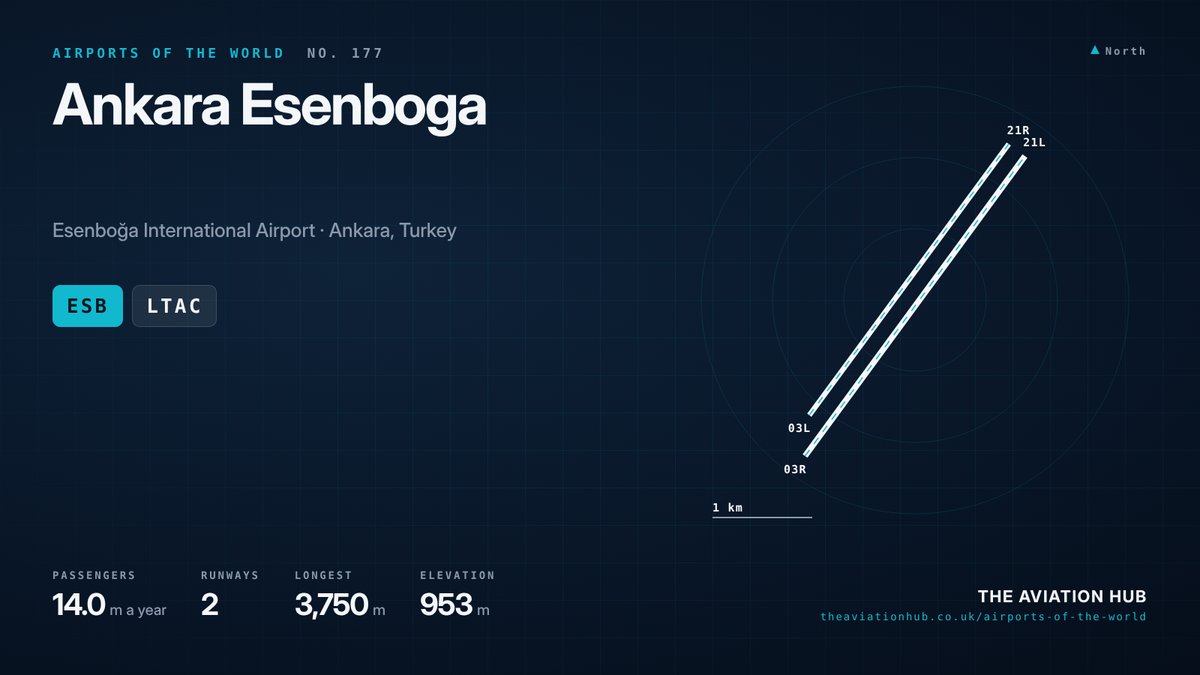
Ankara Esenboga Airport sits on the Anatolian plateau about 17 miles (28 km) northeast of the Turkish capital, in open country above the city beside the village that gave it its name. It is the main airport of Ankara and the fourth busiest in Turkey, with around 14 million passengers a year, the great majority on domestic flights to Istanbul and the provinces. A low cost hub for AJet, a strong Pegasus presence and the base for the state’s VIP fleet give the field a character distinct from the holiday airports on the coast.
Ankara Esenboga Airport at a Glance
The codes are ESB and LTAC. The airport lies 952 m (3,125 ft) above sea level on rolling steppe, with hot dry summers and cold snowy winters that shape its operations. It has two parallel runways, one main terminal building with domestic and international wings and a separate general aviation terminal. Traffic in the latest full year ran to roughly 14 million passengers and around 103,000 movements, with about a quarter of the passengers international.
AJet, the Turkish Airlines low cost subsidiary that began life as AnadoluJet with Ankara as its home, is the largest operator, with Pegasus, Turkish Airlines itself and SunExpress behind it. Qatar Airways, flydubai, Saudia and a cluster of Middle Eastern, Central Asian and Caucasus carriers fly the international routes. TAV Airports has operated the field since 2006 under a build, operate and transfer concession that was extended in December 2022 to run until 2050. Flight information and parking tariffs are on the airport’s official website.
How Ankara Got Its Airport
Ankara Esenboga Airport has been flying since 1955, when the state airports authority opened a new field to replace the cramped facilities closer to the capital. The name is a modernised form of Isen Buga, a Turkic commander in Timur’s army who camped his troops here before the Battle of Ankara in 1402, and it translates roughly as serene bull. For half a century the airport remained a modest state run field, overshadowed by Istanbul even though it served the seat of government.
The turning point came with privatisation. TAV won the concession to build and run new terminals and opened the combined domestic and international building on 16 October 2006, a year ahead of schedule. The airport won the ACI Europe award for the best European airport in the five to ten million passenger category in 2009, the first Turkish airport to do so. A general aviation terminal for business jets and government flights followed in January 2012.
The AnadoluJet brand, launched by Turkish Airlines in 2008 with Ankara as its base, transformed the domestic network and pushed traffic past ten million by the middle of the 2010s. The brand became AJet in 2024 and shifted much of its growth to Istanbul Sabiha Gokcen, but the Ankara base survived. A third parallel runway is now under construction east of the terminal.
Runways at Ankara Esenboga Airport
Two parallel asphalt runways run from southwest to northeast. Runway 03L/21R is 3,750 m (12,303 ft) long and 45 m wide, and runway 03R/21L matches the length at 3,750 m but is wider at 60 m. The generous lengths reflect the elevation. At nearly 1,000 m above sea level in a hot summer, aircraft need considerably more runway than on the coast, and the 60 m width of the eastern runway allows the largest wide bodies, including the Boeing 747-8 of the presidential fleet.
The two strips are far enough apart for segregated operations, with one used for arrivals and the other for departures in busy periods, and both are equipped with ILS. Arrivals on the 03 runways come in from the southwest over Pursaklar on the northern edge of the city, while those on the 21s approach from the Cubuk side to the north east. Winter is the test. Snow, freezing fog and low cloud regularly cut visibility between December and February, and the airport runs a large de icing and snow clearing operation that keeps it open when much of central Anatolia is closed.
Esenboga also hosts the aircraft of the Turkish presidency and government, which operate from the general aviation side, so military and VIP movements mix with the airline traffic throughout the day.
Terminals and Airlines
The 2006 terminal at Ankara Esenboga Airport is a single long building of about 168,000 square metres, divided into a domestic wing and an international wing that share a central check in hall with more than 100 counters and 18 air bridges. The domestic side is the busier by far, with AJet, Pegasus, Turkish Airlines and SunExpress flying Boeing 737-800s, 737 MAX 8s and Airbus A320neo family aircraft to Istanbul and more than 30 Turkish cities.
The international wing handles AJet, Pegasus and SunExpress flights to Europe and the Middle East alongside Qatar Airways, flydubai, Saudia, Azerbaijan Airlines, Uzbekistan Airways and Iranian and Iraqi carriers. Star Alliance is represented by Turkish Airlines, which flies only to Istanbul from here, and Oneworld by Qatar Airways. TAV runs the Primeclass lounge and Turkish Airlines keeps its own lounge for domestic and international passengers. The general aviation terminal next door handles business jets.
Routes and Destinations
Istanbul is the dominant market, split between Istanbul Airport and Sabiha Gokcen, with Turkish Airlines, AJet and Pegasus flying the hour long hop more than 30 times a day between them. Izmir, Antalya, Trabzon, Diyarbakir, Van, Adana and Erzurum are other key domestic routes, and the eastern cities depend on Ankara Esenboga Airport as their link to the capital for business and government travel. The high speed railway to Istanbul and Konya has trimmed some short routes without denting the overall numbers.
International traffic leans towards the Turkish communities in Germany, with Frankfurt, Munich, Dusseldorf, Cologne and Stuttgart among the main European routes, plus Amsterdam, Brussels and Vienna. Doha, Dubai, Amman, Baku, Tehran, Baghdad and Erbil form the eastern network. Kabul and Astana, at roughly 2,000 miles (3,200 km), are the longest year round routes, and the seasonal Pegasus flight to Lisbon reaches about 2,200 miles (3,600 km). Summer brings extra flights to Europe and the Turkish coast, and the Hajj and Umrah seasons add charters to Jeddah and Medina. Cargo is modest.
Getting to and from Ankara Esenboga Airport
There is no rail link, though a driverless metro line to the airport has been planned for years and remains the city’s long term answer. Havas and Belko Air shuttle buses run between the terminal and the city centre at Kizilay and the ASTI intercity bus station, taking 40 to 60 minutes depending on traffic for a fare of a few hundred lira. The EGO municipal bus 442 covers the same ground more slowly and more cheaply, making it the cheapest sensible option.
By road the airport sits off the Esenboga road, which meets the Ankara ring motorway and the Samsun highway, and the drive to the centre takes 35 to 50 minutes. A taxi to Kizilay or the government district costs around 1,000 lira (£20) at current rates, which move quickly with inflation. Short stay parking faces the terminal and a cheaper long stay car park lies beyond it. Car hire desks line the arrivals hall.
Spotting and Photography
Ankara Esenboga Airport is not set up for enthusiasts and has no viewing terrace. The departure lounges offer the best views of the apron and the arriving aircraft taxiing in from the runways. Outside, the open steppe around the thresholds of the 03 runways gives wide shots of arrivals with the hills behind, and the roads near the village of Esenboga pass close to the approach.
The traffic is mostly narrow body, with AJet and Pegasus jets dominant, but the presidential Boeing 747-8 and Airbus A330, visiting government aircraft and the occasional Turkish Airlines wide body on the Istanbul run add interest. Morning light favours the eastern side and afternoons the terminal frontage. Photographing state aircraft and the government apron is a sensitive matter in Turkey, so stay well away from the general aviation area, keep off the perimeter road and comply immediately with police requests.
What Comes Next
TAV’s extended concession gives it until 2050 to invest in Ankara Esenboga Airport, and the plan is incremental rather than dramatic. Further gate and apron expansion is tied to passenger growth, and the third parallel runway will add capacity for decades. The missing piece is the metro, which would give a fast and reliable link to the city and bring the field into line with Istanbul’s airports. Growth depends on AJet’s commitment to its original home and on the eastern Turkish provinces.
The airport is heading for steady domestic growth with a modest international layer, a solid capital city airport rather than a global hub. Compare it with Istanbul and the rest of Turkey on the Airports of the World map.
Continue to follow The Aviation Hub for more analysis and insight.
Advertise with us Your brand, in front of an aviation audience Home page and in-article placements, sold directly, one advertiser per slot. From £250 a year. See the rates

