
Antalya Airport Guide: Turkey’s Summer Holiday Giant
Antalya Airport handles almost 40 million passengers a year, most of them in the summer months. Find out how the Turkish Riviera's gateway copes with the rush.
 By The Aviation Hub
7 min read
Updated October 20, 2026
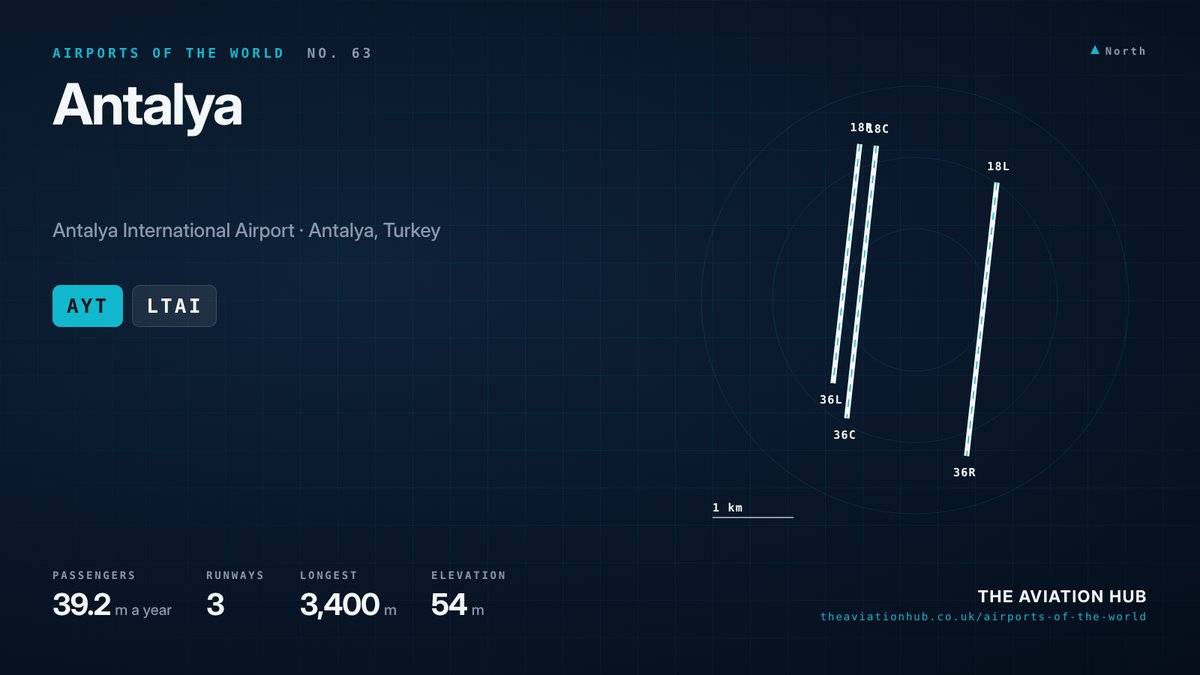
Antalya Airport sits on the Mediterranean coast of southern Turkey, about 8 miles (13 km) northeast of the city centre and within sight of the Taurus Mountains. It is the gateway to the Turkish Riviera, the strip of resorts running from Kemer to Alanya that draws tens of millions of holidaymakers. The airport handled around 39 million passengers in 2025, which places it third in Turkey after the two Istanbul airports. Almost all of that traffic arrives between April and October, which makes it one of the most seasonal large airports in the world.
Antalya Airport at a Glance
The codes are AYT and LTAI. The field lies at 177 ft (54 m) above sea level on flat ground between the city and the coastal resort of Lara. It has three parallel runways, two international terminals and one domestic terminal. The Turkish state airports authority DHMI owns the site, and a joint venture of the German operator Fraport and Turkey’s TAV holds the concession to run the terminals.
Antalya Airport handled just over 39 million passengers in 2025, around two per cent more than the year before. Turkish Airlines treats it as a focus city and its low cost arm AJet bases aircraft here, as do Pegasus, SunExpress, Corendon, Freebird, Southwind and Mavi Gok. Opening hours, terminal allocations and parking tariffs are listed on the airport’s official website.
How Antalya’s Airport Came to Be
The airport opened in 1960 as a modest domestic field at a time when Antalya was a quiet provincial town with a few hotels. Mass tourism arrived in the 1980s, first from Germany and then from across Europe, and the single terminal was soon overwhelmed. The Turkish government turned to the private sector, and a build operate transfer deal produced the first purpose built international terminal in 1998.
A second international terminal opened in 2005 to absorb the surge from Russia and the former Soviet states, which had become the biggest single market. Fraport and its partner IC Ictas began running the terminals in 2007, TAV became Fraport’s equal partner in 2018, and the pair later won a new concession running to 2051. In 2011 ACI named the airport the best in Europe in the 10 to 25 million passenger class.
Traffic has since doubled. Russia, Germany, the United Kingdom and Poland supply the bulk of the arrivals, and in the peak weeks of July and August the airport handles well over 1,000 movements a day. The terminals built for 25 million passengers have been stretched to almost 40 million, which is why a €1.9 billion expansion is under way.
Runways at Antalya Airport
Antalya Airport has three runways, all aligned roughly north to south. Runway 18C/36C and 18L/36R are concrete and each measures 3,400 m (11,155 ft) by 45 m. Runway 18R/36L, on the western side, is asphalt and shorter at 2,990 m (9,811 ft). The two eastern runways carry the airline traffic, with arrivals on 18C/36C and departures on 18L/36R, while the older western runway is rarely used and mainly serves military movements.
The sea breeze dominates in summer, and the direction often changes during the day. Arrivals usually land on the 36 runways from the south over the coast in the morning, then switch to the 18 runways around midday as the wind comes off the Mediterranean, with aircraft on final approach crossing the plain to the north. The flow often switches back in the evening.
Lengths are generous for the traffic. The Boeing 737-800, 737 MAX 8 and Airbus A321neo dominate, with Russian carriers such as Azur Air bringing Boeing 767-300ERs and 777-300ERs on the charter flights from Moscow. The airport has no curfew and the Russian and Central Asian flights run through the night.
Terminals and Airlines
Terminal 1 is the older international building and handles most of the scheduled carriers and the German market. Terminal 2 is the larger international terminal, built for charter and leisure flying and heavily used by the Russian and Central Asian operators as well as several European tour airlines. A separate domestic terminal serves the Turkish Airlines, AJet and Pegasus flights to Istanbul, Ankara and the rest of the country. Allocations shift from season to season, so passengers should check their airline before setting out.
The airline list at Antalya Airport is long. Turkish Airlines, Pegasus, SunExpress and AJet form the Turkish core. From the UK, easyJet, Jet2.com, TUI Airways, British Airways and Wizz Air all fly in. Germany is served by Condor, Eurowings, Corendon, SunExpress and Freebird, while Aeroflot, Azur Air, Southwind and others connect dozens of Russian cities. Lounges are functional rather than luxurious, with Primeclass lounges in both international terminals.
Routes and Destinations
Istanbul is the busiest route from Antalya Airport, with both Istanbul airports served many times a day year round by Turkish Airlines, AJet and Pegasus. Ankara and Izmir follow on the domestic side. Internationally, Moscow has been the heaviest single destination for most of the past two decades, with Azur Air, Aeroflot and others flying from Sheremetyevo, Vnukovo and Domodedovo.
Germany is the largest European market, with Dusseldorf, Frankfurt, Munich, Hamburg, Berlin, Cologne and Stuttgart all served several times daily in summer. From the UK, Manchester, London Gatwick, Birmingham and London Stansted lead. Warsaw, Vienna, Zurich and Amsterdam are strong, and the Gulf is covered by Flydubai. The longest regular flights reach Siberian cities such as Novosibirsk, around 2,700 miles (4,350 km) away, with seasonal links further east.
The seasonal swing is dramatic. A January day may see fewer than 150 movements, whereas a Saturday in August can exceed 1,100. Cargo is minor, limited mainly to belly freight and some fresh produce exports.
Getting to and from Antalya Airport
The AntRay tram system has been extended to the airport, with a stop outside the terminals linking to the city. The tram is the cheapest sensible option, costing only a few lira. City buses 600 and 800 also serve the airport, the former to the Otogar bus terminal and the latter along the coast road to Lara.
Havas shuttle coaches run to the 5M Migros shopping centre on the western side of the city. Taxis are plentiful, cost roughly TRY 700 to 900 (around £15 to £20) to the centre and take 20 to 30 minutes. Most holidaymakers never see the city at all. Tour operator transfers and pre booked minibuses leave directly for the resorts along the D400 coastal highway, with Belek 30 minutes away, Side about an hour and Alanya two hours.
Car hire is the other big business, with every major company and dozens of local firms on site. Parking is cheap by European standards, and the short stay car parks sit directly in front of the terminals.
Spotting and Photography
Antalya Airport has no formal viewing area, but the flat surroundings help. The roads and open ground south of the field near the 36C and 36R thresholds give good views of morning arrivals, and the approach to the 18 runways from the north crosses farmland with several quiet lanes. The balcony of the IC Airport Hotel catches 18L traffic in the evening.
The variety is the draw. Russian Boeing 767s and 777s, Azerbaijani and Kazakh carriers, Turkish charter fleets and the full range of European low cost airlines all appear in a single afternoon. Light is excellent with the sun behind a spotter on the eastern side in the morning and the western side in the afternoon. Summer heat is severe, so carry water.
Turkish authorities are sensitive about photography near military installations, and military aircraft use the field. Stay on public roads, avoid pointing cameras at military aprons and move on if police ask.
What Comes Next
The Fraport TAV joint venture is investing around €1.9 billion in expansion and modernisation under its extended concession, with a loan from the International Finance Corporation backing part of the work. The first phase, completed in 2025, enlarged International Terminal 2 and the domestic terminal, and a new control tower is due by the end of 2026. The programme aims for LEED Gold certification, and capacity should exceed 82 million passengers a year when the work completes.
A second airport near Kas, far to the west, has been proposed to spread tourism along the coast. For now Antalya Airport remains the single door to Turkey’s biggest resort region, and its growth tracks the health of the European and Russian holiday markets. Compare it with the other leisure giants on the Airports of the World map.
Continue to follow The Aviation Hub for more analysis and insight.
Advertise with us Your brand, in front of an aviation audience Home page and in-article placements, sold directly, one advertiser per slot. From £250 a year. See the rates

