
Aruba Airport, officially Queen Beatrix International Airport, sits on the island’s south west coast just outside the capital, Oranjestad. It is the island’s international gateway and the front door for a tourism economy built on North American visitors. Well over three million passengers a year now pass through, many of them clearing United States border checks before they leave the island. Its runway handles everything from island hoppers to wide body jets from Europe.
Aruba Airport at a Glance
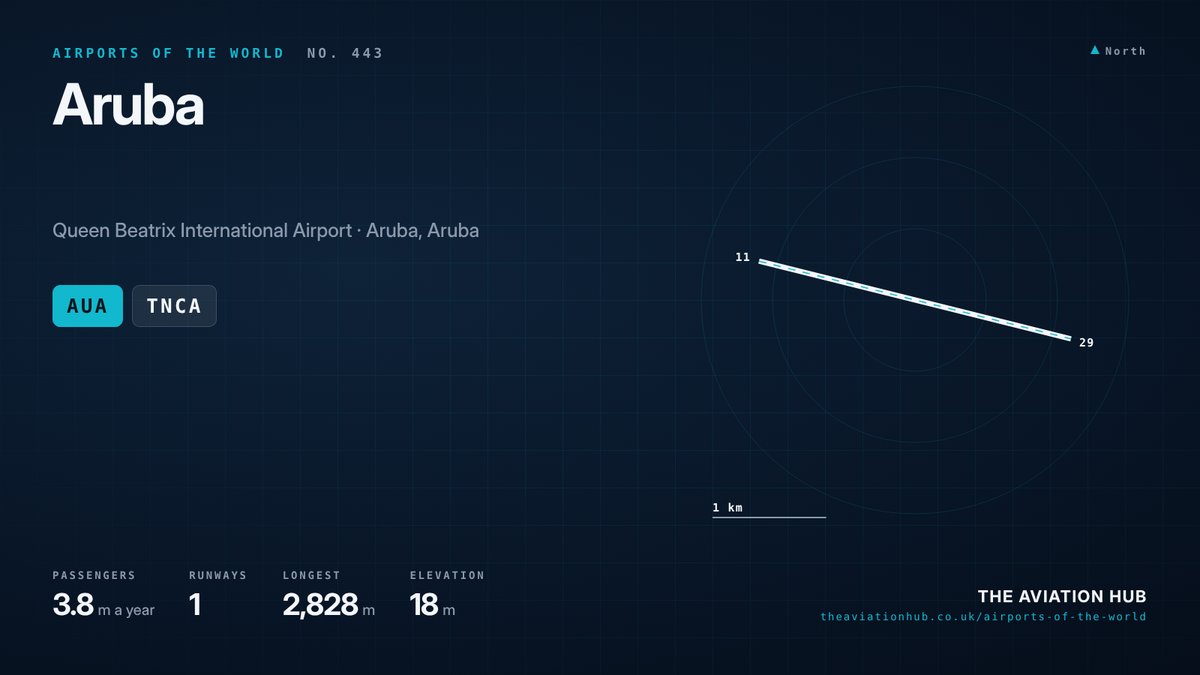
The IATA code is AUA and the ICAO code is TNCA. The field lies about 2 miles (3 km) south east of central Oranjestad and roughly 6 miles (9 km) in a straight line from the Palm Beach hotel strip. It sits 60 feet (18 m) above sea level, with one runway and a single passenger terminal complex. Recent traffic has run at more than three million passengers a year, comfortably above pre pandemic levels.
The operator is Aruba Airport Authority N.V., owned by the government of Aruba. Aruba Airlines is the home carrier, while American, Delta, United and JetBlue provide most of the seats. United States preclearance lets American bound travellers complete immigration and customs before departure. Flight times and arrival guidance are on the airport’s official website.
How Oranjestad’s Airport Came to Be
Commercial flying began in 1934, when Manuel Viana started a weekly mail and passenger service to Curacao from a runway laid on mud flats. KLM took over on 24 December 1934 and scheduled flights began on 19 January 1935. During the Second World War the United States Army Air Forces used the field as Dakota Field, basing A-20, B-18 and P-40 aircraft there to guard the island’s oil refinery.
The airport took its royal name on 22 October 1955, during a visit by Princess Beatrix of the Netherlands. It became Queen Beatrix International Airport in 1980, when she ascended the throne. Tourism transformed the field from the 1960s onward, as American airlines and hotel chains discovered the island’s dry climate and beaches.
Home airlines have come and gone. Air Aruba used the field as its main hub until its bankruptcy in 2000, and Tiara Air was based there until 2016. Aruba Airlines arrived in 2013 and now flies three Airbus A320 family jets and two Bombardier CRJ200s. Aruba Airport has since entered Gateway 2030, a phased expansion programme.
Runways at Aruba Airport
There is one asphalt runway, 11/29, measuring 2,828 metres (9,278 feet) long and 45 metres wide. It runs parallel to the coast, with the sea a short distance to the south. The length suits everything from regional turboprops to the Boeing 787 and 777 wide bodies used on European routes.
Aruba sits in the path of steady easterly trade winds, so runway 11 handles the great majority of movements. Arrivals usually approach from the north west along the coast past Oranjestad, while departures climb out towards the east. Runway 29 comes into use only when the wind drops or swings. Weather is rarely a problem, since the island lies outside the main hurricane belt and sees little rain.
Terminals and Airlines
The passenger terminal at Aruba Airport handles all scheduled traffic, with a dedicated preclearance area for flights to the United States. On 8 April 2025 the first flights departed from a new U.S. Check In Terminal, where American bound passengers drop bags that travel straight to their aircraft without being collected and screened again. A separate terminal for private aircraft opened in 2007.
American flies from Charlotte, Miami and Philadelphia, with seasonal flights from Chicago, Dallas Fort Worth and New York LaGuardia. Delta serves Atlanta and New York JFK, United links Chicago, Houston, Newark and Washington Dulles, and JetBlue flies from Boston, Fort Lauderdale and JFK. Air Canada Rouge and WestJet cover Canada, with Porter serving Toronto from late October 2026. KLM and TUI fly Netherlands connect Amsterdam, while Avianca, Wingo, Copa and LATAM serve South and Central America.
Routes and Destinations
The United States is the core market. Figures from 2009 and 2010 put New York JFK at the top of the table, ahead of Miami, Newark, Atlanta and Charlotte. Saturday is traditionally the peak day, as hotel stays turn over and the apron fills with American and Canadian jets.
Amsterdam is the longest route, at roughly 4,900 miles (7,900 km), reflecting Aruba’s place in the Kingdom of the Netherlands. KLM also flies to Bonaire on selected days. Latin American links have grown quickly, with Bogota, Panama City, Lima, Paramaribo and Buenos Aires all on the map from Aruba Airport. Canadian flights peak in winter, when the island offers a reliable escape from the snow. Cargo is modest and mostly carried in passenger holds.
Getting to and from Aruba Airport
There is no railway on Aruba, so the road does all the work. Taxis wait outside arrivals and charge fixed fares by zone, with Palm Beach around 25 minutes away and central Oranjestad about ten. Arubus public buses run along the main road near the terminal to the Oranjestad bus station, where connections continue to Eagle Beach and Palm Beach. The bus is the cheapest sensible option for light travellers.
Car hire desks sit beside the terminal, and driving is simple on the island’s compact road network. Many resorts arrange transfers. Parking at the terminal is limited but adequate for drop offs and short trips. Check in and preclearance can take time, so allow at least three hours for flights to the United States.
Spotting and Photography
Aruba Airport is a pleasant field to watch. With runway 11 in use most of the time, arrivals pass low along the coast at the western end, and the beaches and roads around Surfside near Oranjestad give close views of final approach. The constant breeze and bright sunshine make for sharp images, though midday heat haze can soften long lens shots. Morning and late afternoon light is best.
Saturday brings the widest mix, from American 737s and JetBlue A321s to KLM wide bodies and TUI 787s. Respect the perimeter, stay off airport land and never fly drones near the approach. Local police watch the area closely, and a polite explanation usually settles any questions.
What Comes Next
Gateway 2030 is the long term plan. Phase 1A delivered the U.S. Check In Terminal, and later phases aim to expand and modernise passenger facilities as traffic grows. New and seasonal routes for the 2026 to 2027 winter season show that airlines remain keen on the island.
The constraints are the usual island ones: limited land, a single runway and the need to protect a fragile tourism environment. The verdict: Aruba Airport is set to grow steadily on the back of North American demand, with Gateway 2030 giving it the space to do so. Explore other Caribbean gateways on the Airports of the World map.
Continue to follow The Aviation Hub for more analysis and insight.
Advertise with us Your brand, in front of an aviation audience Home page and in-article placements, sold directly, one advertiser per slot. From £250 a year. See the rates

