
Astana Airport Guide: Kazakhstan’s Gateway on the Steppe
Astana Airport handled over eight million passengers in 2024. Explore its yurt inspired terminal, Air Astana hub, runway, routes and the light rail link.
 By The Aviation Hub
6 min read
Updated October 20, 2026
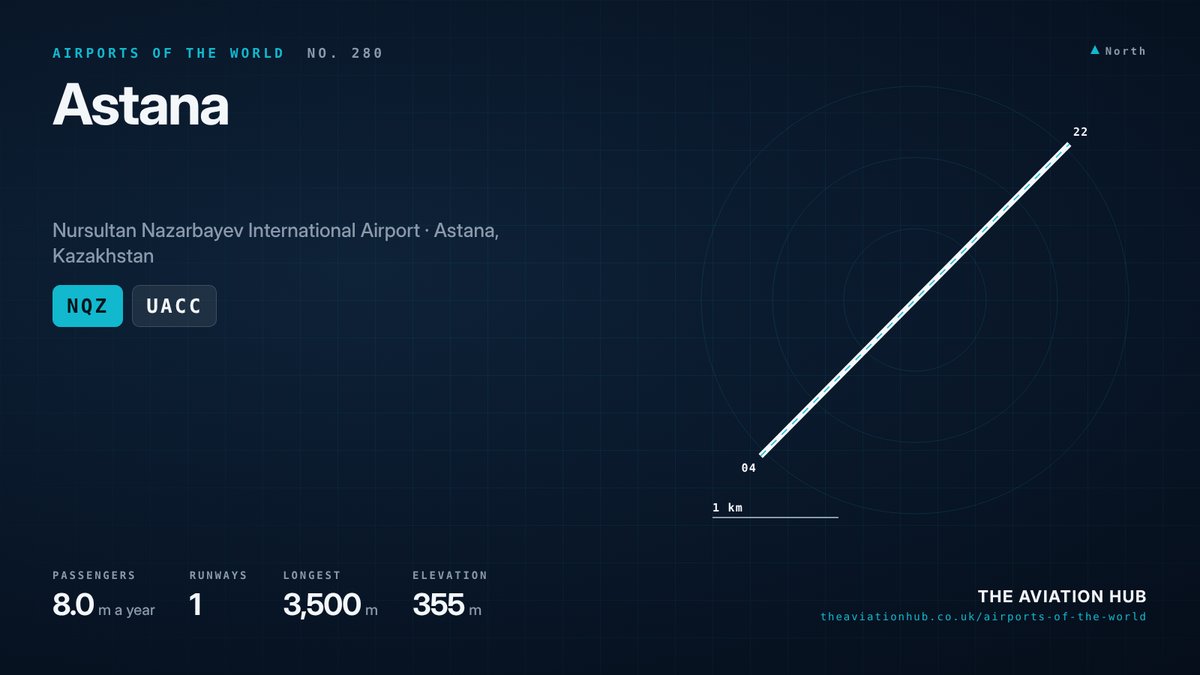
Astana Airport serves Kazakhstan’s capital from the open steppe south of the city, where winter temperatures can plunge below minus 30°C. Officially named Nursultan Nazarbayev International Airport, it handled more than eight million passengers in 2024, making it the country’s second busiest after Almaty. Air Astana uses it as its secondary hub after Almaty, its low cost arm FlyArystan has a base here, and a striking domed terminal by the Japanese architect Kisho Kurokawa gives the field a distinctive identity.
Astana Airport at a Glance
The codes are NQZ for IATA and UACC for ICAO. The airport lies about 10 miles (17 km) from the city centre, roughly 25 minutes by car, at an elevation of 355 metres (1,165 feet). There is one runway and two connected terminals: T1 for international flights and T2 for domestic services.
Traffic reached about 8.32 million passengers in 2024, up around ten per cent on the year before. Air Astana and FlyArystan dominate, SCAT Airlines has its main operating base here, and Qazaq Air has its home base at Astana Airport. A state owned joint stock company runs the site on behalf of the Ministry of Industry and Infrastructure Development, having taken over from Malaysia Airports Holdings, which previously operated it under a trust deed. Flight times are on the airport’s official website.
A Short History of Akmolinsk Airfield
The airport was established in 1930 and opened to the public in 1931 as Akmolinsk Airport, serving a small provincial town on the steppe. When the town became Tselinograd during the Soviet Virgin Lands campaign, the airport took the same name. Accidents in the Soviet era included a Lisunov Li-2 crash in 1967 that killed nine people and an Antonov An-24 overrun in 1989 that injured no one.
Everything changed when Kazakhstan moved its capital from Almaty to Akmola, soon renamed Astana, in 1997. The airport became Astana International Airport and grew with the new capital. Kisho Kurokawa’s domestic terminal, now T2, opened on 2 February 2005, its central dome modelled on a traditional yurt.
The next leap came with EXPO 2017. A new international terminal, T1, opened that year with about 47,000 square metres of space. In June 2017 the government renamed the airport after former president Nursultan Nazarbayev, and on 8 June 2020 its IATA code changed from TSE to NQZ. The city later reverted to the name Astana, but the airport kept its new title and code.
Runways at Astana Airport
Astana Airport has a single asphalt runway, 04/22, which measures 3,500 metres (11,484 feet) long and 45 metres wide. It is equipped with an instrument landing system rated to Category IIIA in both directions, plus VOR/DME, allowing operations in the thick fog and blowing snow that winter often brings.
The runway runs roughly south west to north east across flat, open steppe with no terrain to worry about. Its length easily handles the Airbus A321neo and Boeing 767 aircraft of Air Astana as well as visiting wide bodies from Europe, the Middle East and China. Winter is the real challenge, with temperatures often below minus 30°C and fierce winds sweeping across the plain. Snow clearance and de icing crews work hard for months at a time.
A second parallel runway has been proposed to add resilience and capacity, but it has not been built. With one runway handling all traffic, any closure has an immediate effect on the national network.
Terminals and Airlines
T1 handles international flights. It was built for about 5.2 million passengers a year and includes a capsule hotel. Air Astana is the main operator, joined by Lufthansa, LOT, Air China, Turkish Airlines and its low cost arm AJet, Azerbaijan Airlines, Belavia, flydubai, Pegasus, SCAT, Qazaq Air and Uzbekistan Airways. Aeroflot services have been suspended.
T2, the original Kurokawa building, handles domestic flights for Air Astana, FlyArystan, Qazaq Air and SCAT. It covers about 23,900 square metres and was designed for 3.7 million passengers a year. A transition gallery opened in 2019 links the two terminals airside. Air Astana added a heavy maintenance hangar at Astana Airport in 2018, and a business aviation terminal serves private flights.
Routes and Destinations
Almaty is the busiest route from Astana Airport by far, with about 248 flights a week in July 2025. Shymkent follows with around 92, ahead of Aqtobe, Aqtau, Atyrau and Qyzylorda, which link the capital with the oil cities of the west and the farming south. FlyArystan’s low fares have helped domestic traffic grow quickly.
Istanbul is the busiest international route, with about 18 weekly flights. Other services reach Central Asia, the Caucasus, the Middle East, Europe, Russia and China, with Frankfurt, Warsaw, Dubai and Beijing among the key links. Seasonal holiday flights add resorts in Turkey and beyond.
Getting to and from Astana Airport
The light rail is the cheapest sensible option. The Airport station on the Astana LRT is reached by an elevated walkway from T2, and trains take about 35 minutes to Baiterek and about 50 minutes to Nurly Zhol, the main railway station. The standard fare is just 200 tenge (about 30p).
Buses offer an alternative. Municipal routes 10 and 12 serve the city centre, and Airport Express route 100 runs to Nurly Zhol station between 06:00 and 22:00 for 180 tenge. By road, the airport sits on the P3 regional road, and a car or taxi reaches the centre in about 25 minutes. Yandex Taxi and inDriver operate here, and car parks serve both terminals.
Spotting and Photography
The flat steppe around Astana Airport offers long, uninterrupted sightlines, and the domed T2 makes a distinctive backdrop for apron shots. Because the runway runs south west to north east, positions on the south eastern side keep the sun behind the camera for much of the day. The terminals give views of the apron from the gates.
Air Astana’s Airbus A320neo family jets and Boeing 767s, FlyArystan A320s and Qazaq Air De Havilland Canada Dash 8 turboprops dominate, with Lufthansa, Turkish and Chinese wide bodies adding interest. Winter brings dramatic but punishing conditions. Security culture in Kazakhstan can be cautious, so stay on public land, keep away from fences and follow the instructions of police and airport staff.
What Comes Next
Double digit growth in 2024 has pushed both terminals towards their design limits, which together total around nine million passengers a year. A second runway remains on the drawing board, and further terminal expansion will be needed if growth continues at this pace.
With the capital still growing and Air Astana expanding its network, Astana Airport looks set to keep climbing towards ten million passengers and beyond. See how it compares with Almaty and other Central Asian hubs on our Airports of the World map.
Continue to follow The Aviation Hub for more analysis and insight.
Advertise with us Your brand, in front of an aviation audience Home page and in-article placements, sold directly, one advertiser per slot. From £250 a year. See the rates

