
Auckland Airport Guide: New Zealand’s Long Haul Gateway
Auckland Airport is New Zealand's main gateway and Air New Zealand's hub. Its single runway, terminals, ultra long haul routes and access explained.
 By The Aviation Hub
6 min read
Updated October 20, 2026
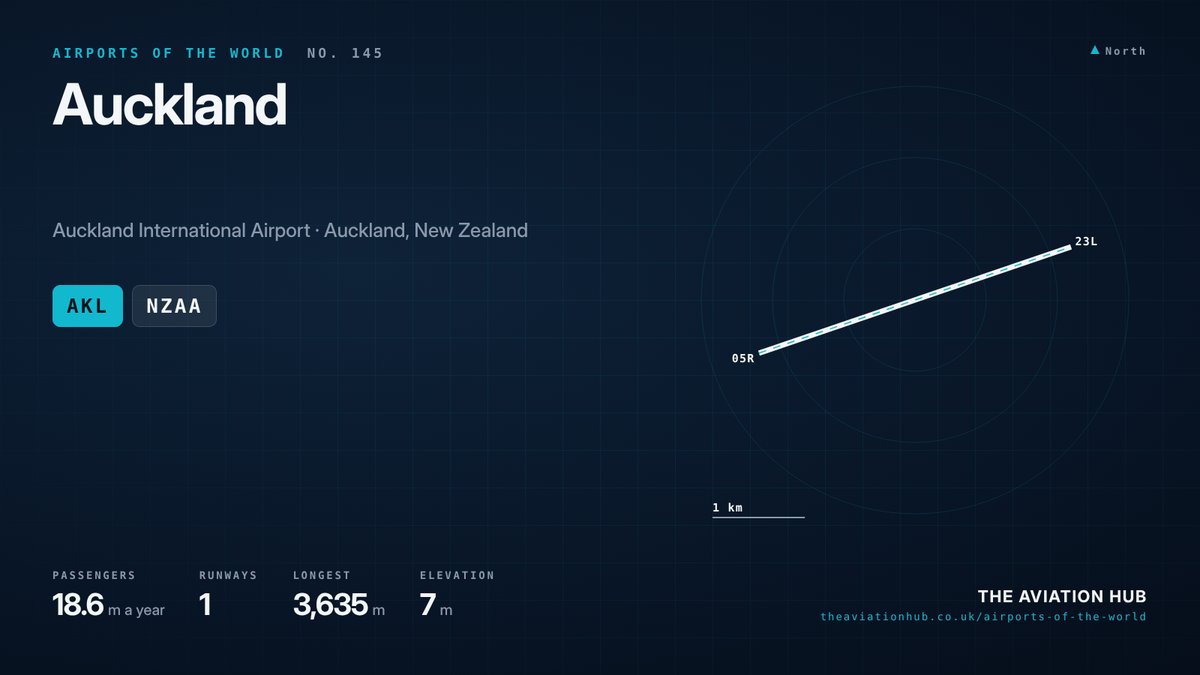
Auckland International Airport is the front door to New Zealand. It sits at Mangere on the shore of the Manukau Harbour, south of the city, and handles close to 19 million passengers a year on a single runway. Auckland Airport is the principal hub of Air New Zealand and the operating base for Jetstar in the country. For most visitors from Europe, Asia and North America it is where the long flight ends, and for many of the world’s airlines it is as far from home as their network reaches.
Auckland Airport at a Glance
The IATA code is AKL and the ICAO code is NZAA. The airport lies about 13 miles (21 km) south of the city centre, at an elevation of just 7 m (23 ft) on land partly reclaimed from the harbour. There is one runway and two terminals, international and domestic, roughly 500 m apart. A free shuttle and a covered walkway connect them, and a new integrated domestic terminal is planned alongside the international building.
Auckland Airport handled almost 19 million passengers in 2025, split between around 8.4 million domestic and 10.3 million international travellers. Air New Zealand operates the bulk of departures, followed by Jetstar and Qantas. Auckland International Airport Limited, a listed company with Auckland Council as a major shareholder, owns and runs the site. Flight status and terminal maps are published on the airport’s official website.
How Auckland’s Airport Came to Be
The Auckland Aero Club began flying from a dairy farm at Mangere in 1928, leasing paddocks beside the harbour. After the Second World War the city’s airline flights operated from RNZAF Whenuapai, a military base to the north west, which served as Auckland’s civil airport from 1948. Whenuapai was never a long term answer, so construction of a purpose built airport at Mangere began in 1960.
The new airport opened officially in January 1966, with much of the runway built on fill pushed out into the Manukau Harbour. A DC-8 training flight crashed on the runway that same year, killing two of the five crew. In 1979 an Air New Zealand Fokker Friendship went into the harbour on approach, again with two fatalities.
The international terminal was named after the pioneering aviator Jean Batten in 1987. A second runway project began in 2007 and has stalled repeatedly. Record rainfall in January 2023 flooded both terminals and shut the airport for almost 24 hours. The 2016 to 2024 light rail scheme that would have linked the airport to the city was cancelled by the government in January 2024.
Runways at Auckland Airport
Auckland Airport runs everything on one concrete runway, 05R/23L, which is 3,635 m (11,926 ft) long and 45 m wide. The odd designation reflects the planned northern parallel runway, which would become 05L/23R if it is ever finished. Around 45 movements an hour pass over the single strip, making it the busiest single runway airport in Oceania. Prevailing south westerlies mean runway 23L is in use most of the time.
The runway is long enough for fully loaded Airbus A380 and Boeing 777-300ER departures to the Gulf and North America. A Singapore Airlines Boeing 747 suffered a serious tail strike here in 2003 after the crew miscalculated the take off weight by 100 tonnes. In March 2025 work began on an alternative runway on the northern land, intended to keep the airport open during major resurfacing of the main runway planned for around 2030.
Terminals and Airlines
The Jean Batten International Terminal has two piers. Pier A has gates 1 to 10 plus bus gates, and Pier B has gates 15 to 18 built for the largest aircraft. Emirates and Singapore Airlines have both put A380s on the stands here, and from 2013 Emirates served Auckland solely with the superjumbo. Air New Zealand, Cathay Pacific, Qatar Airways, United, American, Delta, LATAM and the Chinese carriers all use this building.
The Domestic Terminal is an older and more cramped affair. Air New Zealand’s jet operation uses gates 24 to 33, Jetstar has gates 20 to 23, and a regional wing with gates 34 to 50 handles the ATR 72 and Bombardier Q300 turboprops of Air New Zealand along with Barrier Air and Air Chathams. Alliance wise, Air New Zealand anchors Star Alliance with United, Singapore and Air China, Qantas and Cathay fly the Oneworld flag, Delta, Korean Air and China Airlines represent SkyTeam, and LATAM sits outside the alliances.
Routes and Destinations
Auckland serves roughly 23 domestic and 41 international destinations. Wellington and Christchurch are the heavy domestic trunk routes, flown many times a day by Air New Zealand Airbus A320 and A321neo aircraft. Queenstown is the tourist favourite. Across the Tasman, Sydney, Melbourne and Brisbane are the busiest international routes, with Air New Zealand, Qantas and Jetstar all competing.
Long haul is where Auckland Airport stands out. Air New Zealand’s Boeing 787-9 route to New York JFK, launched in 2022, is among the longest scheduled flights in the world at around 8,800 miles (14,200 km). Qatar Airways’ Doha service and Emirates’ Dubai flights are similar marathons. Los Angeles, San Francisco, Houston, Vancouver, Singapore, Hong Kong, Tokyo and Shanghai fill out the map. Summer in the southern hemisphere, from December to February, is the peak season. Cargo is significant for perishable exports, with dedicated freighters as well as belly capacity.
Getting to and from Auckland Airport
There is no train to Auckland Airport. The SkyDrive express coach runs from both terminals to SkyCity in the central business district in roughly 45 to 60 minutes depending on traffic, with fares of around NZ$17 (about £8). The Airport Link bus connects to Puhinui railway station in about 10 minutes, from where suburban trains run to the city, and this combination is the cheapest sensible option.
By road, State Highway 20A runs north through Mangere to join the motorway network, and SH20B heads east along Puhinui Road. A taxi to downtown takes 35 to 50 minutes and costs roughly NZ$75 to 90 (about £35 to £42); ride hailing apps are usually cheaper. Multi storey and open air car parks sit outside both terminals, with cheaper long stay options served by shuttle. Cycle routes link the airport to the surrounding suburbs for the energetic.
Spotting and Photography
The best known viewing spot is the public area beside the threshold of runway 23L on the north east side, reached from Puhinui Road, where arrivals pass low overhead in the usual south westerly flow. The top floor of the domestic terminal car park looks over the middle of the runway in both directions. Inside, the international terminal’s long windows look across the Pier B stands, so the A380s and 777s are easy to photograph from the gate lounges.
Light at the Puhinui Road viewing areas is best from late morning into the afternoon. On the less common days when runway 05R is in use, departures climb out to the north east and are often too high for good photos there. Many long haul arrivals land in the early morning, so a dawn start pays off. Keep clear of the perimeter fence, park only in designated areas and follow the signs at the viewing spots; the airport company takes security seriously.
What Comes Next
Auckland Airport announced a new integrated domestic terminal in 2023 at an estimated NZ$3.9 billion, built as an extension of the international building. In September 2024 it set out a wider NZ$6.6 billion airfield and terminal programme backed by NZ$1.4 billion of new equity. Air New Zealand and Qantas have opposed the scale of the spending, arguing that the resulting landing charges will push up fares. The northern runway, first started in 2007, is now pencilled in for completion around 2038.
The verdict is that the airport is finally building the capacity it has talked about for decades, but at a price the airlines resent. Compare it with other single runway hubs on our Airports of the World map.
Continue to follow The Aviation Hub for more analysis and insight.
Advertise with us Your brand, in front of an aviation audience Home page and in-article placements, sold directly, one advertiser per slot. From £250 a year. See the rates

