
Austin Airport Guide: From Air Force Base to Texas Boomtown
Austin Airport grew from a closed air force base into a 22 million passenger gateway with live music at the gates. Read about its runways, routes and future.
 By The Aviation Hub
7 min read
Updated October 20, 2026
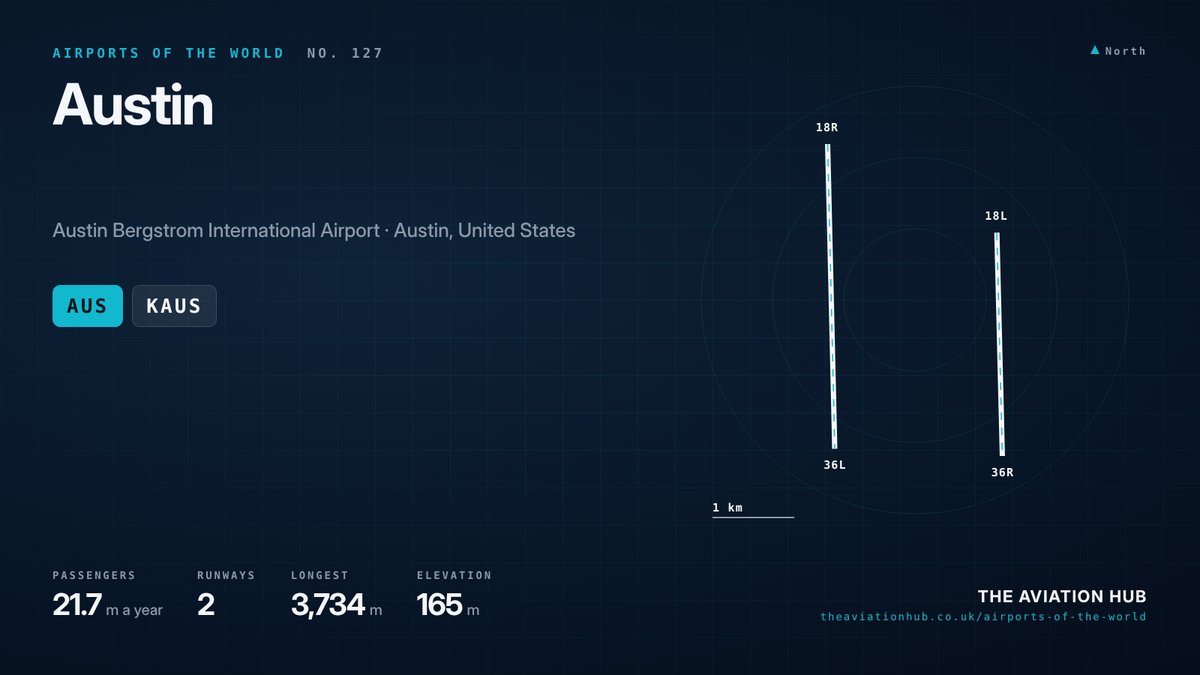
Austin Bergstrom International Airport lies about 5 miles (8 km) south east of downtown Austin, the Texas state capital, on the site of a former Strategic Air Command base. It has been one of the fastest growing large airports in the United States for a decade, riding the city’s technology boom. Austin Airport handled around 21.7 million passengers in 2025, roughly double its traffic of ten years earlier. Two parallel runways, one of them a legacy of the bombers that once used it, and a single busy terminal define the field today.
Austin Airport at a Glance
The codes are AUS and KAUS. The field lies at 165 m (542 ft) above sea level on the flat prairie east of the Colorado river, beside State Highway 71. It has two parallel concrete runways, 18R/36L and 18L/36R, and three helipads. The Barbara Jordan Terminal, with 34 gates, is now the only passenger building after the small South Terminal closed in March 2026.
The City of Austin Department of Aviation owns and operates Austin Airport. Southwest Airlines is the largest carrier with about 41 per cent of passengers and keeps an operating base here, followed by Delta, which treats Austin as a focus city, then American and United. In 2025 the field logged about 265,000 aircraft operations and 276 million pounds of cargo. Parking availability and security wait times are published on the airport’s official website.
How Austin’s Airport Came to Be
The city leased the land to the army in 1942 for Del Valle Army Air Base, renamed in 1943 for Captain John August Earl Bergstrom, the first Austin resident killed in the Second World War. As Bergstrom Air Force Base it hosted B-52 bombers and later RF-4C reconnaissance jets. Meanwhile the city’s airline flights used Robert Mueller Municipal Airport, a cramped field hemmed in by neighbourhoods three miles from the Capitol.
The Base Realignment and Closure Commission selected Bergstrom for closure in 1991, and Austin voters chose to convert it into the new civil airport rather than build on a greenfield site. Military flying ended in 1995. A new terminal named after Congresswoman Barbara Jordan rose beside the old military runway, and the airport opened to the public on 23 May 1999, taking Mueller’s AUS code on the same day.
Growth followed the city’s fortunes. British Airways launched the first scheduled transatlantic route, to London Heathrow, in March 2014. A $350 million expansion added nine gates to the east end of the terminal in 2019, and the pandemic dip was followed by record traffic in 2023.
Runways at Austin Airport
The western runway, 18R/36L, is the old air force strip, 3,734 m (12,250 ft) long and 46 m wide, surfaced in concrete. At opening it ranked among the longest commercial runways in the country, and it comfortably takes the Boeing 787-9s and Airbus A350s on the European routes. The eastern runway, 18L/36R, was built new for the civil airport and measures 2,743 m (9,000 ft) by 46 m, also concrete.
The two runways sit either side of the terminal, far enough apart for independent parallel operations. Southerly winds prevail for much of the year, so arrivals on 18L and 18R from the north over the city are the usual pattern, with departures climbing out towards the south. Winter northers bring operations on the 36 runways.
The long western runway is the natural choice for heavy long haul departures. In May 2020 a pedestrian who had entered the airfield was struck and killed by a landing Southwest Boeing 737, a tragedy that led to a review of perimeter security at Austin Airport.
Terminals and Airlines
The Barbara Jordan Terminal is a long single building with gates numbered along a central concourse, six of them able to handle international flights. Southwest and American work the middle of the concourse, with Southwest running a constant flow of Boeing 737-700, 737-800 and 737 MAX 8 flights. United and Alaska use the western gates, while Delta, JetBlue and the international carriers, including Lufthansa, British Airways, KLM, Air Canada and Aeromexico, use the eastern end.
American, Delta and United each run a lounge in the terminal. A live music stage in the concourse hosts local bands most days, a nod to the city’s claim to be the live music capital of the world, and the food concessions are drawn from Austin restaurants rather than national chains.
The South Terminal, a converted air force building with three gates, opened in April 2017 for Allegiant and Frontier. A legal fight between the city and the terminal’s operator ended with an $88 million settlement, and the building closed on 31 March 2026 to make way for expansion. Its airlines moved into the main terminal.
Routes and Destinations
Austin Airport offers hundreds of daily arrivals and departures. Denver, Atlanta, Dallas Fort Worth, Los Angeles and Phoenix were the busiest domestic routes in the year to May 2026, and Southwest also links the city with Dallas Love Field and Houston Hobby. Delta’s growth as a focus city has added routes such as Boston, Detroit and Miami alongside its Atlanta hub.
International service covers Mexico, Canada and Europe. British Airways to London Heathrow is the busiest international route, with Lufthansa to Frankfurt and KLM to Amsterdam, while Aeromexico and the American carriers serve Mexico City and Cancun. Lufthansa’s Frankfurt flight is the longest route at around 5,300 miles (8,500 km).
Traffic peaks around the South by Southwest festival in March, the Austin City Limits festival in October and the Formula One Grand Prix at the Circuit of the Americas, which sits a few miles from the runways. Cargo has grown with the city’s electronics and car industries, and Amazon, FedEx and UPS freighters use a dedicated ramp.
Getting to and from Austin Airport
Capital Metro bus route 20 leaves from the arrivals level every 15 minutes and runs through downtown to the University of Texas and Manor Road. The fare is a couple of dollars and the journey to downtown takes around 30 to 40 minutes, making it the cheapest sensible option. Route 483 covers the hours after midnight.
State Highway 71 and US 183 lead to the terminal, with a toll road loop avoiding the city. A taxi or ride share to downtown costs around $25 to $35 (about £20 to £27) and takes 15 to 30 minutes outside rush hour. Uber and Lyft pick up from the ground floor of the rental car centre, which opened in October 2015 and sits across the road from the terminal.
Parking ranges from a garage opposite the terminal to economy lots served by shuttle. Voters approved a light rail plan in November 2020 that would have reached the airport, but the scaled back first phase, now targeted for 2033, stops short of it.
Spotting and Photography
The best known viewpoint at Austin Airport is the family viewing area at the end of Golf Course Road on the north east side, which looks onto runway 18L. A pull off on Burleson Road puts arrivals on 36L directly overhead, and the top of the Blue Garage covers movements on 18R. The terminal’s large windows cover the gates well.
Southerly operations put arrivals over the city onto the 18 runways for most of the year, with afternoon light on the western side. The fleet is heavy on Southwest 737s and the Airbus A320 family of American, Delta, United and JetBlue, broken by Lufthansa, British Airways and KLM wide bodies in the afternoon.
Airport police patrol the perimeter and respond quickly to anyone near the fence. Stay on public roads, park legally and keep clear of the approach lights. Texas summer heat makes early morning sessions more comfortable.
What Comes Next
The Journey With AUS programme is the largest construction project in the airport’s history. A new arrivals and departures hall will bring check in, security and baggage claim under one roof, and a new Concourse B will open with more than 20 gates, expandable to 40. An underground tunnel will link it to the existing building, which becomes Concourse A. Opening is expected in the 2030s.
Traffic has plateaued since the 2023 peak as the city’s growth has cooled, but the long term trend remains upward. Runway capacity is ample. The constraint is the terminal, which was designed for a city half Austin’s current size.
Austin Airport is building the airport its city needs about a decade after it needed it, and the next ten years will show whether the plan keeps pace. See how it compares with other Texan fields on the Airports of the World map.
Continue to follow The Aviation Hub for more analysis and insight.
Advertise with us Your brand, in front of an aviation audience Home page and in-article placements, sold directly, one advertiser per slot. From £250 a year. See the rates

