Innocent travellers from Toronto have been detained abroad after airport workers moved their luggage tags onto suitcases full of drugs. Baggage tag switching is not only a Canadian problem, and the systems airlines use to track bags were never built to stop it.
This summer, a Toronto businessman flew to Albania on one of Air Transat’s first direct flights from Toronto Pearson to Tirana. He now faces up to 15 years in prison. Albanian officers found a suitcase holding 23 kg of cannabis under a tag in his name. He says the bag was never his. In October, the RCMP told him it believed he was the victim of a tag switch.
His case opened a five part CTV News W5 investigation that ran last week. W5 has identified more than two dozen cases, almost all of them starting at Pearson, Canada’s largest airport.
The story has struck a nerve. On Google Trends, searches for “airport baggage tag switching” in Canada jumped by 800% to more than 10,000 within hours, according to Google Trends.
How the Scam Works
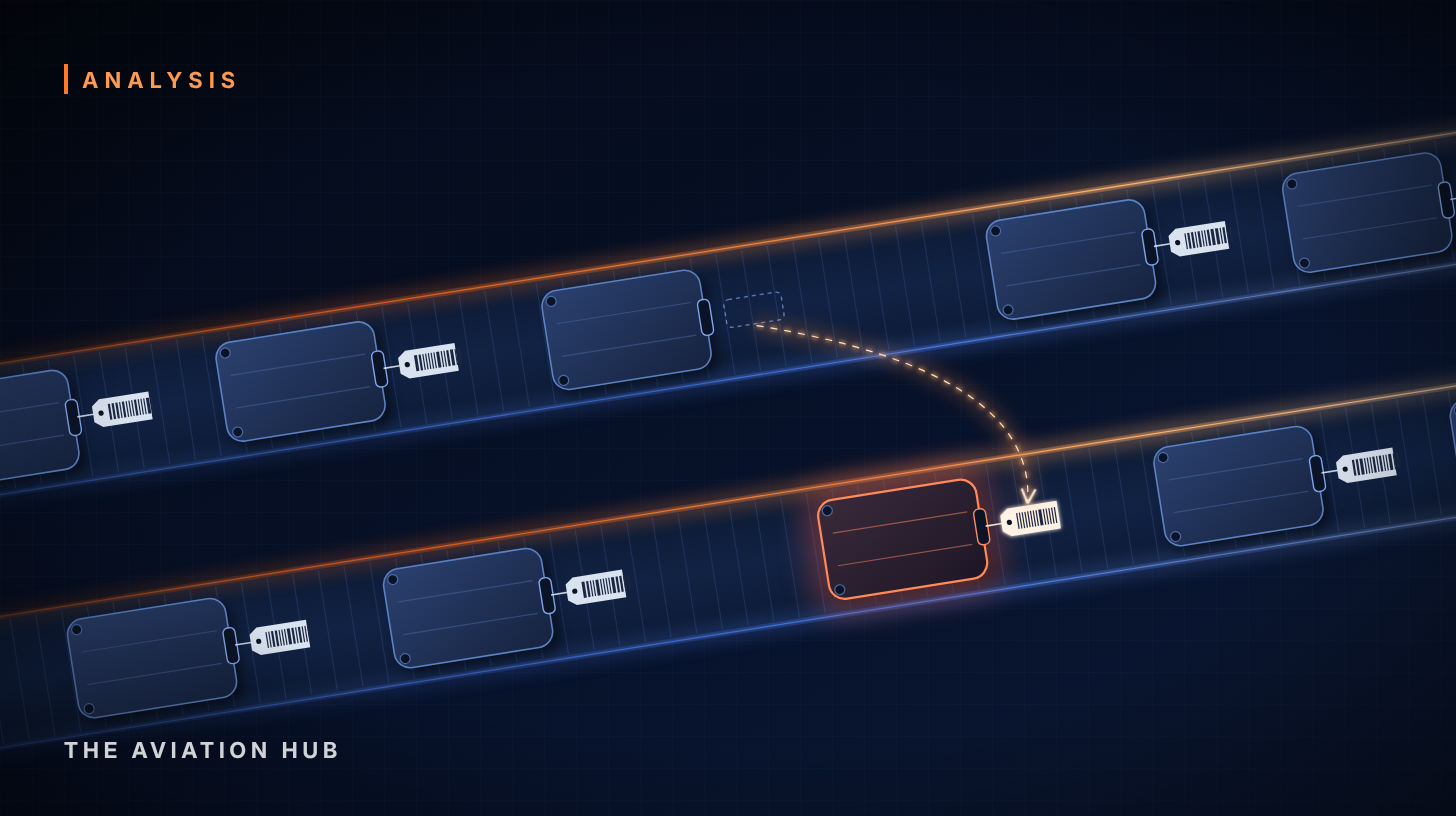
The method is simple. A corrupt worker in the baggage area takes the tag off an innocent passenger’s suitcase and attaches it to a bag of drugs heading to the same destination. A courier waits at the other end to collect it. If customs officers find the drugs first, the bag carries the innocent passenger’s name.
The consequences have been severe. One Canadian spent 24 nights in jail in the Philippines after being accused of importing 24 kg of methamphetamine. Another was detained at Narita Airport in Japan over 21 kg of the same drug. Two passengers on a flight to Germany were held at Pearson for 12 hours after their tags turned up on luggage holding 33 kg of marijuana, and were released without charge, according to CTV News.
The problem is not in doubt. In a Brampton court, a judge acquitted a traveller after two RCMP officers and a Canada Border Services Agency officer testified about Pearson. The judge wrote that they described tag switching there as “a known and ongoing issue”. The RCMP told W5 that 16 Pearson workers had been arrested over five years, at least five of them in connection with tag switching.
Not Just a Canadian Problem
Brazil has seen the same scheme. In March 2023, two Brazilian women flying from São Paulo Guarulhos were arrested in Frankfurt after suitcases tagged in their names were found to hold about 40 kg of cocaine. Their own bags were missing. Footage later showed ground handling staff at Guarulhos handling the bags and changing tags.
The women spent 38 days in a Frankfurt prison before Brazil’s Federal Police sent evidence of their innocence to Germany. Police then served 16 arrest warrants against a smuggling network that used airport employees to carry out its schemes.
The Canadian cases also stretch across continents. In New Zealand, a man convicted over 23 kg of methamphetamine found after a Toronto to Auckland journey via Dubai is appealing, and says his appeal will draw heavily on W5’s reporting.
Everyone Points Elsewhere
The scheme exploits a system in which nobody owns the whole journey of a bag. The Greater Toronto Airports Authority says baggage handlers “are employed or contracted by individual airlines”, and told CTV News this month that it “does not direct or oversee baggage security”. Air Canada says luggage moves through “a complex network of infrastructure operated and overseen by various third parties.”
The national screening body is not looking either. Transport Canada says searching for drugs is outside the mandate of the Canadian Air Transport Security Authority, which screens for threats to aviation security.
Victims are now testing who is liable. Toronto lawyer Paul Miller is acting for 11 Canadians and is seeking between C$100,000 and C$1m in each case. In most cases he plans to sue the airline, Transport Canada and the airport authority. The offers so far have been modest. Cathay Pacific offered one passenger about C$22,000, roughly half her costs, and WestJet offered another a C$300 flight credit.
The Insider Threat
The deeper issue is who is allowed behind the scenes. Airports have spent two decades hardening security against passengers. The people who handle the bags face far less scrutiny.
Ulisses Botelho, a retired RCMP organised crime investigator, calls insider corruption “mission critical” for smugglers. “Without it, it doesn’t exist,” he told W5. Dieter Boeheim, a former investigator with Toronto’s airport intelligence unit, says Pearson has roughly 4,000 security cameras but argues they are not enough without live monitoring of staff. He also says workers can swap shifts without schedulers knowing, so it is not always clear who loaded a particular aircraft.
Boeheim’s warning goes beyond drugs. “I can use the same process and put one kilo of explosive on that same aircraft,” he said.
Ottawa Responds
The federal government has promised action. Transport Minister Steven MacKinnon said that after W5’s report, “we once again went back to the drawing board”. He plans to use powers in the government’s Building Canada Strong Act to raise the threshold for security clearances and tighten access to secure areas. Transport Canada says the new system could screen for links to organised crime networks and signs of coercion or corruption. The bill is in committee and could pass before the end of 2026.
Not everyone thinks that goes far enough. Conservative transport critic Dan Albas said criminals often recruit people with clean records, so clearances alone will not solve the problem. He suggested airports could be required to photograph passengers’ baggage.
What Could Actually Fix It
The industry already tracks bags closely. Under IATA’s Resolution 753, airlines must track baggage at four points: handover from the passenger, loading onto the aircraft, delivery to transfer and return to the passenger. That tells an airline where a tag has been. It does not prove the tag is still on the bag it was printed for.
That is the gap the fixes on the table try to close. A photograph of every bag at check in would link the tag to the suitcase. W5 has also asked why tamper proof tags are not used in Canada. Insiders could be watched more closely with body cameras in baggage areas, personal phones banned on duty and access cards that only open doors during scheduled shifts, all ideas put forward by former investigators.
Passengers are not waiting. A Nanos poll for W5 found that two thirds of Canadians are concerned about tag switching. Among those who had heard the coverage, 44% had changed how they travel, by keeping baggage receipts or putting a tracker in their bag. Photographing bags and their tags at check in is a simple precaution, and it costs nothing.
The Bottom Line
Baggage tag switching turns the industry’s own system against its customers. A tag is treated as proof of who owns a bag, yet anyone with access to the baggage hall can move it. The passenger, who never sees the bag again after check in, carries all the risk.
Canada is now acting, spurred on by W5’s reporting. Every country that relies on the same paper tags and the same trust in airside workers has the same gap. The cases from Brazil show it is not a local problem, and other countries should not wait to be next.
Continue to follow The Aviation Hub for more analysis and insight.
Advertise with us Your brand, in front of an aviation audience Home page and in-article placements, sold directly, one advertiser per slot. From £250 a year. See the rates