
Baghdad Airport Guide: Iraq’s Gateway After Decades of War
Baghdad Airport explained: its 1980s terminals, two long runways, Iraqi Airways and visiting carriers, security on the airport road and expansion plans.
 By The Aviation Hub
5 min read
Updated October 20, 2026
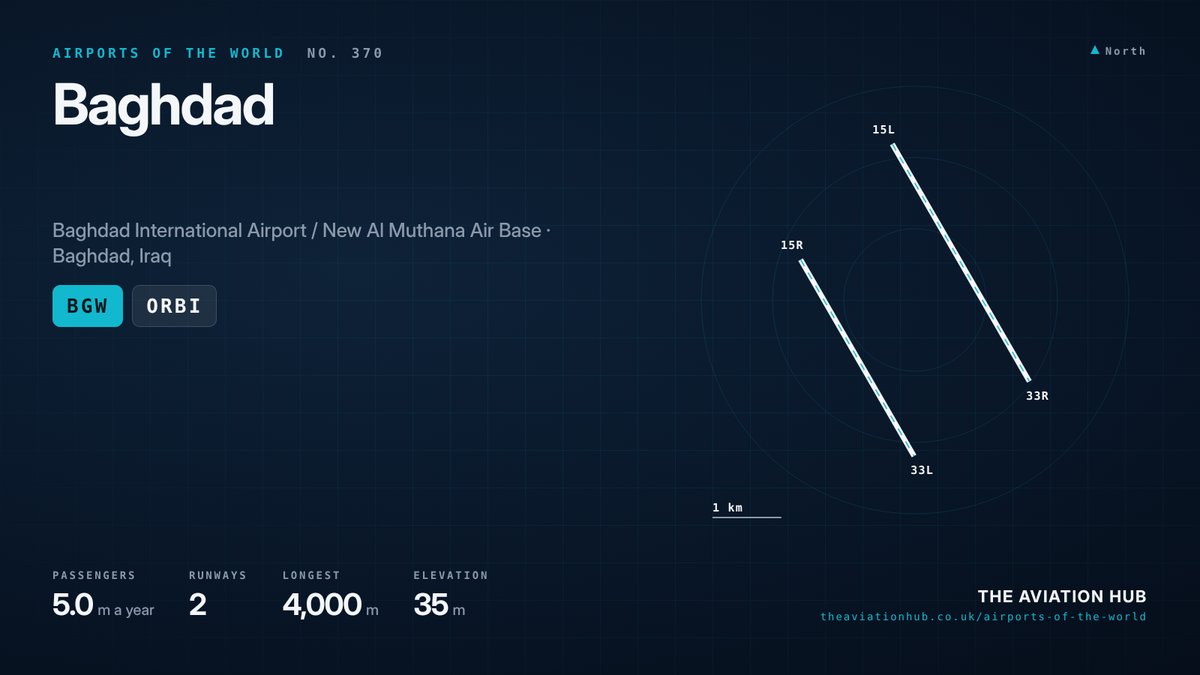
Baghdad Airport is Iraq’s main international gateway and the home base of Iraqi Airways. It lies on the western edge of the capital and has lived through sanctions, invasion, insurgency and repeated attacks. Today it carries several million passengers a year, connecting Iraq with the Gulf, Turkey, Iran and Europe. Few civil airports have a history so closely tied to conflict.
Baghdad Airport at a Glance
The airport uses the IATA code BGW and the ICAO code ORBI. It sits about 10 miles (16 km) west of downtown Baghdad, at an elevation of 114 feet (35 m). There are two long runways and three main terminal buildings. The Iraqi government owns and operates the field, which also contains the New Al Muthana Air Base.
Published passenger figures vary widely between sources, but recent traffic is estimated at roughly five million passengers a year. Iraqi Airways is the dominant carrier at Baghdad Airport, with Fly Baghdad, UR Airlines and Al Burhan Airways also based there. Flight and travel information is available on the airport’s official website.
How Baghdad’s Airport Came to Be
Work began in 1965, and the first airport on the site opened in January 1970 with a single runway. A much larger project followed from 1979, when the three present terminals were built. They opened in 1982, and the airport took the name Saddam International, with its own IATA code, SDA.
The 1991 Gulf War and the UN sanctions that followed shut down civil traffic. Aircraft were destroyed on the ground, and civil flights did not resume until August 2000. In 2003 coalition forces seized the airport during the invasion and restored the Baghdad International name.
Civilian control returned to the Iraqi government in 2004. A US base, Sather Air Base, operated on the western side until 2011, when it became the Baghdad Diplomatic Support Center under the US State Department. Commercial airlines gradually returned as security improved.
Runways at Baghdad Airport
Two parallel concrete runways serve the field. Runway 15L/33R is 4,000 metres (13,124 feet) long and 60 metres wide, among the longer runways in the Middle East. Runway 15R/33L measures 3,301 metres (10,830 feet) by 45 metres.
The shamal, a persistent northwesterly wind, means runway 33 is used most often, with arrivals approaching from the south east. Summer heat above 45°C reduces aircraft performance, so the long runways matter for heavy departures. Dust storms can close Baghdad Airport for hours at a time.
Security has shaped how aircraft fly here. In November 2003 a DHL Airbus A300 freighter was hit by a surface to air missile after takeoff but landed safely without hydraulics. Afterwards civil aircraft routinely flew steep corkscrew approaches to stay within the protected area. In January 2015 a flydubai jet was struck by small arms fire on approach and landed safely.
Terminals and Airlines
The three 1980s terminal buildings sit side by side on a curved forecourt. Not all are in full use. Facilities are functional rather than modern, and the long, layered security process defines the passenger experience.
Iraqi Airways operates the largest fleet at Baghdad Airport, including Boeing 737s, Airbus A320 family aircraft and Boeing 787s. Fly Baghdad and UR Airlines add regional and charter flying. Visiting carriers include flydubai, Qatar Airways, Turkish Airlines, Royal Jordanian and Middle East Airlines, among others.
The alliance presence is limited, though Qatar Airways and Royal Jordanian bring Oneworld connections and Turkish Airlines links into Star Alliance. Many international travellers connect through Doha, Dubai or Istanbul.
Routes and Destinations
Istanbul, Dubai, Doha, Amman, Beirut and Tehran are among the most important routes. Religious tourism matters too, with pilgrims flying to Mashhad and Saudi Arabia and visitors arriving for Shia shrines in Karbala and Najaf.
Iraqi Airways serves around 40 destinations, including Cairo and other regional capitals, with longer links to China. European service has been limited in recent years by safety restrictions, though other operators provide links to cities such as Athens and Copenhagen. The Iraqi diaspora in Europe sustains strong demand.
Domestic flights connect Baghdad Airport with Basra, Erbil and Sulaymaniyah, though road travel and political ties shape demand on these routes. Traffic peaks around religious holidays and the summer travel season.
Getting to and from Baghdad Airport
The main approach is Baghdad Airport Road, which runs from the city to the terminals. Between 2003 and 2007 the route was notorious as one of the most dangerous stretches of road in the world. It was refurbished in 2014 with Turkish assistance and is now heavily guarded.
Security rules have long required most private cars to stop at an outer checkpoint, with passengers continuing to the terminal on approved airport taxis or shuttles. Expect bag screening and document checks before reaching the building. Allow at least three hours before departure.
There is no rail link, and public transport is minimal. Approved airport taxis are the most practical and cheapest sensible option for visitors. Hotels and employers often arrange transfers for business travellers.
Spotting and Photography
Baghdad Airport is not a spotting destination. It contains an active military base and sits in a high security zone, and photographing aircraft, runways or checkpoints can lead to arrest. Visitors should keep cameras away inside the terminal and on the approach roads.
The New Al Muthana Air Base hosts the Iraqi Air Force’s 23rd Squadron, with C-130E Hercules transports, and other military aircraft. Airline traffic is a mix of Iraqi Airways jets and Gulf and Turkish carriers. Window seats on departure offer the only realistic opportunity for images.
Respect local laws absolutely, follow security instructions immediately and never fly a drone anywhere near the airport.
What Comes Next
Expansion has been discussed for years. A 2010 plan proposed three new terminals and refurbishment of the existing buildings, aiming to double capacity to 15 million passengers. Advised by the International Finance Corporation, the government chose a consortium of Corporación América Airports and Amwaj International in 2025 to redevelop and run the airport. The $764 million public private partnership includes a new terminal.
Security remains the biggest risk. In January 2020 a US drone strike near the airport killed Qasem Soleimani and Abu Mahdi al Muhandis, and drone attacks hit the complex again in 2026. Baghdad Airport will grow only as fast as stability allows. Compare it with other regional gateways on the Airports of the World map. The verdict: a strategically vital airport with strong demand and a fragile operating environment.
Continue to follow The Aviation Hub for more analysis and insight.
Advertise with us Your brand, in front of an aviation audience Home page and in-article placements, sold directly, one advertiser per slot. From £250 a year. See the rates

