
Bahrain Airport Guide: Gulf Air’s Hub on Muharraq Island
Bahrain Airport is home to Gulf Air and a big DHL hub. Our guide covers its 2021 terminal, two runways, busiest routes, transport links and spotting.
 By The Aviation Hub
6 min read
Updated October 20, 2026
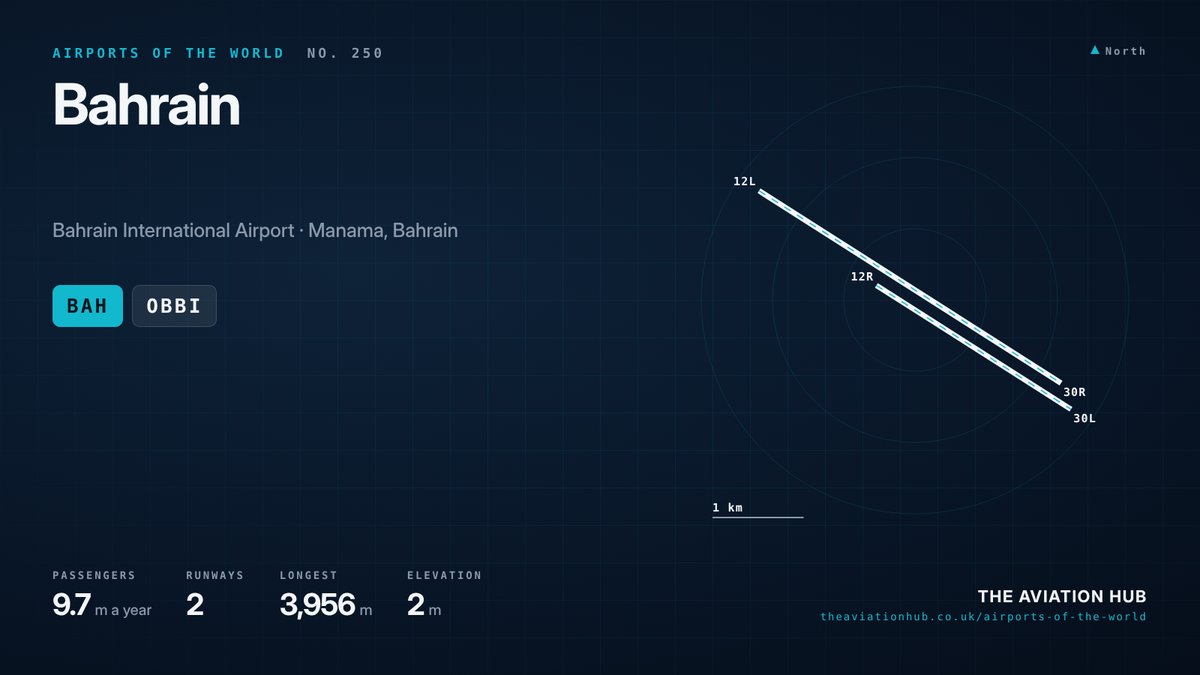
Bahrain International Airport occupies much of Muharraq Island, a short drive across the causeway from Manama. Bahrain Airport handles close to 10 million passengers a year and is the home of Gulf Air, one of the oldest names in Middle Eastern aviation. A new terminal opened in 2021, and the field doubles as the regional hub for DHL, so freighters are almost as much a part of the scene as passenger jets.
Bahrain Airport at a Glance
The IATA code is BAH and the ICAO code is OBBI. Bahrain Airport sits on Muharraq Island roughly 4 miles (7 km) northeast of central Manama, at an elevation of just 2 metres (6 feet). It has two parallel runways and a single passenger terminal, opened in January 2021, with 24 gates and capacity for about 14 million passengers a year.
Traffic reached around 9.7 million passengers in 2025, up about 4 per cent on 2024. Gulf Air is the dominant carrier, and DHL runs its Middle East cargo hub here. The operator is Bahrain Airport Company, part of the state owned Gulf Air Group under the sovereign wealth fund Mumtalakat. Flight times and terminal details are on the airport’s official website.
How Bahrain’s Airport Came to Be
Aviation in Bahrain began in 1927, when a chartered aircraft landed on the island. Scheduled service followed in 1932, as Handley Page H.P.42 airliners such as Hannibal stopped at Muharraq on the London to Delhi route. The field grew into a staging post for British civil and military flying across the Gulf.
Gulf Aviation was founded in Bahrain in 1950 and later became Gulf Air, for years jointly owned by several Gulf states before Bahrain took sole control. In January 1976 British Airways launched scheduled Concorde flights from London to Bahrain, and Pan Am began New York flights the same year. Muharraq was briefly one of the most glamorous stops on the world map.
The decades that followed brought fierce competition from Dubai, Doha and Abu Dhabi. In August 2000 Gulf Air Flight 072, an Airbus A320 arriving from Cairo, crashed into the sea during a go around, killing all 143 on board. A long term expansion plan announced in 2009 led to the new Passenger Terminal Building, which cost about US$1.1 billion and opened on 28 January 2021.
Runways at Bahrain Airport
Bahrain Airport has two parallel runways aligned northwest to southeast. The main runway, 12L/30R, is 3,956 metres (12,979 feet) long and 60 metres wide with an asphalt surface. The secondary runway, 12R/30L, is 2,530 metres (8,302 feet) long and 45 metres wide, also asphalt.
The long main runway handles almost all commercial traffic, including fully loaded wide body departures in summer heat that regularly passes 40C. The shorter parallel suits smaller aircraft and acts as a backup during maintenance. Both runways reach close to the shoreline, so approaches at either end cross open water.
Prevailing northwesterly winds, known locally as the shamal, mean runway 30R is in use most of the time. Arrivals then approach from the southeast over the sea, and departures climb out over the northern tip of Muharraq.
Terminals and Airlines
All scheduled passenger flights use the 2021 terminal, a large building with a sweeping roof, around 9,000 square metres of duty free and e gates for arrivals. The old terminal closed to regular passenger flights when the new building opened.
Gulf Air is the anchor tenant at Bahrain Airport, flying Boeing 787-9 and Airbus A320neo family aircraft. Its Falcon Gold lounge serves premium passengers, and the airline uses its home base to connect Europe with South Asia and the Far East. Gulf carriers are a strong presence, with Emirates, flydubai, Qatar Airways, Etihad, Saudia and flynas all well established.
British Airways and Turkish Airlines link Bahrain with Europe, and a broad mix of Indian and Pakistani carriers serves the island’s large South Asian workforce. Air Arabia and Kuwait Airways add regional options. On the cargo side, DHL and its partners fly a steady stream of freighters through the night, and Kalitta Air is among the visiting cargo operators.
Routes and Destinations
Short Gulf hops dominate the schedule. Dubai is the busiest route by a distance, with more than 100 flights a week, followed by Doha, Riyadh, Kuwait and Abu Dhabi. Flights to Doha resumed in 2023 after a six year diplomatic rift and have grown quickly since.
Gulf Air’s network reaches London Heathrow, Paris, Frankfurt and Athens in Europe, New York JFK across the Atlantic, and Manila, Bangkok and a long list of Indian and Pakistani cities to the east. New York, at roughly 6,600 miles (10,600 km), is its longest sector, while Manila, at roughly 4,600 miles (7,400 km), is the longest in Asia. Summer brings a surge in European leisure routes as residents escape the heat, and the end of the school holidays sends traffic sharply back the other way.
Cargo matters more than at most airports of this size. Bahrain Airport is DHL’s main hub for the Middle East and North Africa, and night arrivals of DHL freighters, typically Boeing 757 and 767 types, link the Gulf with Europe and Asia.
Getting to and from Bahrain Airport
There is no rail link today. The airport connects to Manama by Airport Avenue and the Shaikh Isa Causeway, and the drive to the capital takes 15 to 25 minutes outside rush hour. Taxis run around the clock from the arrivals forecourt and charge a few Bahraini dinars to central Manama.
Public buses run by Bahrain Public Transport Company link the terminal with Manama, Muharraq and other parts of the island. Fares are low, making the bus the cheapest sensible option for anyone without heavy luggage. Ride hailing apps also operate.
Short and long stay car parks face the terminal, and the main car hire firms have desks in arrivals. Visitors from Saudi Arabia often drive across the King Fahd Causeway instead of flying. Bahrain’s planned metro includes an airport station in its first phase, although construction timing remains uncertain.
Spotting and Photography
Bahrain Airport rewards patience. The mix of Gulf Air 787s, Emirates and Qatar wide bodies, South Asian narrow bodies and DHL freighters is unusually broad for a medium sized field. Military aircraft also visit, including the Bahraini royal flight and occasional United States Navy types.
There is no public viewing terrace. With runway 30R in use most days, arrivals come in low over the water from the southeast, and waterfront areas on the southern side of Muharraq Island can offer views of the final approach. The terminal’s large windows offer a safer alternative for passengers waiting at the gates.
Bahrain is sensitive about photography near military and security sites, and the airport hosts both. Keep to public areas, carry identification and stop at once if police ask. Enthusiasts wanting a closer look at military aircraft should plan around the Bahrain International Airshow at Sakhir instead.
What Comes Next
The 2009 masterplan envisaged eventual capacity of around 27 million passengers, roughly double the current terminal. A new fuel farm is under construction on the northeast side, and cargo facilities continue to expand around the DHL hub. Gulf Air’s fleet growth will decide how fast the terminal fills.
The verdict is a compact, efficient hub that cannot outgun Dubai or Doha but does not need to. Bahrain Airport has found its niche in regional connections, South Asian traffic and freight. Compare it with its Gulf neighbours on the Airports of the World map.
Continue to follow The Aviation Hub for more analysis and insight.
Advertise with us Your brand, in front of an aviation audience Home page and in-article placements, sold directly, one advertiser per slot. From £250 a year. See the rates

